
ESG Maturity Model: The Four Stages, What Changes at Each, and How to Advance

An ESG maturity model is a staged framework for judging how deeply a company has built environmental, social, and governance practices into the way it runs, from a reactive, compliance-driven starting point to a purpose-led stage where sustainability shapes strategy, capital allocation, and culture. Its job is to give an organization an honest view of where it stands today and a map for where to go next.
This guide explains what an ESG maturity model is and where the idea comes from, the four stages most models share, the dimensions maturity cuts across, why so many organizations stall partway, and how to assess your own position and move up a stage.
ESG maturity at a glance
What it measures: how deeply ESG is embedded in strategy, governance, data, reporting, and culture, not how many activities are underway
The shape: four broad stages, from reactive to purpose-led, read across several business dimensions
The common wall: most organizations stall between compliance and strategic integration, held back by data rather than ambition
The point: an honest baseline and a sequenced plan, not a label to claim
What an ESG maturity model is
An ESG maturity model measures the degree to which a company has integrated environmental, social, and governance principles into its strategy, daily operations, risk management, and culture. It is best read as a spectrum rather than a finish line. A company low on the spectrum treats sustainability as an afterthought and reacts only when an investor, a customer, or a regulator forces the issue. A company high on it runs most major decisions, from capital allocation to procurement to executive pay, through an ESG lens.
The word maturity is borrowed deliberately. The idea traces back to the capability maturity thinking developed for software processes at Carnegie Mellon's Software Engineering Institute, and the point that carried over is that what matters is not how much activity is underway but whether the organization has a repeatable, managed capability: can it produce reliable, defensible ESG outcomes consistently, or does it depend on heroic individual effort each cycle. Different firms publish their own models with four or five stages and different labels, so what is shared is the progression, not the names.
Stages and dimensions: the two things most models blur
The most common mistake is to treat a maturity model as a single ladder and ask only how far up a company is. Maturity answers two questions: how far along the organization is, and across which parts of the business. A company can run sophisticated, assured climate reporting while its culture and supply-chain engagement stay primitive. One number cannot hold both facts.
It is more honest, and more useful, to read maturity as a grid of stages against dimensions. The dimensions worth tracking are strategy and ownership, governance and accountability, data and systems, reporting and disclosure, and culture and value chain. Each matures at its own pace, and the laggard dimension is usually where the real risk sits and where the next move belongs.
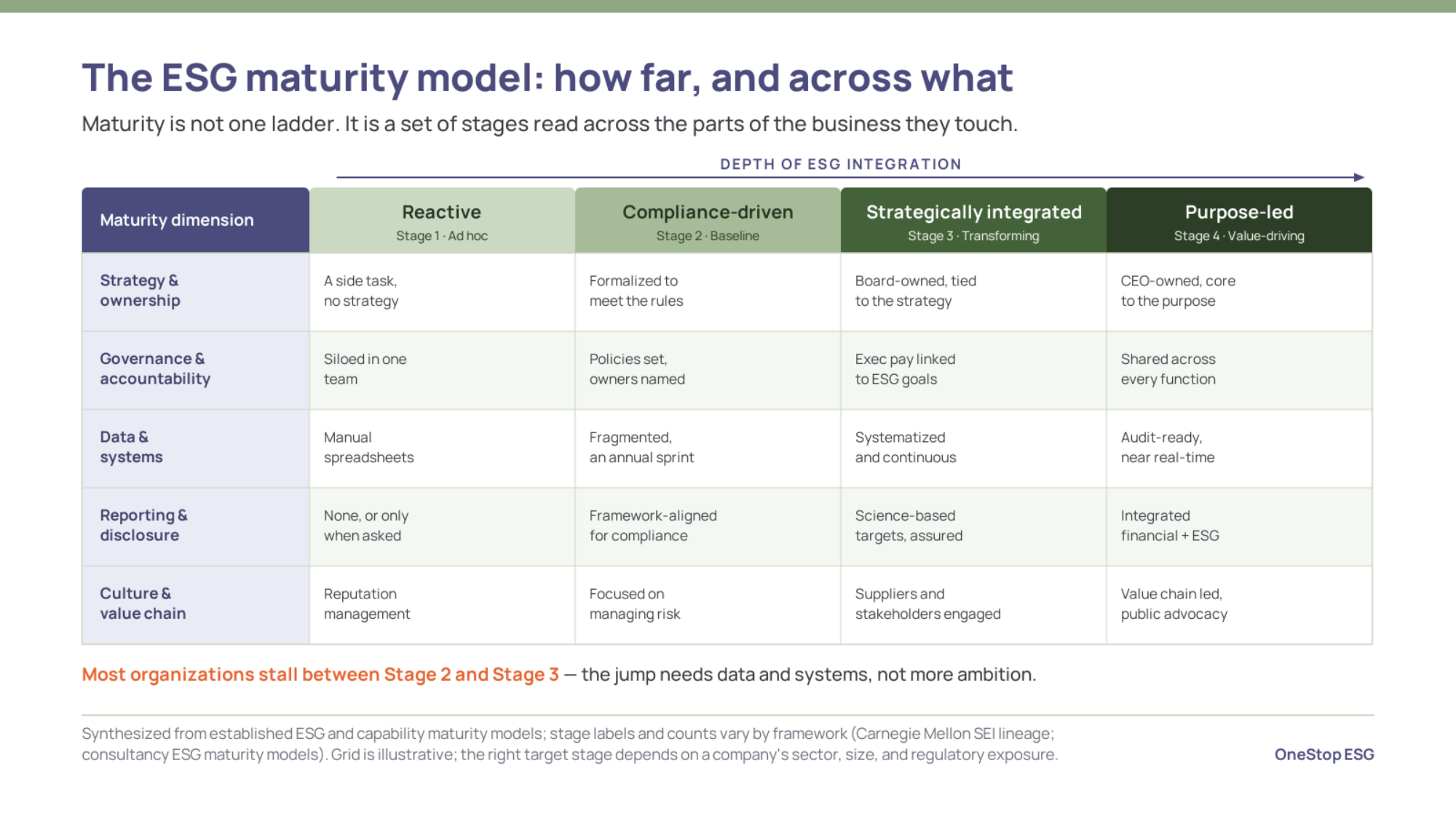
Figure: The ESG maturity model, read as stages across dimensions.
The four stages of ESG maturity
While labels differ between frameworks, most ESG maturity models describe the same four-stage progression, and seeing all four at once makes it easier to place an organization honestly.
At Stage 1, reactive and ad hoc, the company has no formal ESG strategy. Effort is a side task inside one team, data lives in manual spreadsheets, and reporting happens only when someone outside asks. The focus is reputation, and many private companies sit here.
At Stage 2, compliance-driven, incoming disclosure rules push the company to formalize: it runs an initial materiality assessment and aligns to a recognized framework, but data stays fragmented and is treated as an annual sprint, and the posture is still risk management.
At Stage 3, strategically integrated, the board and C-suite own ESG. It enters enterprise risk management, the company sets science-based targets, and executive pay starts to depend on ESG goals; data becomes systematized, though legacy systems are often strained.
At Stage 4, purpose-led, sustainability and business strategy become hard to tell apart. The CEO is accountable, data flows are audit-ready, financial and ESG reporting are integrated, and the company uses its ESG performance to lower its cost of capital, attract talent, and lead its value chain.
What changes as a company matures
Across those stages, a consistent set of markers moves in step, and they are a more reliable guide than any label. Ownership shifts from a siloed team to the board and ultimately the CEO. Data moves from spreadsheets to audit-ready systems. Targets move from none, to framework-aligned, to science-based. Reporting rigor rises until it matches financial reporting, with external assurance, in line with the IFRS Sustainability Disclosure Standards and comparable regimes. Executive pay becomes tied to ESG outcomes, and a materiality assessment begins to drive strategy rather than satisfy a disclosure.
The other marker is reach. Early-stage programs look only at a company's own operations. As maturity rises, the lens widens to the full value chain, where most environmental and social exposure actually sits, and where ESG risk assessment and ESG stakeholder engagement become part of how the business is run rather than annual exercises. A company that has pushed accountability and data out to its suppliers is demonstrably further along than one still counting only its own emissions.
Why most organizations stall between compliance and strategy
Most organizations get stuck at the same place: the jump from Stage 2 to Stage 3. The barrier is rarely ambition; it is reliable data. Fragmented, manual collection can satisfy a basic compliance report, but not the strategic decisions, forward-looking targets, and external assurance that strategic integration requires. The data foundation gives way under the new weight.
This is why advancing maturity is, in practice, a data problem before it is a strategy problem. Building a continuous, documented, auditable flow of ESG information is the precondition for everything above it, which is why ESG data collection is usually the first thing a stalled program has to fix. Regulation adds the pressure that forces the issue: regimes such as the European Sustainability Reporting Standards expect the kind of traceable, assured data that spreadsheets cannot produce, so the systems question cannot be deferred for long.
Maturity is not the same as ambition
A point the stage models can obscure is that not every organization needs to reach the top. The right target depends on a company's sector, size, regulatory exposure, and the demands of its stakeholders: a private business-to-business supplier may rationally aim for a solid middle stage, while a consumer brand or a heavy emitter has reason to pursue the most advanced one. Maturity and ambition are different axes, and a sensible plan sets ambition against what the business actually faces.
Two cautions apply to every organization, though. The baseline of expected reporting quality keeps rising, so standing still means sliding backward relative to peers and regulators. And companies routinely overrate themselves: a net-zero pledge, a sustainability report, and a chief sustainability officer do not make a company a leader, and assuming they do is one of the most common errors in self-assessment.
How to assess where you sit, and move up
A useful self-assessment scores each dimension on evidence, not aspiration. For strategy, governance, data, reporting, and culture in turn, the question is what proof exists today: a board-approved strategy, a named owner, a working data system, an assured report, targets that bind. Rating each dimension separately, rather than picking one flattering overall stage, exposes the laggards a single label would hide. Benchmarking against peers helps calibrate, but a strong ESG rating is not a maturity score, because ESG benchmarking shows how much raters diverge and how differently they define the same thing.
Moving up then follows from the baseline. Close the gap dimension by dimension, led by materiality so effort lands where it matters most. Fix the data foundation first, because it gates everything above it; a company cannot run Stage 4 reporting on Stage 1 data. Treat governance and clear accountability as the enabler that makes the rest stick, and resist leapfrogging, since capability built out of sequence tends to collapse under its first real test.
What greater ESG maturity unlocks
Advancing maturity tends to pay off, though each gain is a tendency rather than a guarantee. More mature organizations generally find it easier to access capital, because lenders and investors read transparency and integration as lower risk, and they adapt to new regulation with less disruption. The integration itself tends to surface inefficiencies in energy, waste, and logistics, to help attract talent, and to reduce exposure to ESG-related shocks. These gains compound as a company moves up, which is the practical case for building maturity deliberately.
Common mistakes
-
Treating maturity as a single ladder and missing the laggard dimension where the real risk sits.
-
Claiming a stage from a pledge or a published report rather than from evidence across every dimension.
-
Trying to leap to strategic integration without fixing the data foundation that it depends on.
-
Assuming every company should aim for the highest stage, regardless of sector, size, or exposure.
-
Running ESG as an annual reporting sprint instead of a continuous, owned process.
-
Confusing a strong ESG rating with real maturity, when ratings diverge and measure different things.
Conclusion
An ESG maturity model is most valuable as a mirror and a map, not a label to claim. Its worth lies in an honest, evidence-based baseline across every dimension and a sequenced plan that fixes the data foundation before reaching for strategic integration. The companies that advance treat ESG as a managed capability to be built stage by stage rather than a report to file, and match their ambition to what their sector and stakeholders genuinely require. Organizations building that capability can find the data platforms, advisory, and assurance partners suited to each stage through an ESG solutions marketplace.
Frequently asked questions
What is an ESG maturity model?
It is a staged framework for assessing how deeply a company has integrated environmental, social, and governance practices into its strategy, operations, risk management, and culture. It runs from a reactive starting point to a purpose-led stage, and it gives an organization a baseline for where it stands and a map for where to go next.
What are the four stages of ESG maturity?
Most models describe the same progression under different labels: Stage 1, reactive and ad hoc, with no formal strategy and manual data; Stage 2, compliance-driven, formalized to meet disclosure rules; Stage 3, strategically integrated, owned by the board with ESG in enterprise risk management and science-based targets; and Stage 4, purpose-led, where sustainability and business strategy are indistinguishable.
Why do most companies get stuck in their ESG maturity?
They stall at the jump from compliance to strategic integration, and the barrier is usually data rather than ambition. Fragmented, manual collection can satisfy a basic report but not the strategic decisions, forward-looking targets, and external assurance the next stage requires, so the data foundation has to be rebuilt first.
Does every company need to reach the highest stage?
No. The right target depends on a company's sector, size, regulatory exposure, and stakeholder demands, so a private supplier may sensibly aim for a solid middle stage while a consumer brand or heavy emitter pursues the most advanced one. Maturity and ambition are different axes, though the baseline of expected reporting quality keeps rising for everyone.
How do you assess your ESG maturity?
Score each dimension, strategy, governance, data, reporting, and culture, on the evidence that exists today rather than on aspiration, and rate them separately so the weakest ones are not hidden by an overall label. Benchmarking against peers helps calibrate, but a strong ESG rating is not a maturity score, since raters diverge in what they measure.


