
ESG Data Collection: Where the Numbers Come From, Why Most of Them Are Hard to Get, and How to Collect Them Defensibly

ESG data collection is the process of gathering the environmental, social, and governance figures a company needs to report, from its own systems and from the suppliers, partners, and third parties across its value chain. It is the foundation every ESG target, disclosure, and rating rests on, and it is the part most companies find hardest, because the figures that matter most do not sit inside the business that has to report them.
This guide covers what counts as ESG data and where it comes from, the standard that governs its quality, why collecting it is difficult, and how to make the result defensible under assurance.
ESG data collection at a glance
What you collect: environmental data (energy, emissions, water, waste), social data (workforce, safety, diversity), and governance data (board, ethics, controls)
Where it comes from: internal systems you control, suppliers and the value chain you do not, and public or third-party datasets
The governing method: the GHG Protocol for emissions, with ESRS and IFRS S2 setting what must be disclosed and to what standard
The bar: every figure traceable to a source document, with its collection method and any estimate disclosed, so it survives external assurance
What ESG data collection involves
ESG data falls into three groups that behave very differently. Environmental data covers energy, emissions, water, and waste, and is where measurement error carries the most regulatory exposure. Social data covers the workforce, health and safety, pay, and diversity. Governance data covers board composition, ethics, and the controls behind the other two. The difficulty is rarely the metric itself; it is where the number lives.
Those sources sort into three tiers. Internal data lives in systems the company controls, its ERP, HR, energy, and fleet systems, where collection can be automated. Value-chain data lives in the company's suppliers and partners, and is the hard majority, because for most companies the bulk of the footprint, especially emissions, sits upstream in organizations they do not own. Public and third-party data fills the remaining gaps. The second tier is where most of the effort goes.
Within those sources, the central distinction is between primary and secondary data. Primary data comes directly from the activity being measured, a supplier's own energy and material flows, a meter reading, an invoice. Secondary data is an estimate, most often a spend figure multiplied by an industry-average emission factor. Primary data is more accurate and harder to obtain; secondary data is easier and less precise. Almost every program begins with secondary estimates and works toward primary data for the sources that matter most.
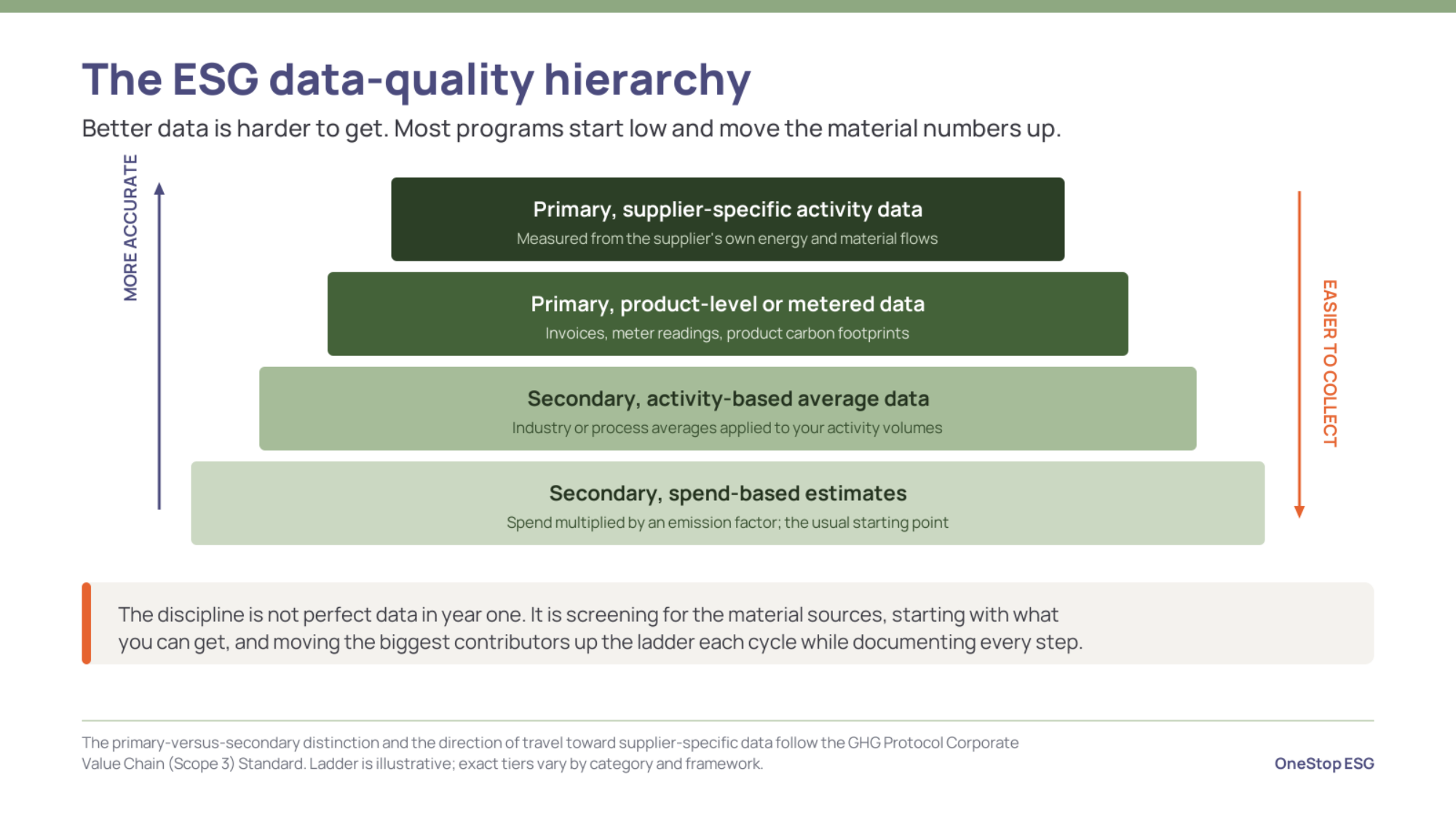
Figure: The ESG data-quality hierarchy. Based on the GHG Protocol Corporate Value Chain (Scope 3) Standard.
The standard that governs data quality
ESG data collection is not freeform; it follows established method, and for emissions that method is the GHG Protocol. The GHG Protocol Corporate Value Chain (Scope 3) Standard sets out how to account for value-chain emissions, including the primary-versus-secondary distinction and how to prioritize collection effort. Rather than demand perfect data everywhere, it directs companies to screen for the categories that matter and concentrate effort there, a materiality-led approach that keeps the work proportionate.
Quality itself is assessed against a defined set of indicators. The Scope 3 Standard provides data-quality indicators covering how reliable, complete, and representative a figure is in time, geography, and technology, and these give collection teams a consistent way to judge inputs and to document the assumptions behind any estimate. The same indicators guide where to improve: the share of a footprint derived from estimates should fall over successive years as better data is gathered.
Disclosure regimes then set what must be collected and to what standard. Under the European Sustainability Reporting Standards that implement the CSRD, in-scope companies disclose how much of their value-chain inventory is primary versus secondary data, a requirement that pushes directly toward supplier-specific figures. IFRS S2 ties climate data to the quality expectations of financial reporting. Both regimes move in the same direction, away from averages and toward measured data, and both make the collection method, not only the number, something the company has to stand behind. The underlying GHG Protocol Corporate Standard governs the operational and energy emissions that sit alongside the value chain.
Why collection is the hard part
The difficulty in ESG data is structural, not conceptual. The method is well defined; the problem is that the data does not belong to the company that has to report it. Supplier non-response is consistently the single largest barrier, because a supplier has its own priorities, may not measure its emissions at all, and gains little directly from answering a questionnaire. The quality that does come back varies widely: a large supplier with a sustainability team sends verified figures, while a small one sends a best guess on a spreadsheet.
That gap forces a reliance on estimates, which are acceptable only when disclosed as such. The failure mode auditors watch for is a reported figure that reads as measured but rests on a spend-based proxy, with no note of the method or its uncertainty. Presenting estimated data without flagging the tier it came from is where a disclosure starts to come apart under scrutiny.
Underneath all of it sits the requirement that defines credible ESG data: traceability. Every reported figure has to trace back to a primary source document, a utility invoice, a meter reading, a supplier questionnaire, so an assurance provider can follow the chain of custody from the headline number to the evidence. A correct number that cannot be traced is, from an assurance standpoint, an unverified number. Two signals mark data that will not survive review: a supplier reporting zero in a category normally material for its type, and a figure with no disclosed calculation methodology.
How to collect ESG data defensibly
A defensible program runs as a repeatable process rather than an annual scramble, and the sequence is consistent across companies.
It begins with a materiality screen. Before contacting anyone, the company models its footprint, usually from spend data, to find the categories and suppliers that account for most of the impact, then prioritizes collection there. Chasing precise data for an immaterial category wastes effort that belongs on the hotspots. The screen defines the perimeter: which categories are in scope, which suppliers to approach, and in what order.
Next comes the collection design. For each data point the company decides the indicator it needs and the method it will accept, and it documents a fallback method before collection starts so the approach stays consistent and defensible. That produces a short, structured template for suppliers, kept deliberately brief because every extra question lowers the response rate. Supplier engagement then runs as a relationship, not a one-off request, with the right contact identified and logged for future cycles. Specialist carbon accounting and ESG data providers handle questionnaire distribution, response tracking, and evidence capture at scale.
Validation and documentation close the loop. Each figure is checked, linked to its source document, and tagged with its method and tier, and the whole approach is recorded in an inventory management plan, the internal document an assurance provider reads first. The validated data is then mapped to the required framework outputs. Choosing ESG KPIs that satisfy the ESRS, IFRS S2, and GHG Protocol at once avoids collecting the same data several ways, and preparing for an ESG audit is far easier when the trail was built from the start. Companies without in-house capacity for scope 3 screening, supplier engagement, or methodology design typically engage ESG advisory and strategy firms for the first cycle and build the capability internally afterward.
Common mistakes
-
Waiting for perfect data before starting, instead of beginning with estimates and improving the material sources each cycle.
-
Changing the calculation methodology between years, which turns an improvement in data into what looks like a change in performance.
-
Collecting figures without a traceable link back to a source document, so the number cannot survive assurance.
-
Skipping the materiality screen and spreading effort evenly, which starves the hotspots that actually move the footprint.
-
Treating supplier data as a one-time exercise rather than an ongoing engagement, so response rates and quality never improve.
Conclusion
ESG data collection decides the credibility of everything built on top of it. A reported figure is only as good as the trail behind it, which means the discipline is less about finding perfect numbers than about screening for what matters, documenting the method, and keeping every figure traceable to its source. A company that builds that trail from the first cycle can defend its disclosures to auditors, investors, and regulators; one that collects numbers without it is holding figures it cannot stand behind.
Frequently asked questions
What is ESG data collection?
It is the process of gathering the environmental, social, and governance data a company reports, from its own systems and from suppliers and third parties across its value chain. Because most of the footprint usually sits upstream, much of the work is collecting data the company does not already hold.
What is the difference between primary and secondary ESG data?
Primary data comes directly from the activity being measured, such as a supplier's own energy use or a meter reading, and is the more accurate but harder to obtain. Secondary data is an estimate, typically spend multiplied by an industry-average emission factor, and is easier to collect but less precise.
How do you collect scope 3 supplier data?
By screening first for the material categories and suppliers, designing a short structured questionnaire with a documented fallback method, engaging suppliers as an ongoing relationship rather than a one-off, and validating and logging each response against its source document for future cycles.
Is estimated ESG data acceptable?
Yes, provided it is disclosed as an estimate with its method stated. Standards expect companies to start with estimates and improve coverage over time. The problem is not estimation itself but presenting estimated figures as if they were measured, without flagging the data tier or its uncertainty.
How do you make ESG data audit-ready?
By ensuring every reported figure is traceable to a primary source document, keeping the calculation method consistent and documented, recording the approach in an inventory management plan, and flagging which data is primary and which is estimated so an assurance provider can follow the chain of custody.


