
ESG Stakeholder Engagement: Who to Involve, How to Engage Each Group, and How to Act on What You Hear

ESG stakeholder engagement is the structured, two-way process of involving the people and groups affected by a company, or able to affect it, in the decisions that shape its environmental, social, and governance performance. It is not one-way communication: the point is to listen as well as inform, so that stakeholder concerns genuinely shape what the company does. It is the input that makes a materiality assessment credible and a sustainability strategy legitimate.
This guide covers who a company's ESG stakeholders are, how to engage each group, the process that runs the engagement and feeds it into strategy, and how to close the loop so that what stakeholders say actually changes something.
ESG stakeholder engagement at a glance
Who: internal stakeholders (employees, management and board, shareholders) and external ones (customers, suppliers, regulators, NGOs, communities)
The standard: the AA1000 Stakeholder Engagement Standard, built on inclusivity, materiality, and responsiveness
The methods: matched to the stakeholder, from surveys and interviews to panels, forums, and investor dialogue
The test: engagement is two-way and acted on; it is judged by what changed, not by how many were consulted
What ESG stakeholder engagement is
Engagement is the exchange of information and dialogue between a company and the parties whose interests intersect with its operations. The company shares its strategy, performance, and sustainability objectives; stakeholders share the perspectives and concerns that bear on those plans. What distinguishes engagement from communication is direction: communication pushes information out, while engagement is a conversation that is expected to change the company's decisions, not just inform the audience of them.
Good engagement rests on three principles drawn from established practice: inclusivity, that the people affected by a decision have a say in it; materiality, that engagement concentrates on the issues that matter most to both the business and its stakeholders; and responsiveness, that the company acts transparently on what it hears. It touches every part of ESG. On the environmental side, engaging communities and regulators reveals local impacts and sharpens sustainability initiatives. On the social side, engaging workers, communities, and customers builds the trust that underpins a company's social license to operate. On governance, engaging shareholders and oversight bodies strengthens accountability and decision-making.
Who your stakeholders are
A company's ESG stakeholders fall into two groups, and effective engagement has to reach both rather than default to the loudest or most powerful. Internal stakeholders are inside the organization. Employees are directly affected by labor practices, workplace conditions, and culture, and engaging them improves retention and surfaces risks early. Management and the board set and execute strategy, so their engagement is what aligns ESG goals with the business. Shareholders, as owners, have a direct interest in both financial and ESG performance and expect their concerns to be heard.
External stakeholders sit outside the organization but shape its prospects. Customers influence reputation and demand, and engaging them builds loyalty and brand value. Suppliers and business partners are integral to the value chain, and engaging them supports responsible sourcing and resilience. Regulators set the rules a company must operate within, so engagement helps it anticipate and meet them. NGOs and advocacy groups bring expertise and scrutiny that can strengthen an initiative's credibility. Local communities feel a company's environmental and social impacts most directly, and their consent often determines whether a project proceeds. Mapping these groups by their influence and their interest or dependence is what sets priorities, provided the mapping does not silence low-power groups who bear high impact.
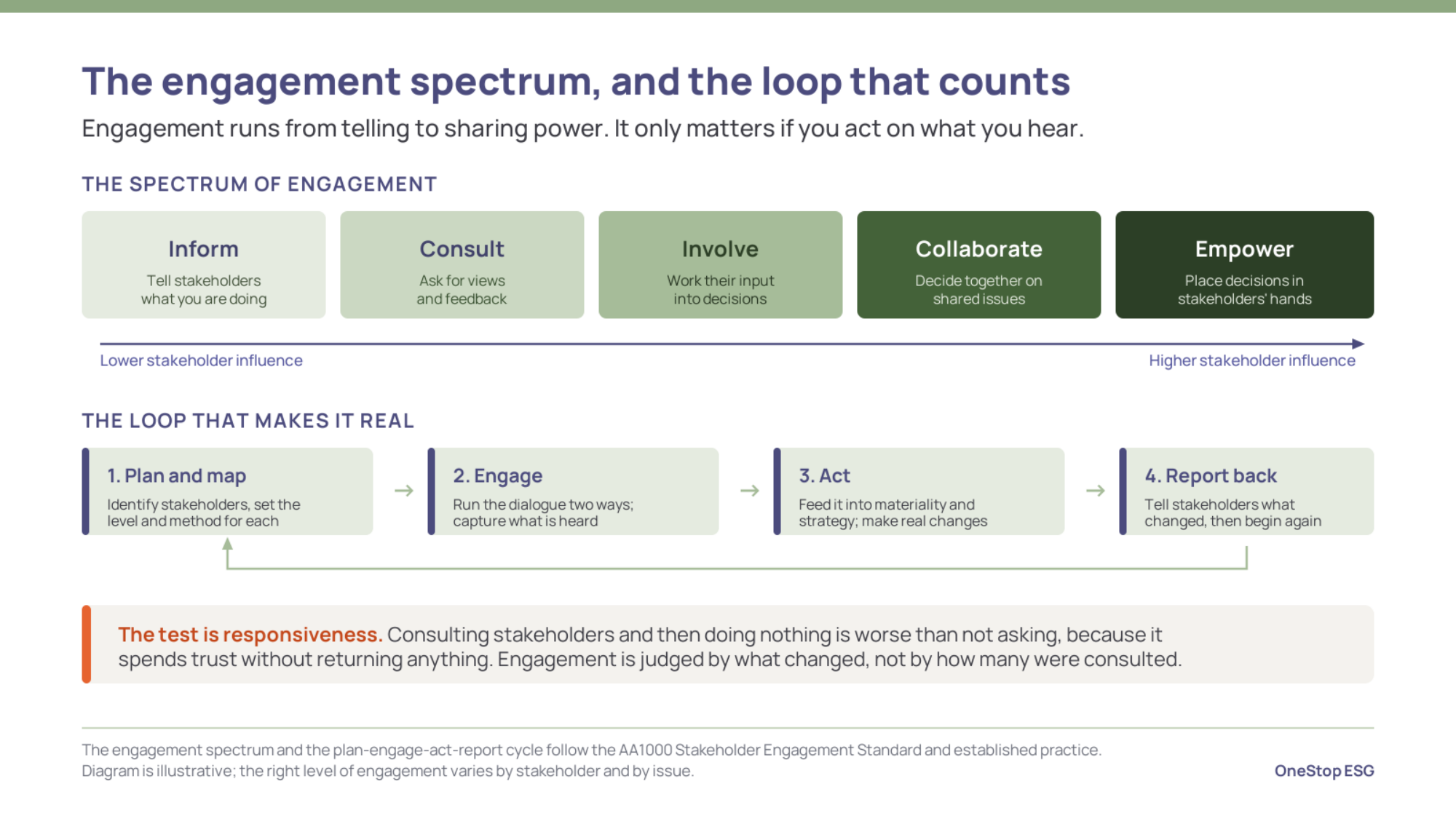
Figure: The engagement spectrum, and the loop that makes it count.
How to engage each group
There is no single way to engage, because different stakeholders want different things through different channels, and a program that treats them all the same reaches none of them well. The practical task is to match the method to the group and to the depth of engagement the issue calls for, which runs along a spectrum from simply informing stakeholders, through consulting and involving them, to collaborating with and ultimately empowering them to make decisions.
Investors, analysts, and shareholders are reached through meetings, briefings, financial and non-financial reports, and dedicated investor channels, and they tend to want financially material ESG data. Employees respond to surveys, workshops, and internal forums, and often value issues such as diversity and working conditions. Communities and NGOs are engaged through public forums, consultations, interviews, and advisory panels, where in-depth conversation matters more than broadcast. Suppliers and value-chain partners are reached through collaboration tools, portals, questionnaires, and shared targets. Structured interviews are a useful instrument across groups, asking which ESG issues a stakeholder considers most important, how they view the company's current efforts, and what they would want to see change. ESG advisory and consulting firms help design engagement that is genuinely two-way rather than a one-way broadcast dressed up as dialogue.
Running engagement and feeding it into strategy
Engagement works as a cycle, not a one-off event. It begins by planning and mapping: identifying the relevant stakeholders, setting the level and method of engagement for each, and defining what the engagement is meant to achieve. The company then prepares, mobilizing resources and building the capacity to engage well, before implementing, inviting and briefing stakeholders, running the dialogue, and documenting what is heard. It closes by reviewing and improving, evaluating the engagement and carrying its lessons into the next cycle.
The most important destination for what engagement produces is the materiality assessment. By listening to stakeholders, a company learns which ESG issues are significant to both the business and the people around it, and that is precisely the judgment a materiality assessment has to make. Engagement is therefore not a parallel activity to strategy; it is an input to it, surfacing risks and opportunities that would otherwise be missed and giving the resulting strategy legitimacy and support. Effective engagement is also demanding: stakeholders are many, resources are limited, and each group needs information tailored to its concerns, which is why prioritization and good process matter. Choosing ESG KPIs that reflect what stakeholders said matters keeps the strategy anchored to the engagement rather than drifting from it.
Closing the loop: responsiveness and reporting
The step that separates real engagement from a box-ticking exercise is responsiveness: acting on what was heard, and then telling stakeholders what changed as a result. Consulting people and then doing nothing is worse than not asking, because it spends trust and returns nothing, and stakeholders notice. Engagement is ultimately judged not by how many people were consulted but by what the company did differently afterward.
Reporting completes the cycle. A company that engages genuinely can communicate its ESG performance in a way that is tailored, credible, and specific to what different groups care about, which is also the surest defense against accusations of greenwashing, since claims are grounded in real dialogue rather than generic messaging. Established frameworks shape how this is disclosed: the AA1000 Stakeholder Engagement Standard sets out how to engage well, the GRI Standards require companies to report how they identify and engage stakeholders, and the European Sustainability Reporting Standards make stakeholder engagement part of the mandatory sustainability statement. Guidance on meaningful engagement with affected people, including the OECD Due Diligence Guidance and the UN Guiding Principles on Business and Human Rights, sets the bar for engaging those most affected by a company's operations. Preparing for an ESG audit of what was engaged and how it was acted on is easier when the cycle has been documented from the start.
Common mistakes
-
Broadcasting information and calling it engagement, when engagement has to be two-way and expected to change decisions.
-
Mapping and engaging only the loudest or most powerful stakeholders, while low-power but high-impact groups go unheard.
-
Consulting stakeholders and then not acting on what they said, which spends trust and invites cynicism.
-
Failing to report back, so participants never learn whether their input mattered.
-
Treating engagement as a one-off exercise rather than an ongoing relationship maintained across cycles.
Conclusion
ESG stakeholder engagement is judged by what changed, not by how many people were consulted. A company that maps the full range of its internal and external stakeholders, engages each through methods that fit, feeds what it hears into its materiality assessment and strategy, and closes the loop by acting and reporting back can build the trust and legitimacy that credible ESG depends on. A company that broadcasts, consults the convenient few, or listens without acting has gone through the motions of engagement without earning any of its value.
Frequently asked questions
What is ESG stakeholder engagement?
It is the two-way process of involving the people and groups affected by a company, or able to affect it, in decisions about its environmental, social, and governance performance. Unlike one-way communication, it is meant to listen and respond, so that stakeholder concerns shape what the company actually does.
Who are a company's ESG stakeholders?
They divide into internal stakeholders, including employees, management, the board, and shareholders, and external ones, including customers, suppliers, regulators, NGOs and advocacy groups, and local communities. Effective engagement reaches both groups rather than only the most visible or powerful.
What is the AA1000 Stakeholder Engagement Standard?
It is a widely used framework for planning and running stakeholder engagement, built on the principles of inclusivity, materiality, and responsiveness. It sets out a cycle of planning and mapping, preparing, engaging, and reviewing, and it is often used to structure how companies engage and report.
What is the difference between engagement and communication?
Communication is one-way: the company pushes information out to an audience. Engagement is two-way: the company listens as well as informs, and the dialogue is expected to influence its decisions. Engagement without the expectation of acting on what is heard is communication in disguise.
How does stakeholder engagement feed into materiality?
Engagement reveals which ESG issues matter most to both the business and its stakeholders, which is exactly the judgment a materiality assessment makes. Listening to stakeholders is therefore a primary input to identifying material issues, and skipping it leaves the assessment resting on the company's own assumptions.


