
ESG Risk Assessment: The Risks to Identify, How to Measure Them, and How to Build Them Into Risk Management

ESG risk assessment is the structured process of identifying, evaluating, and prioritizing the environmental, social, and governance risks that could disrupt a company's operations, damage its reputation, or hurt its financial performance. It is a forward-looking operational risk analysis, not a sustainability scorecard, and its purpose is to turn ESG from a reporting obligation into a system that protects the business.
This guide covers the types of ESG risk a company must assess, how those risks are measured and scored, the process for running the assessment, and how the results are built into enterprise risk management rather than left in a sustainability silo.
ESG risk assessment at a glance
What it assesses: physical and transition environmental risk, social risk, and governance risk, across both operations and the value chain
The lens: double materiality, the risk to the business and the business's impact on the world
The frames: the COSO/WBCSD guidance on applying enterprise risk management to ESG, and ISO risk-assessment method
The output: a scored, prioritized, owned, and monitored set of risks the leadership team can act on
What ESG risk assessment is
An ESG risk assessment is a systematic evaluation of how environmental, social, and governance factors could affect a company's operations, supply chains, assets, and financial stability. It is forward-looking: rather than describe past performance, it asks which facilities face climate hazards, which suppliers sit in vulnerable regions, how a disruption would hit revenue, and which regulations could raise costs. That is what separates it from a sustainability report, which looks backward; the assessment looks forward, at exposure the business needs to manage.
It also works on both sides of materiality. The inward side is financial: how an ESG event could damage the company. The outward side is impact: how the company's activities create risk for people and the environment, which can rebound on the business through regulation, reputation, and lost trust. A credible assessment holds both in view, because an impact ignored today often becomes a financial risk tomorrow.
The types of ESG risk
ESG risk assessment covers four broad types, and they behave differently enough that each needs its own treatment. On the environmental side, physical risk comes from the direct effects of a changing climate, floods, storms, heatwaves, drought, and sea-level rise that can shut a facility, damage a logistics hub, or cut off a raw material. Transition risk comes from the move to a low-carbon economy: policy and carbon pricing, technology shifts, changing market demand, and the reputational and legal exposure that follows perceived inaction.
Social risk sits in labor practices, worker safety, human rights, and community relations, any of which can halt operations through a dispute, an incident, or lost local consent. Governance risk sits in compliance failures, corruption, weak ethics, and poor oversight, which can trigger investigations, penalties, and a collapse in confidence. These are not separate from the environmental risks; an environmental event frequently cascades into social and governance consequences, as a climate shock leads to layoffs, legal action, and regulatory scrutiny at once.
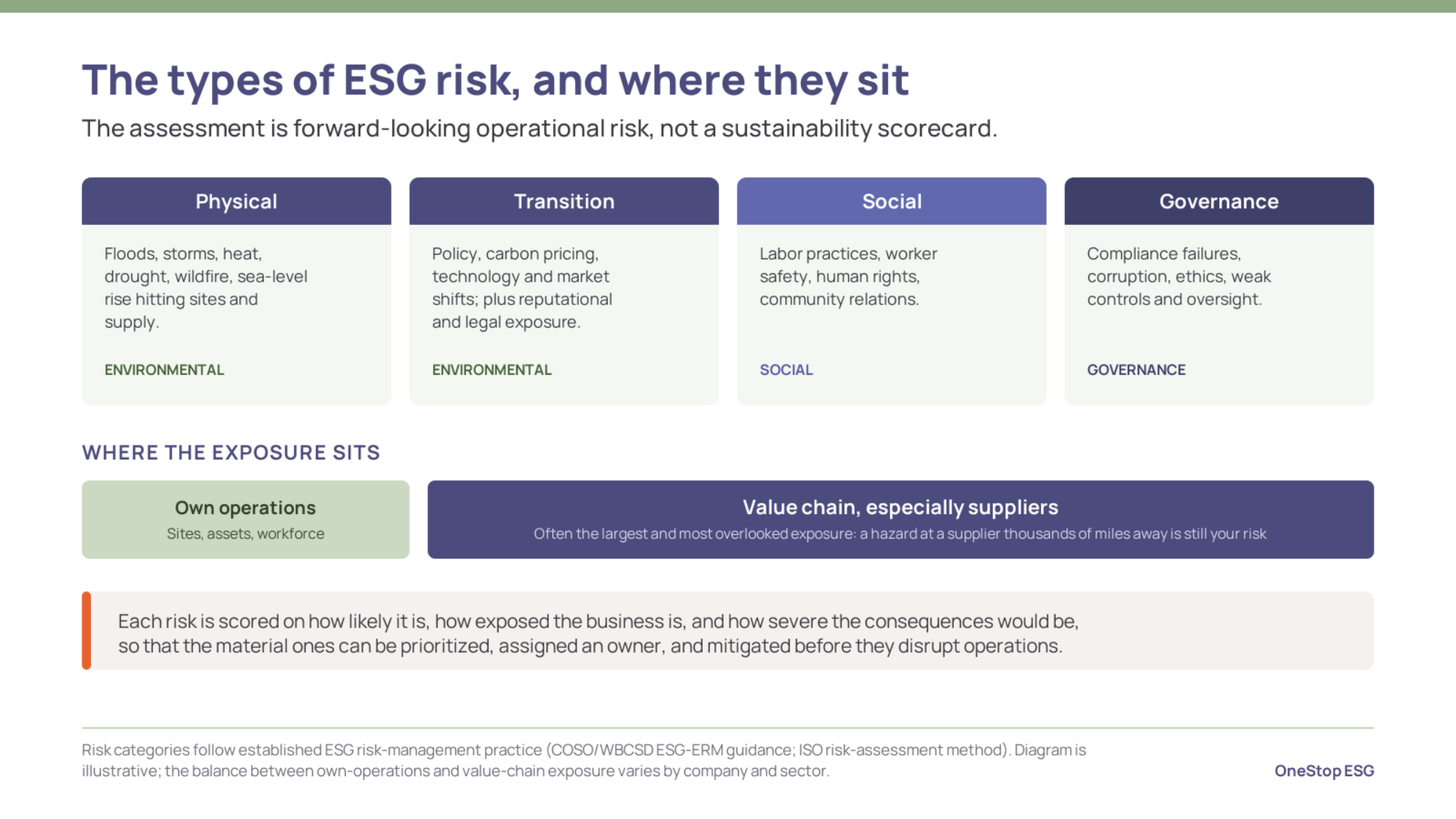
Figure: The types of ESG risk, and where they sit.
Across all four types, the single largest exposure for most companies sits outside their own walls, in the supply chain. A company can run resilient operations and still be disrupted if a key supplier floods, a logistics hub is damaged, or a sourcing region hits water scarcity. Supplier ESG risk assessment, evaluating vendors for hazard exposure, environmental compliance, resource dependency, and operational resilience, is therefore not an add-on; it is often where the highest-risk facility actually sits, thousands of miles from headquarters.
How ESG risk is measured
ESG risk is not scored by instinct. Drawing on established method, including the ISO environmental management and climate risk and vulnerability standards, a risk is assessed as the combination of three things: the likelihood that a hazard occurs, the vulnerability or exposure of the business to it, and the severity of the consequences for the company's objectives. A low-probability event with catastrophic impact can outrank a frequent but minor one, which is why all three dimensions are needed rather than likelihood alone.
Measurement runs from qualitative to quantitative as a program matures. Early assessments use expert judgment and risk indicators that are already quantifiable, such as hazard exposure for physical risk, carbon intensity for transition risk, and water stress and resource dependency for operational vulnerability. These are entry points because the data exists. As the program develops, companies move toward quantifying the financial impact of a risk directly, what a disruption would cost in lost revenue or higher procurement spend, because a figure in dollars is what lets leadership weigh an ESG risk against every other risk on the register.
Scenario analysis is the tool for the risks that historical data cannot capture. Because physical and transition risks unfold over years and the future will not resemble the past, forward-looking scenarios, rather than historical averages, are used to test how exposure changes under different climate and policy pathways. Climate risk and ESG analytics providers supply the hazard models and forward-looking data that make this possible at the scale of a full operation and supply chain.
The assessment process, step by step
A repeatable ESG risk assessment follows a consistent sequence, and documenting it is what turns subjective opinion into a process that can be compared year over year and defended to investors or auditors.
It begins by mapping operations: facilities, logistics routes, and suppliers, because companies routinely underestimate the geographic spread of their exposure. The next steps identify the hazards each location faces, gather the data needed, and analyze each risk by calculating likelihood and impact to produce a score. Risks are then prioritized by materiality, because effort belongs on the ones that could disrupt revenue or operations, not on every issue equally.
Prioritized risks move to mitigation, with responses such as supplier diversification, infrastructure adaptation, relocation or site-selection changes, and operational contingency planning, each assigned to an owner. The final step is to monitor and report: ESG risk is not static, so the register is kept live, tracked against indicators, and fed into disclosure. A structured risk register, recording each risk's type, likelihood, impact, mitigation plan, and responsible team, is what holds this together and keeps the assessment consistent as it scales across locations and suppliers. ESG advisory and strategy firms often design this methodology for a company's first cycle.
Building the assessment into risk management
An ESG risk assessment delivers little if it sits beside the business rather than inside it. The results belong in the company's enterprise risk management, assessed on the same basis and governed by the same board oversight as financial, operational, and strategic risk, so that ESG risks compete for attention and capital on equal terms rather than in a separate sustainability track. Integration into core functions, procurement, finance, and operations, is what moves the assessment from a document to a decision input.
That integration also feeds disclosure, since the risks identified map directly to what regulators now expect, including the double-materiality assessment under the European Sustainability Reporting Standards and the risk sections of IFRS S2. The COSO and WBCSD guidance on applying enterprise risk management to ESG-related risks is the reference point for doing this well, and the ESRS framework is where the impact side becomes a reporting obligation.
The case for the assessment is not limited to listed companies. Pressure now cascades down supply chains: investors and lenders ask for risk transparency before financing, enterprise customers require supplier due diligence, and insurers evaluate climate exposure before underwriting. A private company may never publish a sustainability report and still lose a contract, cover, or investment if it cannot show it understands its operational risks. For those businesses, the assessment is less about reporting than about credibility, and ESG advisory and strategy firms and ESG KPIs help translate it into the evidence partners now ask for. Preparing for an ESG audit of the underlying data is easier when the assessment was documented from the start.
Common mistakes
-
Treating ESG risk as a reputational or reporting matter rather than a forward-looking operational risk with financial consequences.
-
Assessing only the company's own operations and missing the supply chain, where the largest exposure usually sits.
-
Running the assessment once and shelving it, when the risks and the climate that drives them keep changing.
-
Scoring on likelihood alone, without weighing exposure and severity, so a rare but catastrophic risk is underrated.
-
Relying on historical data for physical and transition risk instead of forward-looking scenario analysis.
-
Leaving risks without an owner, so a scored risk never turns into a mitigation action.
Conclusion
ESG risk assessment earns its place by catching what a backward-looking report and a conventional risk register both miss: the forward exposure in a company's operations and, above all, its supply chain. A company that identifies the full range of ESG risks, scores them on likelihood, exposure, and severity, and builds the result into its enterprise risk management can act before disruption rather than after it, and can show investors, lenders, insurers, and customers that it understands its own resilience. A company that treats the assessment as a reporting exercise is measuring the wrong thing with the wrong horizon.
Frequently asked questions
What is ESG risk assessment?
It is a structured process for identifying, evaluating, and prioritizing the environmental, social, and governance risks that could disrupt a company's operations, reputation, or financial performance. It is forward-looking operational risk analysis rather than a backward-looking sustainability report.
What is the difference between physical and transition risk?
Physical risk comes from the direct effects of a changing climate, such as floods, storms, and drought that damage facilities or supply. Transition risk comes from the shift to a low-carbon economy, including policy, carbon pricing, technology and market changes, and the reputational and legal exposure that follows.
Why is supplier ESG risk assessment important?
Because the largest ESG exposure for most companies sits in the supply chain rather than in their own operations. A business can be resilient itself and still be disrupted by a supplier in a hazard-prone region, so assessing vendors for exposure, compliance, and resilience is often where the real risk is found.
How is ESG risk measured?
As a combination of the likelihood that a hazard occurs, the company's exposure or vulnerability to it, and the severity of the consequences. Programs start with qualitative judgment and quantifiable indicators, then move toward quantifying the financial impact of each material risk and using scenario analysis for long-horizon risks.
How often should an ESG risk assessment be repeated?
It should be kept live rather than run once. The risks and the climate and policy conditions that drive them change, so the register is monitored continuously against indicators and formally reassessed on a regular cycle, with results fed into both management decisions and disclosure.


