
.png%3Falt%3Dmedia%26token%3De929e0d0-9fb2-4309-9827-89dabf89c7bd&w=3840&q=75)
BloombergNEF's New Energy Outlook 2026 reveals that successive energy market shocks including Covid-19, the war in Ukraine and the Iran conflict have strengthened the economic case for the energy transition by exposing the cost and risk of fossil fuel import dependency. The report's Economic Transition Scenario projects that solar will become the world's single largest source of electricity by 2032, driven by massive supply overcapacity and falling prices, while battery storage is expected to jump 17-fold from 223 gigawatts in 2025 to 3.8 terawatts by 2035. Global energy transition investment reached a record $2.3 trillion in 2025, but the report warns that achieving net zero requires $235 trillion by 2050, meaning 24 percent more investment than the current trajectory delivers, and confirms that achieving 1.5 degrees Celsius of warming is no longer considered feasible given persistently high emissions.
Energy Security as a Transition Accelerator
The report's central insight is that energy security concerns are now reinforcing rather than competing with the energy transition in many markets. Asian economies with high import liabilities, including Vietnam, Japan, Indonesia and India, paid between 3 and 6 percent of GDP on energy imports in 2025, creating strong economic incentives to accelerate the deployment of domestically produced clean energy. The EU and China, currently spending 2.3 and 2.7 percent of GDP on energy imports respectively, are modelled to rapidly reduce these liabilities over the next decade under the Economic Transition Scenario.
David Hostert, Chief Economist at BloombergNEF, said that unlike in past energy crises there are now real options for countries to react, with viable technologies deployable at scale and at an overall lower cost than fossil fuel alternatives. This cost competitiveness is a structural development rather than a temporary policy artefact, reflecting the decade-long decline in solar, wind and battery costs. The combination of energy security motivation and economic competitiveness creates a dual driver for clean technology deployment that is more durable than policy incentives alone.
Solar, Storage and the Electricity-Led Era
Solar's projected rise to the world's largest electricity source by 2032 reflects a major supply glut, continued technology advances and sustained price declines that are making new solar the lowest-cost generation option across an expanding range of markets. Matthias Kimmel, Head of Energy Economics at BloombergNEF, said solar becomes the world's largest generator overall by 2032 while storage jumps 17-fold, underscoring how clean technologies are increasingly critical to energy security, system flexibility and meeting the world's growing power needs. The scale of the storage expansion reflects the growing recognition that variable renewable energy requires dispatchable capacity to maintain system reliability as coal and gas are phased down.
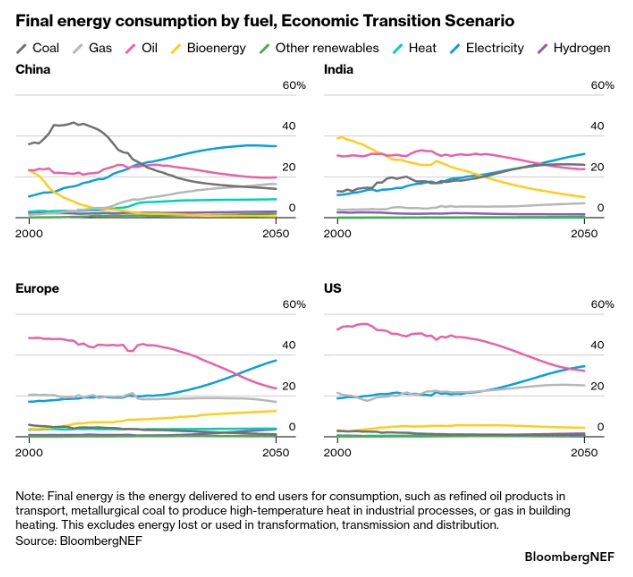
The long-term trajectory described in the Economic Transition Scenario is an electricity-led era in which electricity meets two-thirds of new energy demand over the next 24 years while natural gas supplies another 25 percent. Global electricity demand has more than doubled since 2000 and is projected to rise a further 29 percent by 2035 and 69 percent by 2050, driven by electric vehicles, data centres and industrial electrification. Global data centre capacity reached 84 gigawatts in 2025, consuming 500 terawatt hours or 1.9 percent of total global electricity demand, a 20 percent increase year-on-year, with demand from data centres more than doubling to 1,114 terawatt hours by 2050.
Regional Transition Timelines and Coal's Decline
Energy transition timelines diverge significantly by region, with China already electrifying rapidly and coal's share of power generation projected to fall from 54 percent in 2025 to 19 percent in 2035 and 7 percent by 2050. India is expected to see electricity overtake oil and coal by 2041 despite continued industrial coal use, while Europe is projected to reach electricity dominance by 2043 and the United States by 2047. This regional divergence reflects differences in economic structure, existing energy infrastructure, policy frameworks and the pace of clean technology deployment in each market.
Coal faces a structural decline in power generation across the Economic Transition Scenario, slipping to half of current levels of power generation use by 2050 even as some coal-rich nations may re-emphasise domestic coal in response to energy security concerns. The economic uncompetitiveness of coal relative to renewables and batteries is the primary driver of this trajectory, with falling clean technology costs making continued coal investment increasingly difficult to justify on financial grounds alone. China and India together account for 80 percent of nuclear capacity additions in the scenario through 2035, reflecting how both countries are pursuing low-carbon baseload alongside renewables.
Explore OneStop ESG Marketplace: Renewable Energy
Net Zero Scenarios and Investment Gap
The report's updated Net Zero Scenario, representing a credible maximum-effort pathway to keep warming well below 2 degrees Celsius, reflects a slower pace of transition than the 2024 edition due to shifting policy priorities and limited progress in next-generation clean technologies. Under this pathway peak warming reaches 1.81 degrees Celsius compared with 1.75 degrees Celsius in the 2024 edition, and BNEF confirms that achieving 1.5 degrees Celsius is no longer considered feasible given persistently high emissions and continued investment in emissions-intensive assets. This downgrade represents a significant shift in the authoritative assessment of the global climate trajectory.
The investment gap between the Economic Transition Scenario and net zero is substantial, requiring $235 trillion by 2050 under net zero versus the current trajectory. Closing this gap requires directing 84 percent of energy investment toward low-carbon technologies under the Net Zero Scenario, compared with the current mix. Despite $0.5 trillion in corporate equity and billions in government support over five years for startups and clean technology ventures, the next great low-cost energy technology has yet to emerge at commercial scale, with hopes for new nuclear, advanced geothermal or next-generation storage yet to be proven sufficiently in deployment.
Outlook for Clean Technology Investment and Grid Infrastructure
The combination of rising electricity demand, solar cost competitiveness and accelerating storage deployment creates a structurally favourable environment for clean energy investment through the remainder of the decade. A larger and more dynamic power system requires significantly increased flexibility, with the report projecting that 11 percent of megawatt hours generated will be shifted by 2035, compared with 3 percent today. This implies massive investment requirements in grid infrastructure, interconnection, demand response and storage, placing growing pressure on grid investment, system expansion and permitting timelines across all major electricity markets.
Whether the Economic Transition Scenario delivers on its energy security and emissions reduction potential will depend on the pace of grid investment, permitting reform and the ability of clean technology supply chains to scale alongside accelerating demand. The convergence of economic competitiveness, energy security motivation and climate policy creates a powerful set of incentives for continued clean technology deployment. However, the gap between current trajectories and the Net Zero Scenario underscores the need for significantly more ambitious policy action and capital allocation to avoid the most severe climate outcomes.
Subscribe to our newsletter for more insights, case studies, and ESG intelligence.
Keep abreast of the top ESG Events on OneStop ESG Events.
OneStop ESG Educate: Your go-to source for top ESG courses and training programs tailored to your needs.
Stay informed with the latest insights on OneStop ESG News.
Discover meaningful career opportunities on OneStop ESG Jobs.

Ankit Palan is a Canada based writer who has been writing about sustainability for the past four years. He focuses on making topics like climate change, ESG, and responsible business easier to understand and more relatable. His work looks at how sustainability plays out in the real world, across businesses, finance, and everyday decisions, without overcomplicating it.
.png%3Falt%3Dmedia%26token%3D6e282d8a-faa8-4ce6-b538-15cb21872bf4&w=1920&q=75)
.png%3Falt%3Dmedia%26token%3D6402380e-df06-4f60-83a3-36ba7e809cde&w=1920&q=75)


%252010th%2520Edition.png%3Falt%3Dmedia%26token%3D28295a93-506a-42b8-aef2-79cd319b0edc&w=3840&q=75)
Comments
Have a thought on this? Share it with other readers.