
ESG in Retail: Why the Footprint Sits in the Supply Chain, What the Rules Require, and How Retailers Respond
A retailer's own operations, its stores, warehouses, and delivery fleet, are the visible part of its footprint and the smallest part. The goods on the shelves were made, grown, and shipped by other companies, and the emissions and the labor conditions of that supply chain dwarf anything the retailer does directly. ESG in retail is therefore a supply-chain discipline: the work of influencing companies the retailer buys from but does not own.
This guide covers what is material for a retailer, how the supply-chain disclosure and due-diligence rules fit together, where the risk concentrates, and what implementation looks like in practice.
ESG in retail at a glance
Dominant dynamic: the footprint and the social risk sit upstream, in suppliers the retailer does not own, so influence runs through purchasing power rather than direct control
Signature issues: supply-chain emissions, labor and human rights in manufacturing, and product and packaging waste
Reporting and due-diligence anchors: the CSRD and the Corporate Sustainability Due Diligence Directive in the EU, the SASB consumer-goods and retail topics under IFRS S2
Pressure source: regulation on supply-chain disclosure and due diligence, investors, and consumers who increasingly ask where and how products are made
What ESG means in retail
For a retailer, materiality is concentrated upstream. According to the CDP supply-chain report with Boston Consulting Group, published in 2024, supply-chain emissions are on average 26 times larger than a company's own operational emissions, yet CDP's previous supply-chain report found that only 41% of disclosing companies reported any of their supply-chain emissions at all. For retail specifically, where the business is built on sourcing and selling goods made by others, the imbalance is even starker: the great majority of the footprint sits in purchased goods, raw materials, manufacturing, and freight, not in the stores.
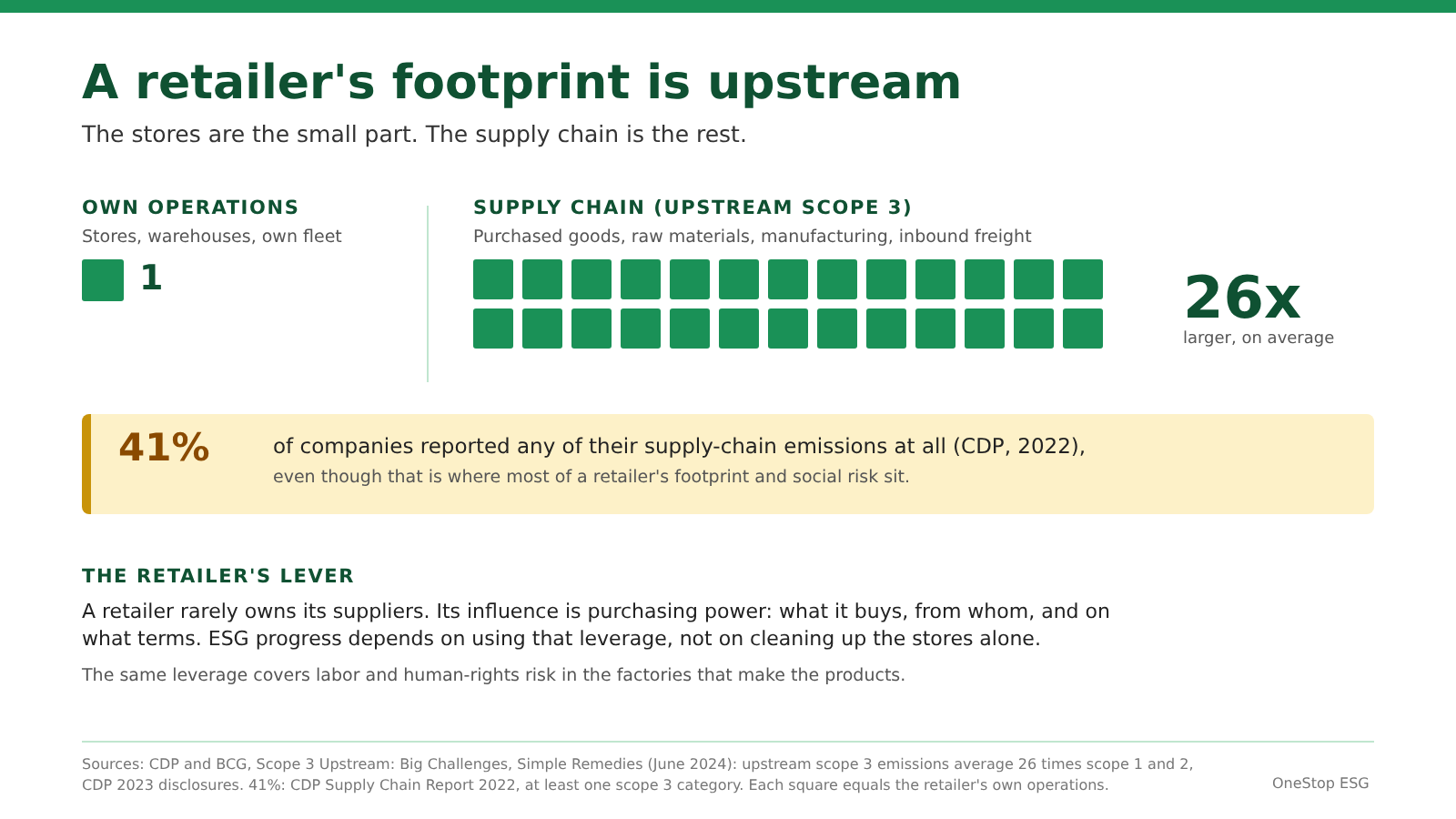
Figure: A retailer's footprint is upstream. Sources: CDP and BCG, Scope 3 Upstream: Big Challenges, Simple Remedies, 2024; CDP Supply Chain Report, 2022 (41% figure).
The social pillar in retail is as material as the environmental one, and it lives in the same place: the supply chain. The labor conditions, wages, safety, and human rights of the workers who make the products, often several tiers down from the retailer, are a direct ESG and legal exposure. A retailer that cannot see past its first-tier suppliers cannot know whether forced labor, unsafe factories, or child labor sit in its chain, which is why traceability is a social issue before it is an environmental one.
Waste completes the picture. Product and packaging waste, overproduction of goods that are never sold, and the end-of-life of what is sold are material in sectors such as apparel and electronics, where the volume of goods moved makes disposal a significant impact. Governance ties these together: the integrity of sustainability claims about products, the ethics of sourcing decisions, and board oversight of a supply chain that the retailer is increasingly held legally responsible for.
Regulation and frameworks that apply to retail
Retail's ESG framework is shifting from voluntary disclosure toward legal due-diligence duty, and the change is concentrated in the supply chain. What applies depends on where a retailer is incorporated, where it sells, and where its goods are made.
The regime with the sharpest teeth is supply-chain due diligence. The EU's Corporate Sustainability Due Diligence Directive, which entered into force in 2024 and, as amended in 2026, applies from July 2029, requires large companies to identify, prevent, and address adverse human-rights and environmental impacts in their own operations and their supply chains, not merely to disclose them. It makes a retailer responsible for conditions at suppliers it does not own, which is a step beyond reporting. Similar duties exist in national law in several countries, covering modern slavery, child labor, and supply-chain transparency, so a retailer selling across markets faces a layered set of obligations.
On the disclosure side, the Corporate Sustainability Reporting Directive requires larger EU retailers and those with significant EU activity to report on sustainability including scope 3 emissions, which forces supplier data into the open. The SASB consumer-goods and retail standards, maintained by the ISSB, set the industry disclosure topics, covering supply-chain management, labor practices, product sourcing, packaging, and data security, and IFRS S2 carries climate reporting and those topics into a single standard. The common thread across all of them is that they reach past the retailer's own walls into its suppliers.
Where ESG risk concentrates
The defining feature of ESG risk in retail is that the exposure sits with companies the retailer does not control. A manufacturer can change its own factory; a retailer can only ask, incentivize, or require its suppliers to change theirs, and then verify that they have. This is the mirror image of an owned business, and it makes influence, not control, the central problem.
Supply-chain emissions are the clearest case. Because the footprint is overwhelmingly upstream, a retailer that measures only its stores is reporting on a fraction of its exposure and cannot meet disclosure rules that now ask for scope 3. The data problem is severe: a retailer's scope 3 emissions are its suppliers' own emissions, held by third parties who may not measure them, so reported figures rest on estimates until supplier data improves. Carbon accounting and ESG data providers that specialize in supply-chain data are the usual route to closing that gap.
Social risk carries the heaviest consequences. Forced labor, unsafe conditions, or child labor in a supplier factory is a human-rights failure, a legal exposure under due-diligence law, and a reputational crisis that can move sales, often all at once. Because these conditions sit several tiers down, a retailer that cannot trace its chain cannot manage the risk, which turns supply-chain visibility from a reporting nicety into a core control. The financing relationships behind suppliers, and the lender-side view of their emissions, are covered in the guide to ESG in banking.
Product and claim risk completes the exposure. Overproduction ties up capital in goods that may be discounted or discarded, and a green claim about a product that the supply chain cannot substantiate is a greenwashing exposure that regulators in several markets now pursue directly. A retailer is accountable for the accuracy of what it says about goods it did not make, which raises the bar on sourcing evidence.
How retailers implement ESG
Implementation in retail is built around supplier influence, because that is where the footprint and the risk sit. It runs from visibility to engagement to reporting.
Visibility comes first. A retailer maps its supply chain beyond the first tier, identifies where emissions and labor risk concentrate, and sets a scope 3 baseline, because nothing can be managed that cannot be seen. Choosing ESG KPIs that satisfy the CSRD, the SASB topics, and the due-diligence regimes at once avoids collecting supplier data several ways, and setting the baseline early rather than under regulatory deadline is the single most useful discipline.
Supplier engagement is the main lever. A retailer writes ESG requirements into supplier contracts, audits conditions in factories, supports suppliers in measuring and reducing emissions, and weights sustainability in sourcing decisions, using its purchasing power to drive change it cannot mandate directly. Where suppliers need operational help, decarbonization and energy efficiency providers work at the factory level.
Looking to help suppliers reduce their environmental impact? Explore decarbonization and energy efficiency solutions on the OneStop ESG Marketplace.
Reducing overproduction and improving packaging and product end-of-life sit alongside, as design and merchandising decisions rather than supply-chain ones.
Reporting and assurance then draw the picture together. A retailer aggregates supplier data into scope 3 disclosures and due-diligence reporting, and an ESG audit of that data is easier when traceability and measurement were built in from the start. Retailers without in-house capacity for supply-chain mapping, scope 3 accounting, or human-rights due diligence typically engage ESG advisory and strategy firms for the first cycle and build the capability internally afterward.
Need support with supply-chain ESG and due diligence? Explore ESG strategy consulting providers on the OneStop ESG Marketplace.
Common mistakes
-
Measuring store and warehouse emissions and stopping there, when the supply chain is the overwhelming majority of the footprint.
-
Mapping only first-tier suppliers, so labor and emissions risk several tiers down stays invisible.
-
Treating supplier ESG as a contract clause rather than an engagement, so requirements are set but never verified.
-
Making product sustainability claims the supply chain cannot substantiate, which is a direct greenwashing exposure.
-
Managing overproduction as a merchandising issue only, ignoring its ESG and waste dimension.
Conclusion
ESG in retail is the discipline of changing a supply chain the retailer does not own. A retailer that traces its chain beyond the first tier, uses its purchasing power to raise supplier performance, substantiates the claims it makes about its products, and reports the scope 3 footprint that regulation now requires can meet its due-diligence duty and defend its position. A retailer that polishes its stores while leaving its supply chain unseen is managing the smallest part of what it is answerable for.
Frequently asked questions
What does ESG mean in retail?
It refers to how a retailer manages the environmental and social impact of the goods it sells, most of which occurs in the supply chain, alongside its own operations and the governance of its sourcing and claims. Because the footprint and the labor risk sit upstream, ESG in retail is largely a supply-chain discipline.
Why are a retailer's scope 3 emissions so large?
Because a retailer sells goods made by others, so the emissions of manufacturing, raw materials, and freight all sit in its supply chain rather than its stores. Across companies generally, supply-chain emissions average many times operational emissions, and for retail the imbalance is more pronounced.
What is the Corporate Sustainability Due Diligence Directive?
An EU law that requires large companies to identify, prevent, and address adverse human-rights and environmental impacts in their own operations and supply chains, rather than only disclose them. It makes a retailer responsible for conditions at suppliers it does not own, and, as amended in 2026, it applies to the largest companies from July 2029.
How can a retailer manage emissions it does not control?
Through influence rather than control: mapping the supply chain, writing ESG requirements into contracts, auditing suppliers, supporting them in measuring and cutting emissions, and weighting sustainability in sourcing. Purchasing power is the lever a retailer uses in place of the direct control an owner would have.
Why is traceability a social issue in retail?
Because labor abuses such as forced labor and child labor usually sit several tiers down the supply chain. A retailer that cannot trace its chain beyond the first tier cannot see those conditions, so visibility is the prerequisite for managing the social risk and meeting due-diligence duties.


