
ESG in Banking: What It Means, What Regulators Expect, and How Banks Put It Into Practice

A bank's own operations are a small part of its ESG profile. The emissions, labor practices, and governance of the companies and households it lends to are what sit on its balance sheet, and that is where supervisors, investors, and campaigners look first. ESG in banking is therefore a portfolio question before it is a facilities question.
This guide covers what is material for a bank, how supervision and reporting frameworks fit together, where ESG risk sits in a loan book, and how implementation works.
ESG in banking at a glance
Dominant pillar: environmental, through financed emissions and climate risk in lending and investment books, with governance a close second
Reporting anchors: IFRS S2 and the SASB Commercial Banks standard, EU Pillar 3 ESG disclosures and the CSRD, and PCAF for financed emissions
Supervisory anchor: the Basel Committee principles on climate-related financial risk, applied through national supervisors
Main pressure source: prudential supervisors treating climate as a financial risk, followed by disclosure regulation and investor expectations
What ESG means in banking
A bank's material ESG issues follow its exposures rather than its buildings. CDP's first analysis of the financial sector, published in April 2021 from 2020 disclosures by 332 financial institutions, found that portfolio emissions from lending, investing, and underwriting were on average more than 700 times larger than the institutions' direct emissions. The same report found that only a quarter of those institutions reported portfolio emissions at all.
On the environmental side, this makes financed emissions the central measurement task, and physical and transition risk in the loan book the central risk task. A mortgage portfolio concentrated in flood-prone areas, or a corporate book weighted toward carbon-intensive sectors, carries environmental exposure that never appears in the bank's own footprint.
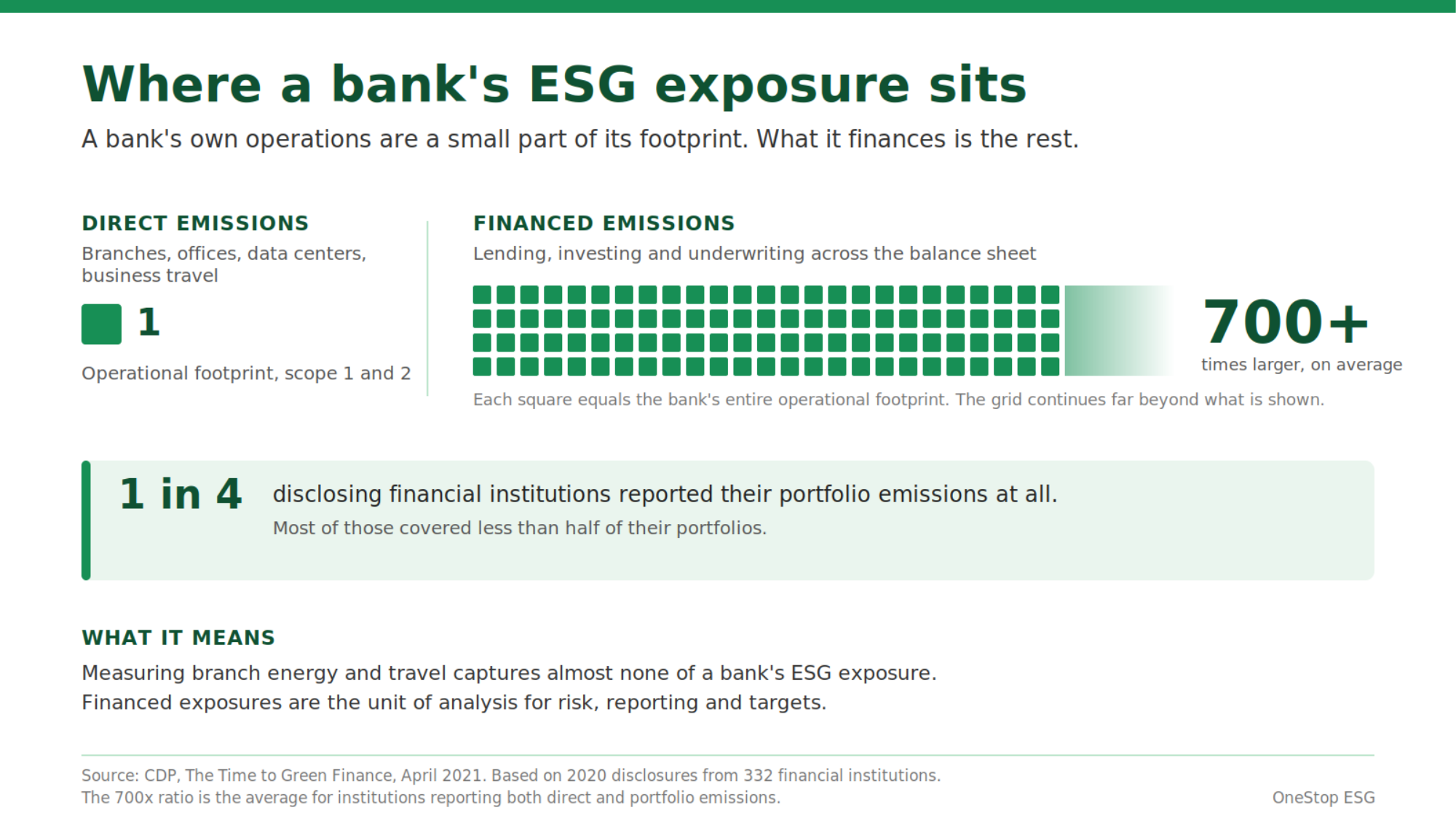
Figure: Where a bank's ESG exposure sits. Source: CDP, The Time to Green Finance, April 2021, 2020 disclosures from 332 financial institutions.
The social pillar in banking centers on how the bank treats customers and the public rather than on its workforce alone. The SASB Commercial Banks standard, now maintained by the ISSB, sets out five disclosure topics for the sector: data security, financial inclusion and capacity building, the incorporation of ESG factors in credit analysis, business ethics, and systemic risk management. Three of the five are social or governance topics, a corrective to the assumption that banking ESG is only climate.
Governance covers board oversight of sustainability risk, risk culture, remuneration links, and the controls that stop sustainable finance products from being mislabeled. Issues that dominate ESG in other sectors, such as water use, waste, and factory conditions, are rarely material for a bank's own operations and belong in its assessment of borrowers instead.
Regulation and frameworks that apply to banks
Banking is unusual in that its ESG requirements come from prudential supervisors, who treat ESG mainly as a source of financial risk, as well as from disclosure regulators.
The common reference point is the Basel Committee on Banking Supervision's Principles for the effective management and supervision of climate-related financial risks, finalized in June 2022. The document sets out 18 principles, 12 addressed to banks and six to supervisors, covering governance, internal controls, risk assessment, management, reporting, and the use of climate scenarios in stress testing. The principles are not binding on their own; national supervisors decide how to apply them.
Application varies by jurisdiction. In the European Union, the European Central Bank published its guide on climate-related and environmental risks in November 2020 and has since used supervisory reviews and stress tests to check progress. The European Banking Authority's Pillar 3 technical standards on ESG risks require banks to disclose their exposure to transition and physical risk, a requirement that began with large listed institutions and that the revised Capital Requirements Regulation extends to all EU institutions on a proportionate basis; the amended standards are covered in OneStop ESG's reporting on the EBA changes. The green asset ratio, the share of a bank's covered assets financing EU Taxonomy-aligned activities, originates in the Taxonomy Regulation's own disclosure rules, and large banks also fall under the Corporate Sustainability Reporting Directive as companies in their own right. In the United Kingdom, the Prudential Regulation Authority first set supervisory expectations on climate-related risk in April 2019 and has since replaced them with an updated supervisory statement. In Singapore, the Monetary Authority of Singapore issued Guidelines on Environmental Risk Management for banks in December 2020 and has added guidance since. In the United States, there is no dedicated supervisory climate guidance in force; the federal banking agencies expect climate exposures to be handled under existing safety and soundness standards alongside other material risks.
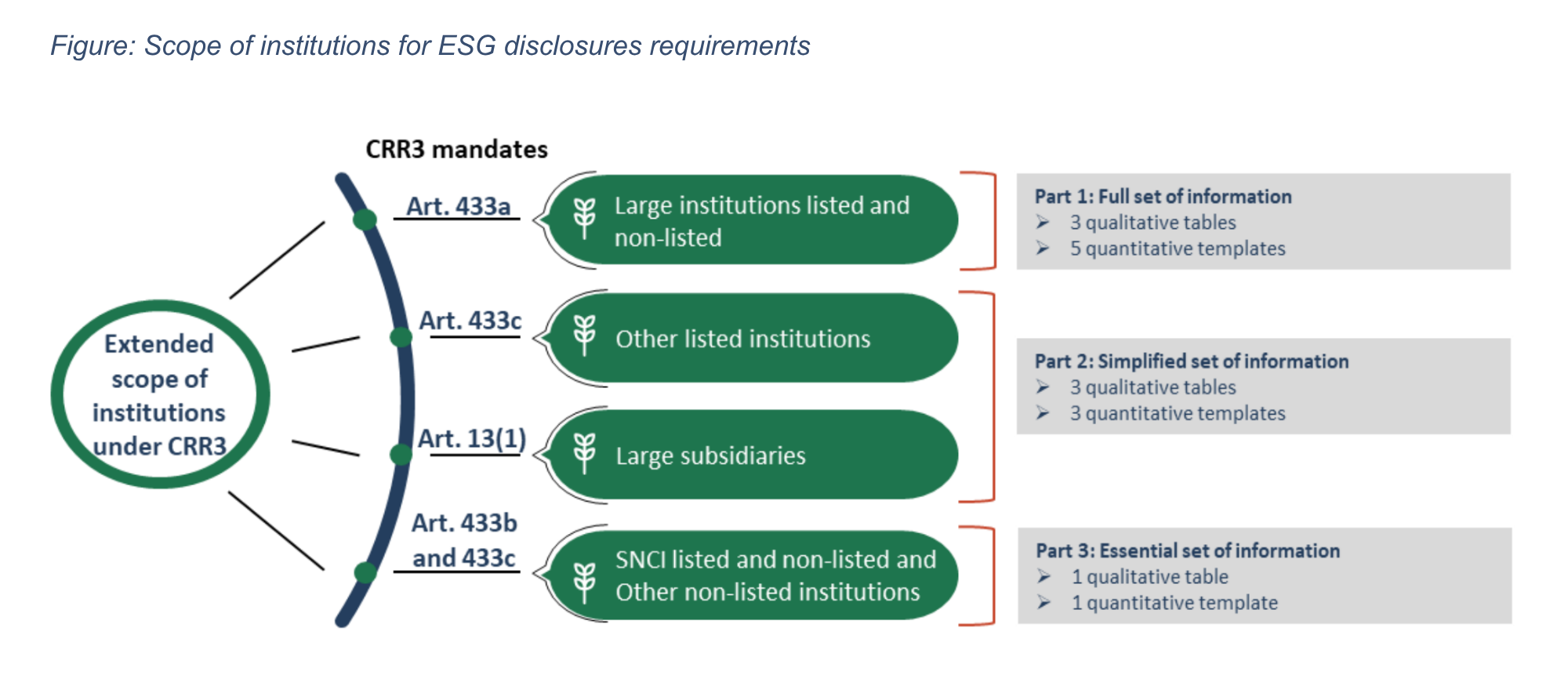
Source: European Banking Authority, Final report on draft ITS on amended disclosure requirements for ESG risks, June 2026.
Alongside supervision sit the voluntary frameworks that shape disclosure and target-setting. IFRS S2, issued by the ISSB in June 2023, carries forward the TCFD structure and incorporates the SASB industry topics for banks. The Partnership for Carbon Accounting Financials, whose Global GHG Accounting and Reporting Standard for the Financial Industry was first published in November 2020, is the dominant method for calculating financed emissions. The Equator Principles govern environmental and social risk in project finance, and the UN Principles for Responsible Banking, launched in September 2019, commit signatories to align strategy with the Paris Agreement and the Sustainable Development Goals.
Where ESG risk shows up in a loan book
For most companies, ESG risk is reputational first. For a bank it is credit risk first, because the ESG exposure of a borrower becomes the bank's exposure through the loan.
Transition risk arrives through policy, technology, and market shifts that weaken the cash flows of carbon-intensive borrowers. A power producer or cement plant facing carbon pricing can see its probability of default and collateral value move for reasons unrelated to its management. Physical risk arrives through the assets the bank holds as security and the regions where its borrowers operate: flood, storm, drought, and heat all affect property values, agricultural lending, and business continuity.
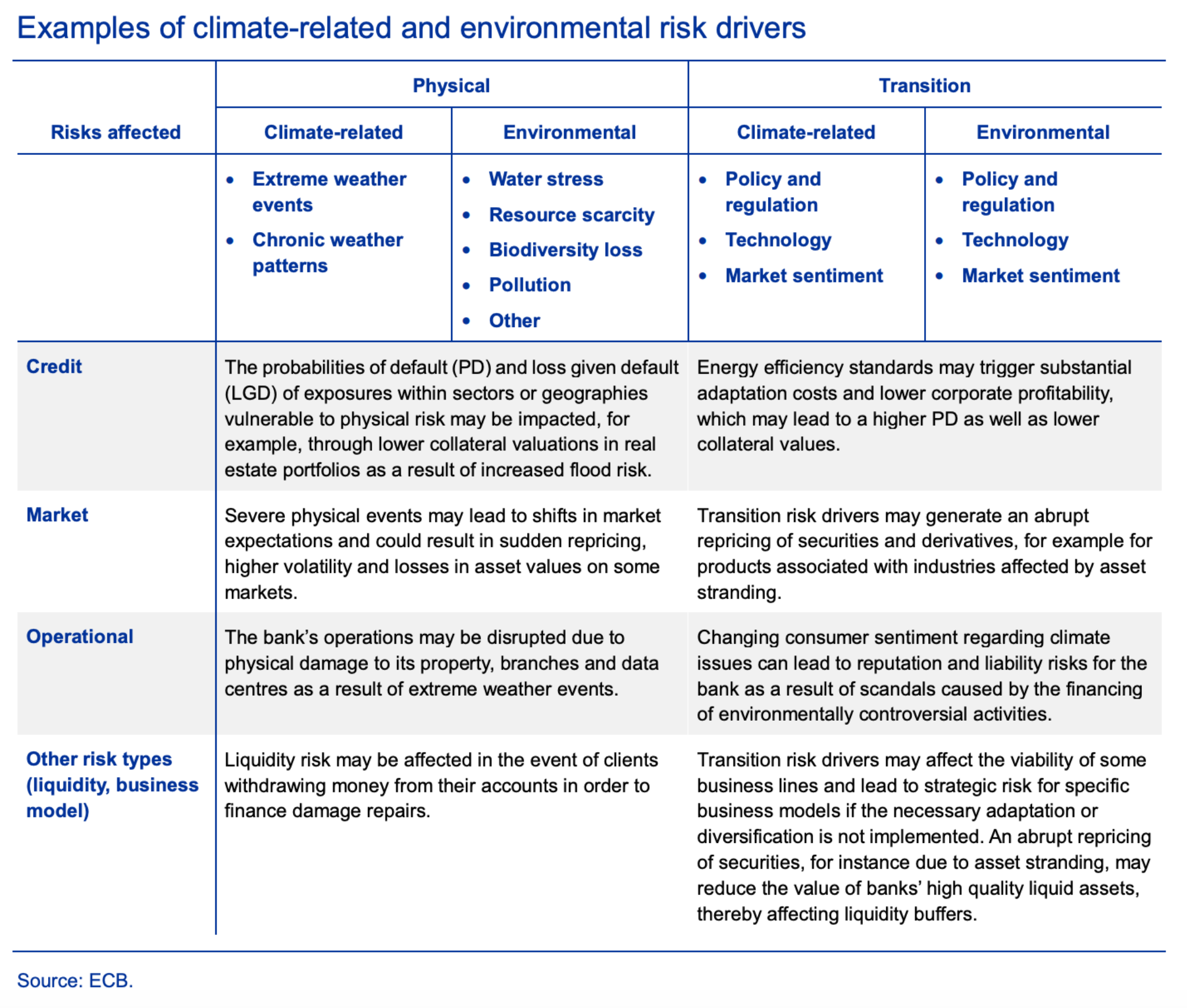
Source: European Central Bank, Guide on climate-related and environmental risks, November 2020.
The same CDP report found that 65% of disclosing financial institutions were not reporting climate-related credit risk, and 74% were not reporting climate-related market risk, even though the potential financial impact they attributed to those two categories exceeded one trillion US dollars against 34 billion for operational risk. That gap, between where the risk sits and where measurement effort goes, is the sector's defining weakness.
What sets banking apart from every other sector is that the bank is both exposed to the transition and a financier of it. Its lending decisions shape which real-economy assets get built, which means a bank's ESG performance is judged on its influence as well as its exposure. A bank can only reduce financed emissions by changing what it lends to, engaging borrowers, or exiting relationships, and all three carry commercial and social consequences.
Conduct risk completes the picture. Green bonds, sustainability-linked loans, and labeled funds create exposure to greenwashing claims if the sustainability features are weakly defined or poorly monitored, and supervisors increasingly treat mislabeled products as a prudential concern.
How banks implement ESG
Data is the first and hardest step. A bank's financed emissions depend on borrower-level emissions data that the bank does not own and often cannot obtain, so PCAF-aligned calculations rely on a data quality hierarchy that runs from reported and verified figures down to sector averages. Most banks start with estimates and improve coverage over time, which is why ESG data, carbon accounting, and climate risk analytics providers form the largest vendor category banks engage with.
The credit process is where ESG becomes operational. Banks add ESG questionnaires or scores to onboarding and annual review, set sector policies that restrict or condition lending to high-risk activities, and build transition-finance frameworks that distinguish borrowers with credible decarbonization plans from those without. Pricing adjustments and covenants tied to sustainability targets follow once the assessment is in place.

Reporting then pulls the pieces together. A bank typically reports under several regimes at once, so building a single metrics set that serves Pillar 3, the CSRD, and IFRS S2 avoids duplicating work. The step-by-step ESG reporting process and the choice of ESG KPIs for a financial institution are covered in dedicated guides.
Assurance is increasingly expected for financed-emissions figures and taxonomy alignment, and preparing for an ESG audit is easier when data lineage has been documented from the start. Banks without in-house capacity for scenario analysis, materiality assessment, or transition planning typically engage ESG advisory and strategy firms for the first cycle and build internal capability afterward.
Common mistakes
-
Measuring the operational footprint and stopping there. Branch energy and business travel are a rounding error next to the loan book.
-
Treating ESG as a marketing function rather than a risk function, leaving labeled products without governance.
-
Relying on third-party ESG ratings of borrowers without understanding what the rating measures. How risk-rating methodologies are built determines whether a score is fit for credit decisions.
-
Hiding data coverage gaps behind estimated figures without disclosing the data quality tier for each portion of the portfolio.
-
Setting portfolio targets without a transition-finance framework, which forces the bank to choose between missing the target and dropping clients who need capital to change.
Conclusion
ESG in banking is a balance-sheet discipline. A bank that cannot quantify what it finances cannot manage its largest source of ESG risk, cannot meet the disclosure requirements that supervisors and standard setters now apply to it, and cannot defend the sustainability claims it makes about its products. The institutions that treat financed exposures as the unit of analysis, rather than their own buildings, are the ones whose ESG programs hold up to scrutiny.
Frequently asked questions
What does ESG mean in banking?
It refers to how a bank manages environmental, social, and governance factors across its lending, investment, and underwriting activities, as well as its own operations.
How do banks measure financed emissions?
Most use the PCAF standard, which attributes a share of each borrower's or investee's emissions to the bank in proportion to its financing, and tags each figure with a data quality score based on whether it came from verified reports, estimates, or sector averages.
Is ESG reporting mandatory for banks?
It depends on jurisdiction and size. EU banks have mandatory Pillar 3 ESG disclosures scaled to their size, and large ones also carry CSRD obligations; the UK and Singapore have supervisory expectations on climate risk management; many other markets rely on voluntary frameworks or listing rules.
What is a green asset ratio?
It is a metric from the EU Taxonomy framework showing the share of a bank's covered assets that finance Taxonomy-aligned activities. It is designed for comparability rather than as a full measure of a bank's sustainability performance, its scope excludes some exposures, and the rules on where and how banks disclose it have been revised more than once.
How does ESG affect lending decisions?
Through sector policies that restrict certain activities, client-level ESG assessments at onboarding and review, pricing or covenant terms tied to sustainability performance, and transition-finance criteria that favor borrowers with credible decarbonization plans.


