
ESG in Private Equity: Why Ownership Changes the Job, What Gets Reported, and How Firms Deliver It

A private equity firm does not sit outside the companies it invests in; it owns and controls them. That single fact changes what ESG means for the sector. A public-market shareholder is exposed to the ESG risk of the companies it holds. A private equity owner sets the board, shapes the strategy, and decides what gets measured, so it is accountable for the ESG performance of its portfolio, not merely exposed to it.
This guide covers what is material for a general partner, how the reporting frameworks that limited partners now expect fit together, where the risk sits across the fund lifecycle, and what implementation looks like in practice.
ESG in private equity at a glance
Dominant dynamic: control. The firm can change portfolio-company ESG performance directly, which makes ESG an ownership responsibility rather than a disclosure exercise
Reporting anchors: the ESG Data Convergence Initiative for GP-to-LP metrics, SFDR fund classification in the EU, IFRS S2 at portfolio-company level, and the PRI for firm-level commitments
Pressure source: limited partners, who allocate capital and increasingly require comparable ESG data as a condition of investing
Where it bites: across the whole lifecycle, from diligence through the hold period to exit, rather than at a single reporting date
What ESG means in private equity
In most sectors ESG is about a company managing its own impact. In private equity it is about an investor managing the impact of the companies it owns, which is a different task. Because the firm controls its portfolio companies through the hold period, it can set emissions targets, change governance, improve labor practices, and build reporting into how a company is run. The influence a public shareholder exercises through voting, a private equity owner exercises through ownership.
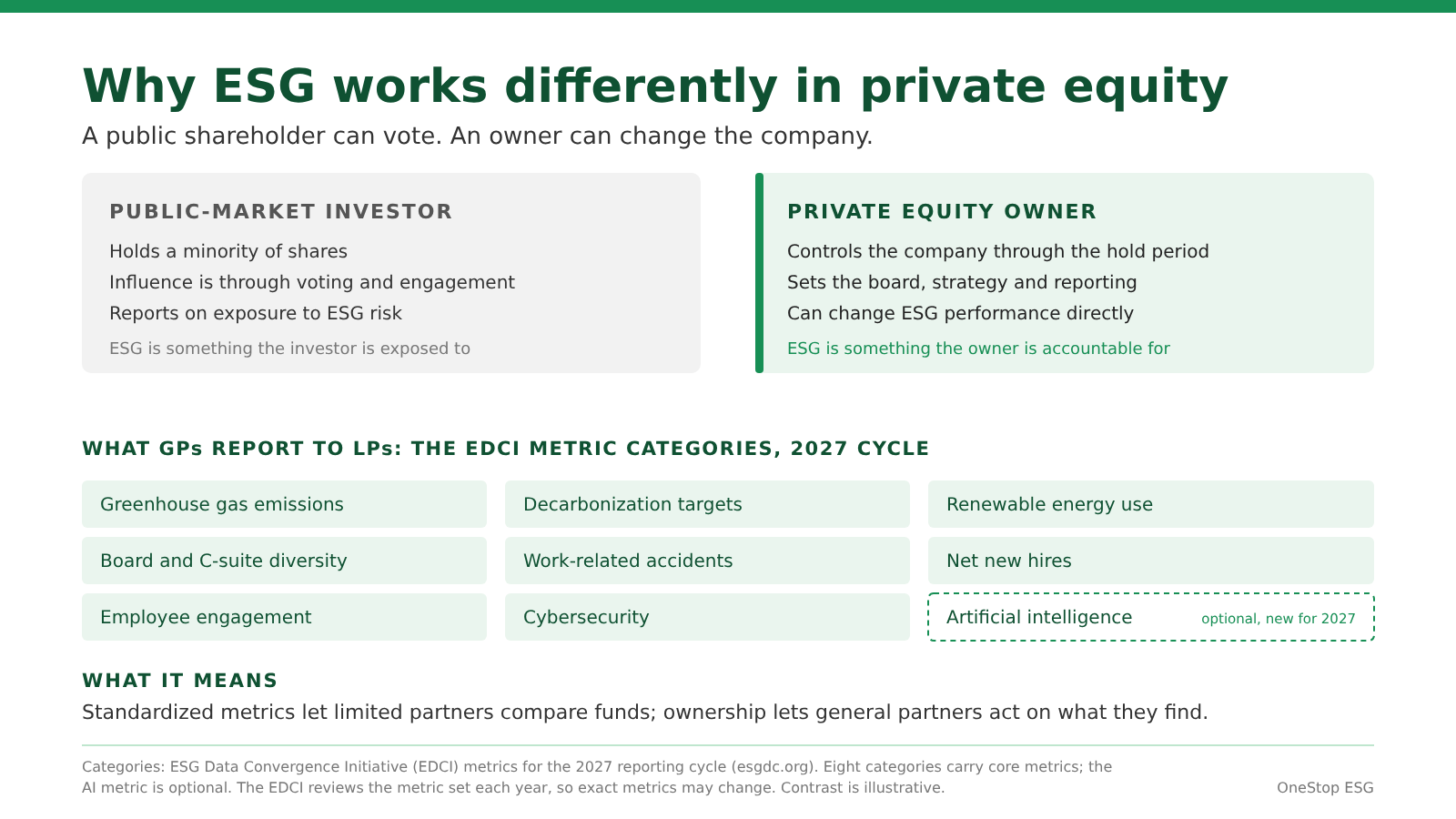
Figure: Why ESG works differently in private equity. Metric categories from the ESG Data Convergence Initiative.
Materiality is set at two levels. At the firm level, the general partner has its own governance, its diversity and culture, and its commitments as a signatory to initiatives such as the Principles for Responsible Investment. At the portfolio level, what is material depends on each company's sector: emissions for an industrial holding, data security for a software holding, labor practices for a services holding. A credible program assesses materiality company by company rather than applying one checklist across a mixed portfolio.
The governance pillar is unusually direct here because the firm appoints the board. Board composition, executive incentives, data integrity, and the controls that prevent a sustainability claim about a fund from outrunning what the portfolio actually does are all within the firm's gift. That control is also the source of the sector's sharpest ESG risk, greenwashing at the fund level, because a firm that labels a fund as sustainable is making a claim it is directly responsible for substantiating.
Frameworks that apply to private equity
Private equity has no prudential supervisor of its own. The frameworks that shape its ESG practice come from limited-partner expectations, EU fund-disclosure law, and the general-purpose corporate standards that apply to portfolio companies, so what a firm faces depends on where it raises capital and where its companies operate.
The reference point for GP-to-LP reporting is the ESG Data Convergence Initiative, EDCI, launched in September 2021 by a group of general and limited partners to standardize the ESG metrics that firms report. Before it, every limited partner asked for ESG data in a different format, which made comparison across funds impossible. The initiative defines a core set of metrics across categories including greenhouse gas emissions, renewable energy use, board diversity, work-related injuries, net new hires, and employee engagement, and aggregates them into an anonymized benchmark; how the initiative works in detail is covered in OneStop ESG's guide to the EDCI. The Institutional Limited Partners Association maintains related reporting templates that many limited partners now expect.
In the European Union, the Sustainable Finance Disclosure Regulation governs how funds describe their sustainability characteristics. It distinguishes funds that promote environmental or social characteristics from those that have sustainable investment as their objective, and it requires firms to disclose accordingly. The classification a firm chooses for a fund is a claim it must then evidence, which ties SFDR directly to the greenwashing risk above. At portfolio-company level, IFRS S2 and the SASB industry topics apply to companies large enough to report, and larger portfolio companies in the EU fall under the Corporate Sustainability Reporting Directive. Firm-level commitments are often anchored to the Principles for Responsible Investment, whose signatories report annually on how they integrate ESG.
Where ESG risk shows up across the fund lifecycle
Unlike a public investor that can sell a holding in a day, a private equity firm is locked into its companies for years, so ESG risk accrues across the lifecycle rather than at a reporting date. It shows up at four points.
At diligence, an unassessed ESG liability in a target, an exposed supply chain, a governance weakness, a pending environmental claim, becomes the new owner's problem the moment the deal closes. Screening for these before acquisition is cheaper than remediating them afterward. During the hold period, the firm owns the task of improvement: setting targets, collecting portfolio-company data, and building reporting, which is where most of the operational work sits. Carbon accounting and ESG data providers that collect data at portfolio-company level are the usual route, because a firm cannot report what its companies do not measure.
At exit, ESG performance affects value directly. A buyer or a public market increasingly prices a company's ESG position into what it will pay, so a hold period that improved emissions, governance, and labor practices can support the exit valuation, while unaddressed liabilities discount it. This is the clearest line from ESG work to financial return in the sector, and it is why ESG improvement is treated as value creation rather than compliance by firms that take it seriously.
Reporting risk runs alongside all three. Limited partners now condition capital on comparable ESG data, so a firm that cannot produce it is at a fundraising disadvantage, and a firm that misreports, or labels a fund more favorably than its portfolio supports, carries regulatory and reputational exposure. The financing relationships that sit beneath portfolio companies, and the lender-side view of their emissions, are covered in the guide to ESG in banking.
How firms implement ESG
Implementation follows the lifecycle: build it into diligence, run it through the hold period, and report it to limited partners in a form they can compare.
Diligence comes first. The firm screens targets for material ESG risks and factors them into price and into the post-acquisition plan, so that known liabilities are owned deliberately rather than discovered later. Setting the data baseline at acquisition, rather than scrambling for it before the first LP report, is the single most useful discipline.
During the hold period the firm acts as owner. It sets portfolio-company targets, installs the governance and reporting it wants, and collects the metrics that the EDCI and its limited partners require. Choosing ESG KPIs that satisfy the EDCI, SFDR, and portfolio-company reporting at once avoids collecting the same data several ways. Where a company needs operational change, the firm engages decarbonization and energy efficiency providers or sector specialists directly, because it has the authority to commission the work.
Reporting then aggregates portfolio-company data into fund-level and firm-level disclosures for limited partners and regulators. An ESG audit of that data is easier when collection was standardized from acquisition, and firms without in-house capacity for materiality assessment, fund classification, or benchmark reporting typically engage ESG advisory and strategy firms for the first cycle and build the capability internally afterward.

Explore Sustainable Construction Solutions on OneStop ESG Marketplace
Common mistakes
-
Treating ESG as a fund-marketing label rather than an ownership responsibility, which is exactly the gap that produces greenwashing claims.
-
Leaving the data baseline until the first LP report is due, when it should be set at acquisition.
-
Applying one ESG checklist across a mixed portfolio instead of assessing materiality company by company.
-
Classifying a fund under SFDR more favorably than the portfolio can evidence, then being unable to substantiate the claim.
-
Running ESG as a compliance function separate from the deal and operating teams, so it never reaches the value-creation plan.
Conclusion
ESG in private equity is an ownership discipline, exercised across the life of each investment. A firm that screens for ESG at diligence, sets the data baseline at acquisition, improves performance through the hold period, and reports it to limited partners in a comparable form turns ESG into value creation and can defend its claims to investors and regulators. A firm that treats it as a label applied at fundraising is exposed at every stage it skipped.
Frequently asked questions
What does ESG mean in private equity?
It refers to how a firm manages the environmental, social, and governance performance of the companies it owns, across diligence, the hold period, and exit. Because the firm controls its portfolio companies, it is accountable for their ESG performance rather than merely exposed to it.
What is the ESG Data Convergence Initiative?
An industry effort launched in 2021 by general and limited partners to standardize the ESG metrics that firms report, so that limited partners can compare funds. It defines a core set of metrics and aggregates them into an anonymized benchmark.
What is the difference between an SFDR Article 8 and Article 9 fund?
Under the EU Sustainable Finance Disclosure Regulation, one category covers funds that promote environmental or social characteristics, and the other covers funds whose objective is sustainable investment. The distinction sets the disclosure a firm must make, and the classification is a claim it must be able to evidence.
Why does ESG affect exit value?
Because buyers and public markets increasingly price a company's ESG position into what they will pay. A hold period that reduced emissions, strengthened governance, and improved labor practices can support the exit valuation, while unaddressed liabilities discount it.
Do portfolio companies have to report under CSRD or IFRS S2?
It depends on each company's size and location. Larger EU portfolio companies fall under the CSRD, and companies large enough to apply IFRS S2 and the SASB topics report under them. A firm should confirm what applies to each company it owns rather than assume a single answer across the portfolio.


