
ESG in Oil and Gas: Why the Product Is the Problem, What the Rules Require, and How Producers Respond

For most sectors, ESG is about cleaning up how a company operates. For oil and gas, the harder truth is that most of the emissions come from the product doing exactly what it was sold to do. When customers burn the oil and gas a producer sells, the resulting emissions dwarf everything the company does in extraction, processing, and transport. ESG in oil and gas therefore runs into a problem no amount of operational efficiency can solve: the footprint is in the product, not just the operations.
This guide covers what is material for a producer, how the methane, flaring, and disclosure frameworks fit together, where the risk concentrates, and how implementation works.
ESG in oil and gas at a glance
Dominant dynamic: the majority of emissions are scope 3, from customers using the product, so the central ESG question is about what the company sells, not only how it operates
Signature near-term lever: methane, where stopping leaks and routine flaring is the cheapest and fastest operational cut available
Reporting and operational anchors: the Oil & Gas Methane Partnership 2.0, the World Bank zero-routine-flaring initiative, the SASB oil and gas topics under IFRS S2
Pressure source: investors and lenders repricing transition risk, regulators capping emissions and methane, and the long-term question of demand itself
What ESG means in oil and gas
Materiality in oil and gas is defined by where the emissions sit, and they sit overwhelmingly downstream. Operational emissions from extraction, processing, and transport, scope 1 and 2, are real and worth cutting, but they are a minority of the total. The emissions from customers burning the product, scope 3, are the large majority of a producer's footprint. The product itself is the emission, which makes scope 3 the defining and the hardest issue.
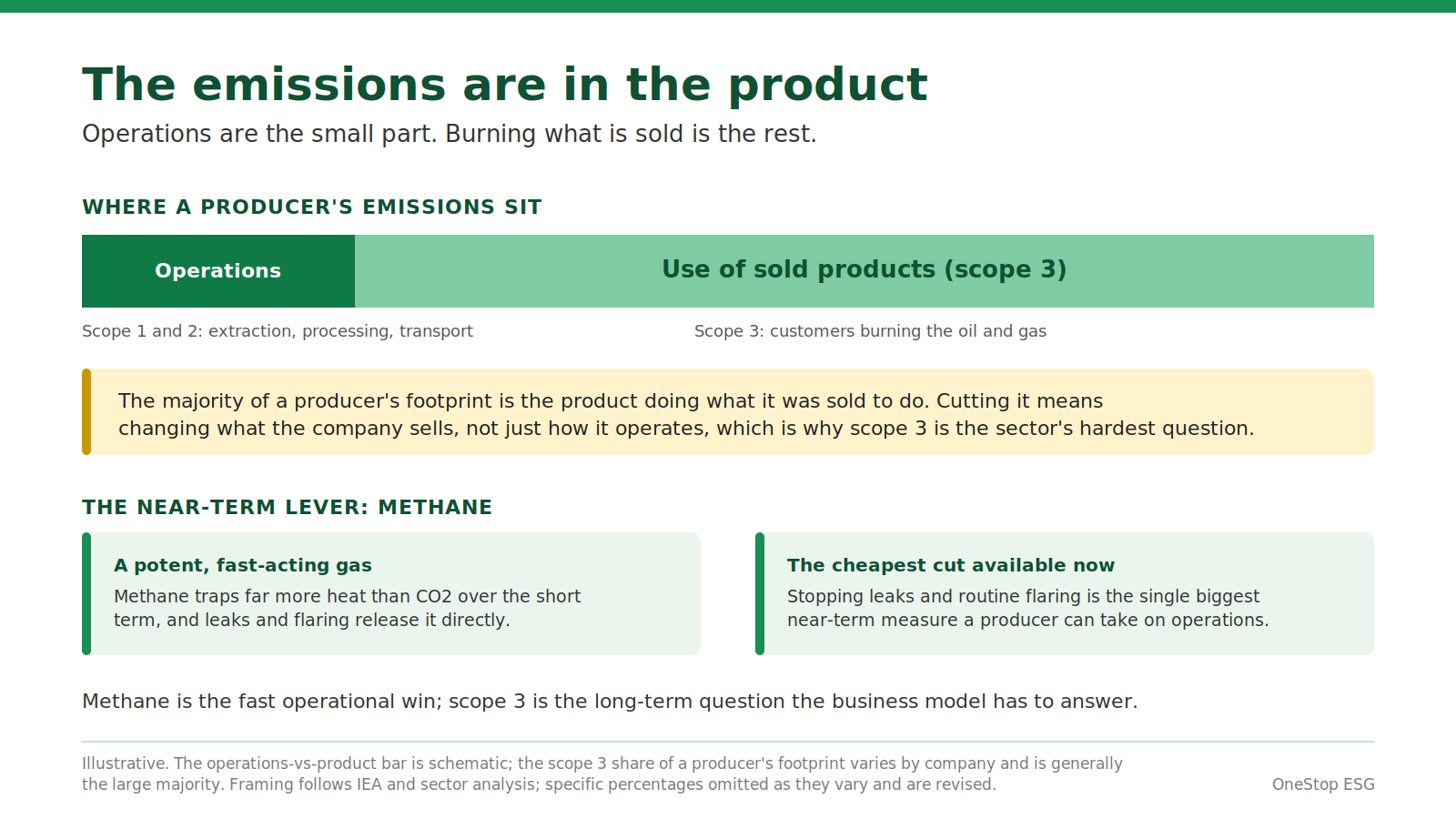
Figure: For oil and gas, the emissions are in the product, not just the operations.
Within operations, one issue stands out for its near-term impact: methane. It leaks from wells, pipelines, and processing, and is released by routine flaring and venting, and because it traps far more heat than carbon dioxide over the short term, cutting it delivers an outsized and fast climate benefit. The industry and energy agencies describe stopping methane leaks and routine flaring as the single most effective near-term measure a producer can take, and unlike the scope 3 problem it is cheap and available now.
The social and governance pillars carry the weight of large, hazardous, often remote operations. Worker and process safety, the rights and consent of communities and Indigenous peoples near extraction sites, spills and local environmental damage, revenue transparency in resource-rich countries, and the integrity of climate disclosures are all material. Governance has a specific edge: because the central issue is the future of the product, the credibility of a company's transition strategy, and whether its stated ambition matches its capital spending, is itself a governance question.
Regulation and frameworks that apply to oil and gas
Oil and gas faces a tightening mix of operational rules, disclosure standards, and the market pressure of the energy transition. What applies depends on where a producer operates and where it is listed, and the direction of travel is toward binding limits on the emissions that can be measured most precisely.
Methane is where regulation is moving fastest, because it is measurable and cheap to cut. The Oil & Gas Methane Partnership 2.0, convened under the UN Environment Programme, is the main measurement-based international reporting framework for methane, moving the sector from estimates toward measured data. Alongside it, the World Bank's Zero Routine Flaring initiative commits participating governments and companies to end routine flaring, and several jurisdictions have introduced methane rules and emissions caps on the sector. The IEA's work on methane abatement frames why this is the priority lever.
On disclosure, the general-purpose standards apply with sector-specific topics. The SASB oil and gas standards, maintained by the ISSB, set disclosure topics across the exploration, midstream, and refining sub-sectors, covering greenhouse gas emissions, air quality, water and hazardous materials, community and safety, and critically the management of the energy transition and of reserves that may not be produced. IFRS S2 carries climate reporting, including scope 3 where material, into a single standard, and larger producers report under jurisdictional regimes such as the EU Corporate Sustainability Reporting Directive. The common thread is that disclosure increasingly forces producers to address scope 3 and the transition, not only operations.
Where ESG risk concentrates
The risk that defines the sector is that its core product is the source of its largest emissions, which makes the central ESG challenge existential rather than operational. A producer can run the cleanest extraction in the industry and still carry a footprint dominated by the use of what it sells, so the scope 3 problem cannot be engineered away; it can only be addressed by changing the product mix over time. This is why transition strategy, not operational efficiency, is the issue on which producers are ultimately judged.
Transition risk is therefore the headline financial exposure. As policy, technology, and demand shift, reserves that were assets can become liabilities never produced economically, the stranded-asset risk, and capital markets increasingly price the credibility of a producer's transition plan into its cost of capital. A company whose climate ambition is not matched by where it invests carries a governance and a financial risk at once, and the lender-side view of that repricing is covered in the guide to ESG in banking.
Methane and operational risk sit alongside, and here the exposure is immediate as well as regulatory. Underreported methane is both a climate failure and, increasingly, a compliance breach as measurement improves and rules tighten, so a producer that cannot measure and cut its methane is exposed on the one lever regulators and investors watch most closely. Spills, safety failures, and local environmental damage carry direct legal and community consequences too.
Social and governance risk completes the picture. Operations in resource-rich but fragile regions raise revenue-transparency, corruption, and human-rights exposures, and a producer's relationship with nearby communities can determine whether projects proceed. The greenwashing exposure is acute here: a climate claim the capital spending does not support is scrutinized more heavily than almost anywhere else.
How producers implement ESG
Implementation in oil and gas separates into what can be done now and what the business has to decide over time. The near-term work is operational and measurable; the long-term work is strategic and about the product itself.
Methane and operational emissions come first because they are the fastest, cheapest cut. Producers move from estimated to measured methane data, fix leaks, end routine flaring, electrify operations, and deploy carbon capture where it fits, measuring against the methane framework and the flaring commitment. Carbon accounting and ESG data providers and methane-detection specialists, including satellite and drone monitoring, support the shift to measured data, and decarbonization and energy efficiency providers handle operational cuts.
Transition strategy is the long-term work, and it is where credibility is won or lost. Producers set and disclose how they will manage the scope 3 problem over time, whether through lower-carbon products, diversification, or managed decline, and align capital spending with whatever they claim, because the gap between ambition and investment is what investors and regulators test. Choosing ESG KPIs that satisfy the SASB oil and gas topics, the methane frameworks, and any jurisdictional regime at once avoids reporting the same data several ways.
Disclosure and governance tie it together. Producers report emissions across all three scopes where material, including the transition and reserve risk the SASB topics require, and an ESG audit of that data, methane measurement especially, is easier when measurement was built in from the start. Strengthening safety, community engagement, and revenue transparency runs continuously alongside. Producers without in-house capacity for scope 3 accounting, methane measurement, or transition-scenario analysis typically engage ESG advisory and strategy firms for the first cycle.

Explore Sustainable Construction Solutions on OneStop ESG Marketplace
Common mistakes
-
Reporting and setting targets only for operational emissions while leaving scope 3, the large majority of the footprint, unaddressed.
-
Estimating methane rather than measuring it, when measurement is now the standard and the gap is where regulatory and reputational risk sits.
-
Treating the transition as a communications exercise while capital spending stays aligned with the existing product mix.
-
Relying on carbon capture or offsets to justify unchanged output rather than as one part of a credible plan.
-
Underinvesting in safety, spill prevention, and community relations, where a single failure carries outsized legal and reputational cost.
Conclusion
ESG in oil and gas is the discipline of cutting what can be cut now while answering the harder question of what the business sells over time. A producer that measures and eliminates methane and routine flaring, reports honestly across all three scopes, and aligns its capital spending with the transition strategy it claims can defend its position to investors and regulators. A producer that polishes its operations while avoiding the scope 3 question, or lets its climate ambition outrun its investment, is exposed on exactly the issue the sector is ultimately judged on: the product itself.
Frequently asked questions
What does ESG mean in oil and gas?
It refers to how a producer manages the emissions of its operations and, more importantly, of the product customers burn, alongside the safety, community, revenue-transparency, and governance issues of large extractive operations. Because most of the footprint is in the product, the central ESG question is about the company's transition strategy, not only its operations.
Why are oil and gas scope 3 emissions so important?
Because the emissions from customers burning the oil and gas a company sells are the large majority of its total footprint, far exceeding the emissions from extraction and processing. A producer cannot address its climate impact meaningfully without confronting scope 3, which is why it is the sector's defining and hardest issue.
Why is methane such a priority in oil and gas?
Because methane traps far more heat than carbon dioxide over the short term, and it leaks from operations and is released by routine flaring and venting. Stopping those leaks is the cheapest and fastest near-term emissions cut available to a producer, which is why energy agencies describe it as the single most effective operational measure.
What is a stranded asset in oil and gas?
A reserve or facility that was expected to generate value but may never be produced economically because policy, technology, or demand has shifted. As the transition advances, the risk that reserves become stranded liabilities rather than assets is a central financial exposure for producers.
How is a producer's transition strategy judged?
Primarily by whether its capital spending matches its stated climate ambition. A company that claims a low-carbon direction while continuing to invest overwhelmingly in its existing product mix faces scrutiny from investors and regulators, because the gap between ambition and investment is treated as the real signal.


