
ESG in Mining: The Transition Paradox, the Tailings Risk, and How Operators Respond
Mining sits on both sides of the energy transition. The copper, lithium, nickel, cobalt, and rare earths that solar panels, wind turbines, grids, and electric vehicles depend on all come out of the ground, so demand for mined minerals is rising sharply. Yet mining carries some of the heaviest environmental, social, and safety liabilities of any sector, and supply cannot scale faster than those liabilities can be managed. ESG in mining is the work of resolving that tension at each site.
This guide covers what is material for a miner, how the sector's standards and disclosure frameworks fit together, where the risk concentrates, and what implementation looks like in practice.
ESG in mining at a glance
Dominant tension: the transition needs far more mined minerals, while the sector carries high environmental, social, and safety liabilities that gate how fast supply can grow
Signature risk: tailings storage, where a dam failure is catastrophic and irreversible, governed by its own global standard
Reporting and performance anchors: the Global Industry Standard on Tailings Management, the ICMM Mining Principles, and the SASB metals and mining topics under IFRS S2
Pressure source: investors and lenders, communities and regulators, and downstream customers who now ask where minerals come from
What ESG means in mining
Mining's ESG profile is unusually broad because a mine touches everything around it. The environmental issues are water use and quality, biodiversity and land disturbance, energy and emissions from extraction and processing, and the management of waste, above all tailings. The social issues are the safety of a large and often hazardous workforce, the rights and consent of communities and Indigenous peoples near a site, and the economic contribution a mine makes to the region. Governance covers revenue and contract transparency, anti-corruption, and board oversight of catastrophic risk.
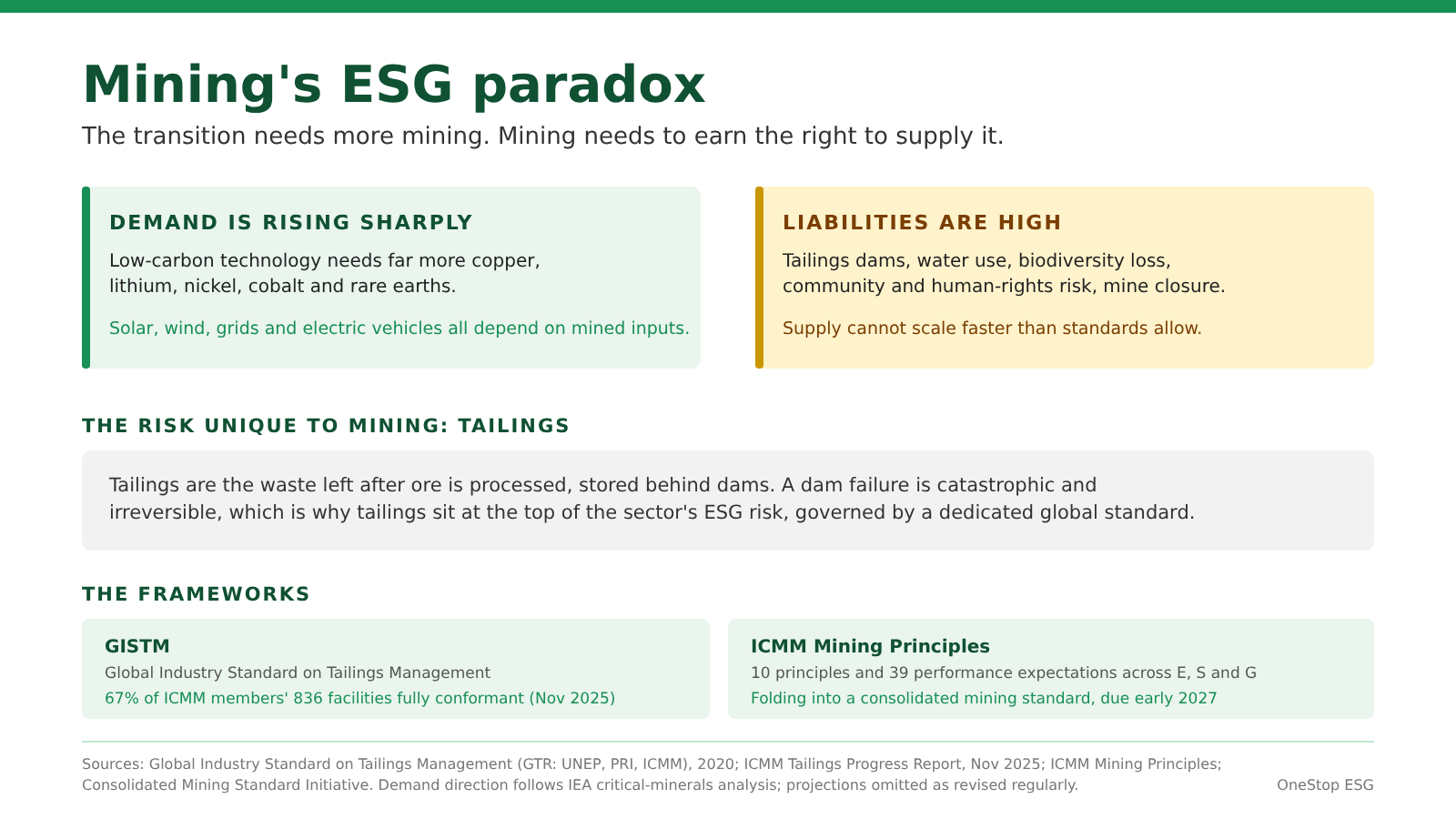
Figure: Mining's ESG paradox. Frameworks: Global Industry Standard on Tailings Management and the ICMM Mining Principles; conformance data from ICMM, November 2025.
One issue stands apart. Tailings are the waste left after ore is processed, and they are usually stored as a slurry behind dams. When a tailings dam fails, the result is catastrophic and irreversible, with loss of life, destroyed communities, and long-term contamination downstream. No other routine industrial activity carries a failure mode of that scale as a normal part of operations, which is why tailings sit at the top of mining's ESG risk and have their own dedicated global standard.
The sector also carries a paradox that shapes every other issue. The same transition driving demand for minerals is why the sector is under pressure to decarbonize and operate responsibly, so a miner cannot simply grow to meet demand. It has to grow while raising its environmental and social performance, because investors, customers, and regulators now treat how a mineral is produced as part of whether it can be sold.
Regulation and frameworks that apply to mining
Mining has no single global supervisor. Its ESG framework is a combination of industry performance standards, national mining and environmental law that varies by jurisdiction, and the general-purpose corporate disclosure regimes, so what applies depends on where a mine operates and where its owner is listed.
The standard that defines the sector's signature risk is the Global Industry Standard on Tailings Management, published in August 2020 by the Global Tailings Review, a body convened by the UN Environment Programme, the Principles for Responsible Investment, and the International Council on Mining and Metals. It sets requirements across six topic areas, from affected communities and the knowledge base through design and monitoring to governance, emergency response, and public disclosure, and it was a direct response to fatal dam failures. Investors have made adoption a condition of their support, which has given a voluntary standard real force. ICMM reported in November 2025 that 67% of its members' 836 tailings facilities were in full conformance, rising to over 80% of those with extreme or very high failure consequences, and an independent Global Tailings Management Institute launched in 2025 to audit and certify conformance.
Alongside it, the ICMM Mining Principles set out the broader performance expectations that member companies commit to as a condition of membership, covering ethical business, human rights, health and safety, environmental performance, biodiversity, and community engagement across a defined set of principles and performance expectations. ICMM and three partner schemes are folding their requirements into a single consolidated mining standard, now housed with Veramark Assurance, formerly the Copper Mark, with launch expected in early 2027. On the disclosure side, the SASB metals and mining standard, maintained by the ISSB, sets the industry's disclosure topics, and IFRS S2 carries climate reporting and those topics into a single standard. Larger miners also report under jurisdictional regimes such as the EU Corporate Sustainability Reporting Directive where they fall within scope. The IEA's work on critical minerals frames the demand side that sits behind all of this.
Where ESG risk concentrates
The risk that defines the sector is catastrophic and physical. A tailings failure is not a reputational matter that can be managed after the fact; it kills people and contaminates land and water irreversibly, and it is a direct liability for the owner and a safety concern for the communities downstream. Because the consequence is so severe, the governance expectation is now that catastrophic tailings risk is owned at board level rather than delegated to a site, and that failure risk is classified, monitored, and disclosed. This is the clearest case in any sector of an ESG issue that is a life-safety issue first and a disclosure issue second.
Social risk sits close behind, because a mine cannot operate without the acceptance of the people who live near it. The consent of communities and Indigenous peoples, resettlement, water shared with local users, and the economic benefit that stays in the region all determine whether a mine keeps its social license to operate. A project that loses that acceptance can be delayed or stopped regardless of its permits, which makes social performance a direct operational and financial risk.
Transition risk in mining runs in two directions at once. A miner is exposed to the carbon intensity of its own extraction and processing, and to the water and biodiversity limits of the places it operates, yet it also supplies the minerals the transition depends on. That dual position means the demand side can mask weak environmental performance, so a miner that is essential to the transition is not automatically a responsible operator. The financing that funds new projects increasingly tests both, and the lender-side view of that exposure is covered in the guide to ESG in banking.
Closure and legacy complete the picture. A mine has a finite life, and the cost of closing it, rehabilitating the land, and managing waste in perpetuity outlasts the revenue. An operation that does not provision for closure from the start leaves an environmental and financial exposure that transfers to the owner, the community, or the public.
How operators implement ESG
Implementation in mining runs from catastrophic-risk governance outward, because the consequences of getting tailings and safety wrong dwarf everything else, and then extends to measurement, community, and closure.
Tailings and safety governance comes first. Operators classify each tailings facility by consequence of failure, assign accountability for it at board level, monitor it continuously, and align to the global standard, supported where needed by independent review. This is treated as a life-safety system, not an ESG reporting line, and it is resourced accordingly.
Measurement across environmental and social metrics follows. Operators track water use and quality, energy and emissions across scopes, biodiversity and land disturbance, and workforce safety, choosing ESG KPIs that satisfy the SASB topics, the ICMM expectations, and any jurisdictional regime at once. Because extraction and processing are energy-intensive, decarbonization and energy efficiency providers and electrification of mine fleets are a growing part of the operational response, and carbon accounting and ESG data providers close the measurement gap.
Community engagement is run as a continuous process, not a one-off consultation, because social license has to be maintained across the life of the mine. Closure planning and financial provisioning are set at the start and revisited as the mine develops. Reporting then draws the whole picture together, and an ESG audit of the data and the tailings governance is easier when both have been documented from the beginning. Operators without in-house capacity for tailings assurance, scope 3 accounting, or closure modeling typically engage ESG advisory and strategy firms and specialist engineers.

Explore Sustainable Construction Solutions on OneStop ESG Marketplace
Common mistakes
-
Treating tailings as an engineering line item rather than a board-level catastrophic risk, so accountability sits too low in the organization.
-
Assuming that being essential to the energy transition excuses weak environmental or social performance.
-
Running community engagement as a one-off permitting exercise instead of a relationship maintained across the life of the mine.
-
Measuring operational emissions while under-provisioning for closure and long-term waste management.
-
Reporting against a single framework when tailings, membership standards, and jurisdictional law each ask for different things.
Conclusion
ESG in mining is the discipline of growing supply without outrunning the standards that make that supply acceptable. A miner that governs tailings and safety at board level, maintains the consent of the communities it depends on, measures and reduces its environmental footprint, and provisions for closure from the start can supply the transition and defend how it does so. A miner that leans on the demand for its minerals to excuse its performance is carrying a liability that the market, and the ground, will eventually surface.
Frequently asked questions
What does ESG mean in mining?
It refers to how a mining company manages the environmental impact of extraction and processing, the safety of its workforce and the rights and consent of nearby communities, and the governance of catastrophic risk and revenue transparency. The environmental and safety pillars carry unusual weight because the consequences of failure are physical and often irreversible.
Why are tailings such a significant ESG issue?
Because tailings, the waste left after ore is processed, are stored behind dams whose failure is catastrophic: a collapse can kill people and contaminate land and water irreversibly. No other routine part of mining carries a failure mode of that scale, which is why tailings have their own global standard.
What is the Global Industry Standard on Tailings Management?
A standard published in 2020 by a review convened by the UN Environment Programme, the Principles for Responsible Investment, and the International Council on Mining and Metals, setting requirements for how tailings facilities are designed, governed, monitored, and disclosed, with the goal of preventing catastrophic failures.
How does the energy transition change ESG in mining?
It raises demand for the minerals the transition needs, which increases pressure to expand supply, while at the same time raising the environmental and social performance that investors, customers, and regulators require. A miner has to grow and improve at once, because how a mineral is produced now affects whether it can be sold.
What is a social license to operate?
The ongoing acceptance of a mine by the communities and stakeholders affected by it, beyond the legal permits. A project that loses that acceptance can be delayed or halted regardless of its formal approvals, which makes community consent a direct operational risk.


