
ESG in Insurance: The Two Sides of the Balance Sheet, the Protection Gap, and How Insurers Respond

An insurer is the only financial actor that sits on both sides of climate risk at once. On the liability side, it underwrites physical risk, pricing and bearing the cost of floods, storms, wildfire, and drought. On the asset side, it invests the premiums it collects, making it one of the largest pools of long-term capital in the economy. ESG in insurance therefore bites twice, on what the insurer underwrites and on what it invests in, and the two cannot be managed in isolation.
This guide covers what is material for an insurer or reinsurer, how its sustainability principles and supervisory expectations fit together, where the risk concentrates, and how implementation works.
ESG in insurance at a glance
Dominant dynamic: the dual role. An insurer is both an underwriter of physical risk and a large investor, so ESG applies to both sides of the balance sheet
Signature issue: the protection gap, the share of disaster losses that are not insured, which is widening as climate losses rise
Reporting and supervisory anchors: the Principles for Sustainable Insurance, the IAIS supervisory guidance on climate risk, the SASB insurance topics under IFRS S2, and the CSRD
Pressure source: prudential supervisors treating climate as a solvency risk, alongside investors, customers, and the physical reality of rising losses
What ESG means in insurance
Insurance is unusual in that its core business is the pricing of risk, so climate change is not an ESG concern bolted onto operations; it is a direct input to whether the business works. On underwriting, the material issues are how physical risk is modeled and priced, what the insurer chooses to cover, and whether cover stays available and affordable. On investment, the issues are those any large asset owner faces, including the carbon exposure and transition risk of the portfolio the premiums are invested in. Governance ties the two together, because the board has to oversee a risk that appears on both sides of the balance sheet at once.
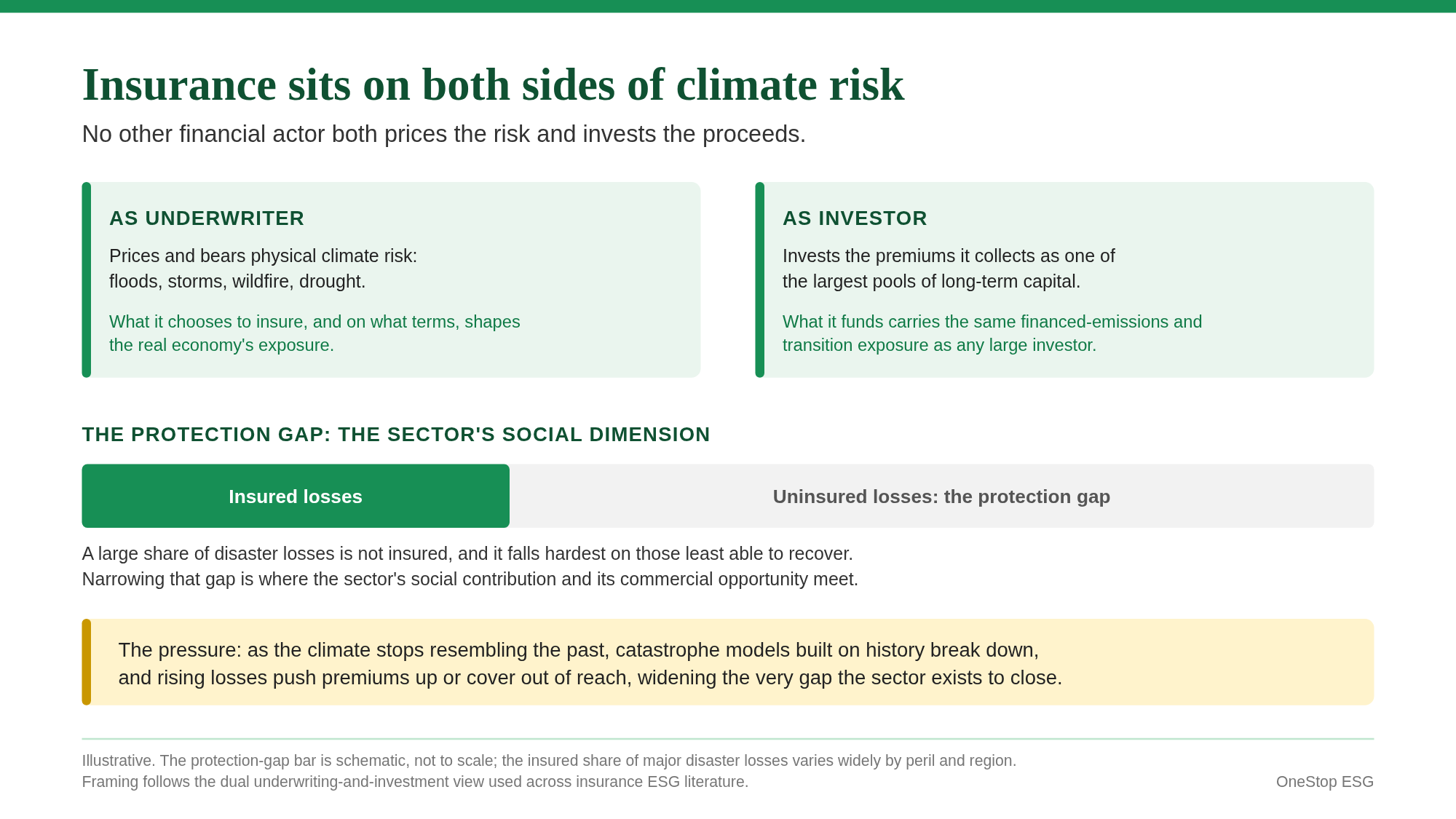
Figure: Insurance sits on both sides of climate risk, as underwriter and as investor.
The social pillar has a feature unique to insurance: the protection gap. This is the share of disaster losses that is not covered by insurance, and it matters because the losses that fall outside cover land hardest on the people and places least able to recover. The sector's social contribution is measured partly by how much of society's risk it absorbs, so narrowing the protection gap is both a social good and a commercial opportunity. As climate losses rise and push premiums up or make some risks uninsurable, the gap tends to widen, which is the opposite of what the sector exists to do.
The investment side carries the social and governance issues of any major institutional investor: the labor, human-rights, and governance practices of the companies the portfolio holds, and the integrity of the insurer's conduct toward policyholders, including fair treatment in claims and pricing. An insurer that underwrites responsibly but invests in the activities driving the losses it pays out works against itself.
Regulation and frameworks that apply to insurance
Insurance is a heavily supervised sector, and its ESG agenda is increasingly driven by prudential supervisors who treat climate as a risk to solvency, not only by voluntary principles. What applies depends on where an insurer is licensed and where it writes business.
The supervisory reference point is the guidance that insurance regulators apply to climate risk. In April 2025 the International Association of Insurance Supervisors published an application paper on the supervision of climate-related risks, replacing the 2021 version it produced with the UN-convened Sustainable Insurance Forum. It sets out how existing supervisory principles apply to climate across governance, risk management, investments, disclosure, scenario analysis, and market conduct. National supervisors have built on it, so a large insurer typically faces supervisory expectations to assess climate risk on both sides of its balance sheet, often through scenario analysis and stress testing. Because these come from prudential regulators, they carry the force that voluntary frameworks lack.
Alongside supervision sit the voluntary and disclosure frameworks. The UN Environment Programme's Principles for Sustainable Insurance set out how insurers can embed ESG into underwriting and investment, and are the sector's main voluntary commitment. On disclosure, the SASB insurance standard, maintained by the ISSB, sets the industry topics, covering physical risk exposure, the environmental and social characteristics of underwriting, and policyholder treatment, and IFRS S2 carries climate reporting into a single standard. Larger insurers in the EU also report under the Corporate Sustainability Reporting Directive.
Where ESG risk concentrates
The risk that defines the sector is that climate hits the business model directly, on both sides at once. On the liability side, the models insurers rely on to price catastrophe risk are built on historical data, and as the climate stops resembling the past those models become less reliable, so the sector's core competence, pricing risk, is undermined by the thing it most needs to price. Mispricing in either direction is dangerous: too low threatens solvency when losses arrive, too high pushes cover out of reach and widens the protection gap.
Underwriting risk is therefore existential rather than reputational. An insurer that underprices physical risk can face losses large enough to threaten its capital; one that withdraws from high-risk regions to protect itself contributes to the protection gap and the social harm that follows. This is a genuine tension with no clean answer, and it is the defining ESG dilemma of the sector: the responsible response to rising risk, charging more or covering less, can itself cause social harm.
Investment risk mirrors the exposure that any large asset owner carries. The insurer's portfolio holds transition and physical risk, and what it finances has the same financed-emissions character covered from the lender side in the guide to ESG in banking. An insurer that underwrites the transition while its investment portfolio funds high-carbon activity carries a contradiction that investors and supervisors increasingly scrutinize.
Conduct risk completes the picture. Fair treatment of policyholders in pricing and claims, the clarity of what is covered, and honesty about sustainability-linked products are governance exposures on top of the climate ones, policed by conduct regulators as directly as solvency is policed by prudential ones.
How insurers implement ESG
Implementation in insurance has to address both sides of the balance sheet in parallel, because managing one while ignoring the other leaves the business exposed. It runs from risk modeling through underwriting and investment policy to disclosure.
Risk modeling comes first, because everything else depends on pricing risk correctly. Insurers update catastrophe models to reflect a changing climate rather than only historical experience, run climate scenario analysis and stress tests as supervisors expect, and feed the results into pricing and reserving. Carbon accounting and ESG data providers and climate-risk analytics specialists support both the physical-risk modeling and the portfolio-emissions measurement.
Underwriting and investment policy are then set in tandem. On underwriting, insurers decide which activities to cover, on what terms, and how to support climate adaptation and resilience that reduces future losses, including products that reward risk reduction. On investment, they apply the same ESG discipline as any asset owner, integrating transition and physical risk into the portfolio. Choosing ESG KPIs that satisfy the SASB insurance topics, the supervisory expectations, and the CSRD at once avoids reporting the same data several ways, and decarbonization and energy efficiency providers support the insurer's own operational footprint, which is small by comparison but still disclosed.
Disclosure and resilience complete the cycle. Insurers report climate risk on both sides of the balance sheet, and an ESG audit of that data is easier when modeling and measurement were built in from the start. Narrowing the protection gap, through product design, public-private schemes, and risk-reduction incentives, is where the sector's social contribution is made concrete. Insurers without in-house capacity for climate scenario analysis, portfolio-emissions accounting, or disclosure typically engage ESG advisory and strategy firms for the first cycle.

Explore Sustainable Construction Solutions on OneStop ESG Marketplace
Common mistakes
-
Managing underwriting climate risk and investment climate risk as separate problems, when they sit on one balance sheet.
-
Relying on catastrophe models built only on historical data in a climate that no longer behaves like the past.
-
Underwriting the transition while the investment portfolio funds the activities driving the losses being paid out.
-
Withdrawing from high-risk regions to protect capital without regard for the protection gap that withdrawal widens.
-
Treating fair treatment of policyholders in pricing and claims as a conduct afterthought rather than a core governance issue.
Conclusion
ESG in insurance is the discipline of managing climate risk on both sides of the balance sheet at the same time. An insurer that prices physical risk honestly as the climate changes, aligns what it invests in with what it underwrites, treats policyholders fairly, and works to narrow rather than widen the protection gap can meet its supervisors and defend its role. An insurer that manages one side while ignoring the other, or lets its investments undermine its underwriting, is carrying a contradiction that rising losses will eventually expose.
Frequently asked questions
What does ESG mean in insurance?
It refers to how an insurer manages environmental, social, and governance factors in both of its roles: as an underwriter that prices and bears physical risk, and as an investor of the premiums it collects. Because the two sides sit on one balance sheet, ESG in insurance has to be managed on both at once.
What is the protection gap?
The share of disaster and catastrophe losses that is not covered by insurance. It matters because uninsured losses fall hardest on those least able to recover, and it tends to widen as climate losses rise and push premiums up or make some risks uninsurable, which is the opposite of the sector's purpose.
Why does climate change threaten insurers specifically?
Because insurers price risk using models built on historical data, and as the climate stops resembling the past those models become less reliable, undermining the sector's core competence. Rising losses also threaten capital if risk is underpriced, while overpricing pushes cover out of reach.
How does an insurer's investment side relate to its underwriting?
An insurer invests the premiums it collects, making it a large asset owner with the same transition and physical risk as any investor. If its portfolio funds the high-carbon activities driving the losses it underwrites, the two sides work against each other, which is why they are managed together.
What are the Principles for Sustainable Insurance?
A UN Environment Programme framework setting out how insurers can embed environmental, social, and governance factors into their underwriting and investment decisions. They are the sector's main voluntary ESG commitment, sitting alongside the supervisory expectations that prudential regulators now apply.


