
ESG in Healthcare: Why Care Delivery Carries the Footprint, What Is Material, and How Providers Respond

Health care is unusual among sectors because the service it provides is also the source of most of its emissions. The energy to keep a hospital running, the medicines and devices it consumes, the gases used in surgery, and the freight that supplies it all deliver care and emit at the same time. ESG in health care is therefore a question about how care is delivered, not something added on top of it.
This guide covers what is material for a hospital, health system, or supplier, how the frameworks and net-zero commitments fit together, where the risks sit, and how implementation works.
ESG in health care at a glance
Dominant pillar: environmental through the carbon of care delivery and the supply chain, with a strong social pillar covering patient safety, access, equity, and workforce
Reporting anchors: the SASB health care industry standards under IFRS S2, the CSRD for larger EU providers and suppliers, and national health-system net-zero frameworks such as the NHS
Regulatory anchor: health-system net-zero mandates and procurement rules rather than a single financial supervisor; clinical and patient-safety regulation sits alongside
Main pressure source: government and health-system decarbonization targets and green procurement, followed by investor and insurer expectations on listed providers and suppliers
What ESG means in health care
Health care's environmental weight is larger than most people assume. Health Care's Climate Footprint, published by Health Care Without Harm with Arup in September 2019, put the sector's emissions at 4.4% of global net greenhouse gas emissions, which would make it the fifth-largest emitter if it were a country. The same report found that 71% of that footprint sits in scope 3, the supply chain of medicines, medical devices, food, and freight, with 17% in direct scope 1 and 12% in purchased energy.
So a provider's own buildings and vehicles are a minority of its footprint; the medicines and devices it procures matter more. Two emission sources are distinctive to the sector: anaesthetic gases used in surgery and the propellants in metered-dose inhalers, which the same report put at around 1% of all global emissions between them. Desflurane, a volatile anaesthetic, has a global warming potential thousands of times that of carbon dioxide, which is why several health systems have moved to decommission it.
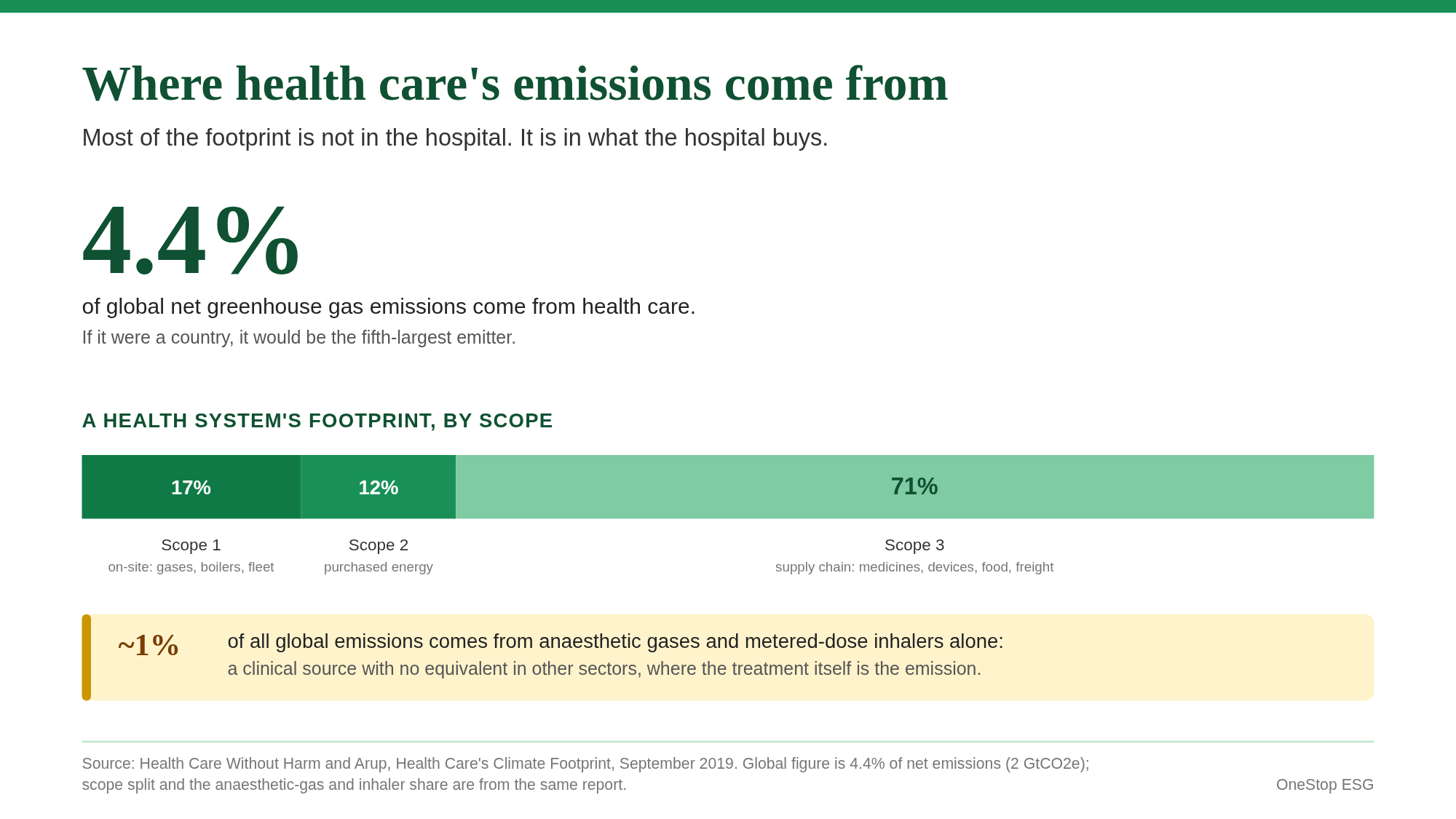
Figure: Where health care's emissions come from. Source: Health Care Without Harm and Arup, Health Care's Climate Footprint, September 2019.
The social pillar is heavier here than in most sectors. Patient safety and quality of care, equitable access, the health and safety of a large clinical workforce, data privacy for patient records, and affordability of treatment are all material and scrutinized directly. A provider that decarbonizes while cutting access or safety has not improved its ESG position.
Governance covers board and clinical oversight of safety and sustainability, the integrity of outcomes and billing data, supply-chain ethics, and the controls that prevent conflicts of interest in procurement and prescribing. For listed providers and device and pharmaceutical companies, it also covers how product sustainability claims are substantiated.
Regulation and frameworks that apply to health care
Health care has no single financial supervisor driving its ESG agenda. Pressure comes from health-system mandates, procurement rules, and the corporate disclosure regimes that cover other large organizations, so what applies depends on whether the entity is a public system, a private provider, or a listed supplier.
National health systems increasingly set their own net-zero requirements. In England the NHS net-zero program commits the health service to net zero for the emissions it controls directly and, on a longer timetable, for its wider supply chain, and it has begun to require suppliers to publish carbon-reduction plans as a condition of winning contracts. Because the NHS is one of the largest single purchasers of health goods in the world, those procurement rules reach suppliers far beyond England. A specific example is the national move to decommission the anaesthetic gas desflurane, which turns a clinical practice change into an emissions reduction.
On the disclosure and benchmarking side, the frameworks are the general-purpose ones applied to the sector. The SASB health care standards, maintained by the ISSB, set industry-specific disclosure topics across the health care sub-sectors, covering issues such as energy and water use, waste including hazardous and medical waste, product safety, access and affordability, and data security. IFRS S2 carries climate reporting and the SASB topics into a single standard. Larger EU providers, and the pharmaceutical and device companies that supply them, report under the Corporate Sustainability Reporting Directive as companies in their own right.
Where ESG risk shows up for a provider
The risk that is specific to health care is that the fix and the mission can pull against each other. Reducing emissions cannot come at the expense of patient safety, access, or clinical outcomes, which rules out the blunt levers available in other sectors. A manufacturer can cut output to cut emissions; a hospital cannot cut care. This constraint is the defining feature of ESG risk in the sector, and it is why credible programs start from care pathways, not the estate.
Supply-chain risk dominates the environmental side because most of the footprint sits there. A provider measuring only its own buildings manages a small fraction of its exposure and cannot answer procurement rules that now ask for supplier carbon data. The data problem is acute: emissions for a single medicine or device depend on manufacturing and logistics data the provider does not hold, so reported figures often rest on spend-based estimates until supplier data improves. Carbon accounting and ESG data providers that specialize in health-sector supply chains are the usual route to closing that gap.
Social risk is reputational and regulatory at once. A breach of patient records, a lapse in clinical safety, or a service inaccessible to part of the population is both an ESG failure and a direct legal exposure, governed by health law as well as ESG expectations. A purely environmental program would miss it.
Transition risk reaches listed suppliers through their customers. As health systems tighten procurement, device and pharmaceutical companies that cannot evidence a credible decarbonization path face lost contracts, which is a commercial risk transmitted from the buyer side. The financing dimension of that pressure is covered from the lender's perspective in the guide to ESG in banking.
How providers and suppliers implement ESG
The sequence runs from measurement to clinical change to reporting, and it differs from other sectors in that the biggest levers sit inside clinical practice rather than facilities.
Measurement comes first, across all three scopes, because a footprint dominated by scope 3 cannot be managed from utility bills alone. Providers combine their own energy and gas data with spend-based and, where available, supplier-specific data for procured goods. Choosing ESG KPIs that satisfy the SASB health care topics, the CSRD, and any national health-system framework at once avoids reporting the same data several ways.
Clinical and operational change is where the largest reductions are found: switching away from high-impact anaesthetic gases and inhaler propellants, preventing avoidable procedures, and reducing single-use consumables where it is safe to do so. These changes are led by clinicians, not facilities teams, which is why clinical engagement is part of the ESG program. Energy, waste, and estate measures, supported by decarbonization and energy efficiency providers, sit alongside.
Procurement is the lever for the scope 3 majority. Providers add carbon-reduction requirements to tenders, weight supplier sustainability in award decisions, and work with suppliers on product redesign. Reporting then draws on the same dataset, and an ESG audit of the data trail is easier when measurement has been documented from the start. Providers without in-house capacity for materiality assessment, scope 3 accounting, or transition planning typically engage ESG advisory and strategy firms for the first cycle.

Explore Sustainable Construction Solutions on OneStop ESG Marketplace
Common mistakes
-
Measuring the hospital estate and stopping there, when most of the footprint sits in procured medicines and devices.
-
Treating decarbonization as a facilities project rather than a clinical one, which leaves the largest levers untouched.
-
Pursuing emissions cuts in ways that quietly reduce access, safety, or outcomes, so an environmental gain becomes a social loss.
-
Reporting supplier emissions from spend-based estimates without disclosing that the data is estimated, then presenting it as measured.
-
Running the environmental and the patient-safety programs separately, so trade-offs between them are never surfaced.
Conclusion
ESG in health care is a question of how care is delivered, measured across the whole system that delivers it. A provider that accounts for its supply chain as well as its estate, that leads decarbonization from clinical practice, and that holds emissions reductions to the test of patient safety and access can defend its program to regulators, purchasers, and the public. A provider that manages only its buildings is reporting on the smallest part of what it is responsible for.
Frequently asked questions
What does ESG mean in health care?
It refers to how hospitals, health systems, and their suppliers manage the environmental impact of care delivery, the social outcomes for patients, communities, and staff, and the governance behind safety, data, and procurement. The social pillar carries unusual weight because patient safety and access are material in their own right.
Why is health care's carbon footprint so large?
Because delivering care is energy- and material-intensive. Most of the footprint, around seven-tenths, sits in the supply chain of medicines, devices, food, and freight rather than in hospital buildings, and some clinical practices such as anaesthetic gases carry a very high warming impact per unit.
Which emissions are unique to health care?
Anaesthetic gases used in surgery and the propellants in metered-dose inhalers. Together they account for a small but globally significant share of emissions, and some agents such as desflurane have a global warming potential thousands of times that of carbon dioxide.
Do ESG reporting rules apply to hospitals?
It depends on the entity and jurisdiction. Larger EU providers and their suppliers report under the CSRD; many health systems set their own net-zero and procurement requirements; listed providers and medical-device and pharmaceutical companies report under IFRS S2 and the SASB topics. Each entity should confirm what applies to it.
How can a provider cut emissions without harming patients?
By starting from clinical practice rather than cost-cutting: switching to lower-impact anaesthetic agents and inhalers where clinically appropriate, preventing avoidable procedures, and reducing waste where it is safe to do so, with every change tested against patient safety and access before it is adopted.


