
ESG in Construction: Why the Carbon Is Locked In, What the Rules Require, and How Builders Respond
Most of the carbon in a building is spent before anyone moves in. The emissions from making and installing its concrete, steel, glass, and other materials, its embodied carbon, are locked in the moment the structure goes up, and unlike the energy a building uses in operation, they cannot be reduced afterward. ESG in construction is therefore front-loaded: the decisions that matter most are made at the design stage, because that is the only point at which embodied carbon can still be changed.
This guide covers what is material for a contractor, developer, or materials supplier, how the rules on embodied carbon and the heavy social obligations fit together, where the risk concentrates, and how implementation works.
ESG in construction at a glance
Dominant dynamic: embodied carbon is set at design and fixed once built, so the decisive ESG choices are upfront and irreversible
Signature issues: the carbon of materials, above all cement and steel; worker health and safety; and labor and human rights in materials supply chains
Reporting and regulatory anchors: the EU EPBD life-cycle carbon requirement for new buildings, the CSRD, the SASB engineering and construction topics under IFRS S2, and World GBC embodied-carbon targets
Pressure source: building regulation, developers and investors specifying low-carbon materials, and clients who now ask for whole-life carbon
What ESG means in construction
Construction's material ESG issues split cleanly into the carbon of what is built and the safety of how it is built. On the environmental side, the central issue is embodied carbon. The World Green Building Council puts the built environment at around 39% of global energy-related emissions, of which roughly 28% is operational, the energy buildings use, and about 11% is embodied, the emissions from materials and construction. As buildings become more efficient in use, the embodied share rises, because it is the part that does not fall when the grid cleans up. Cement and steel dominate those material emissions, which is why they are the focus of almost every reduction strategy.
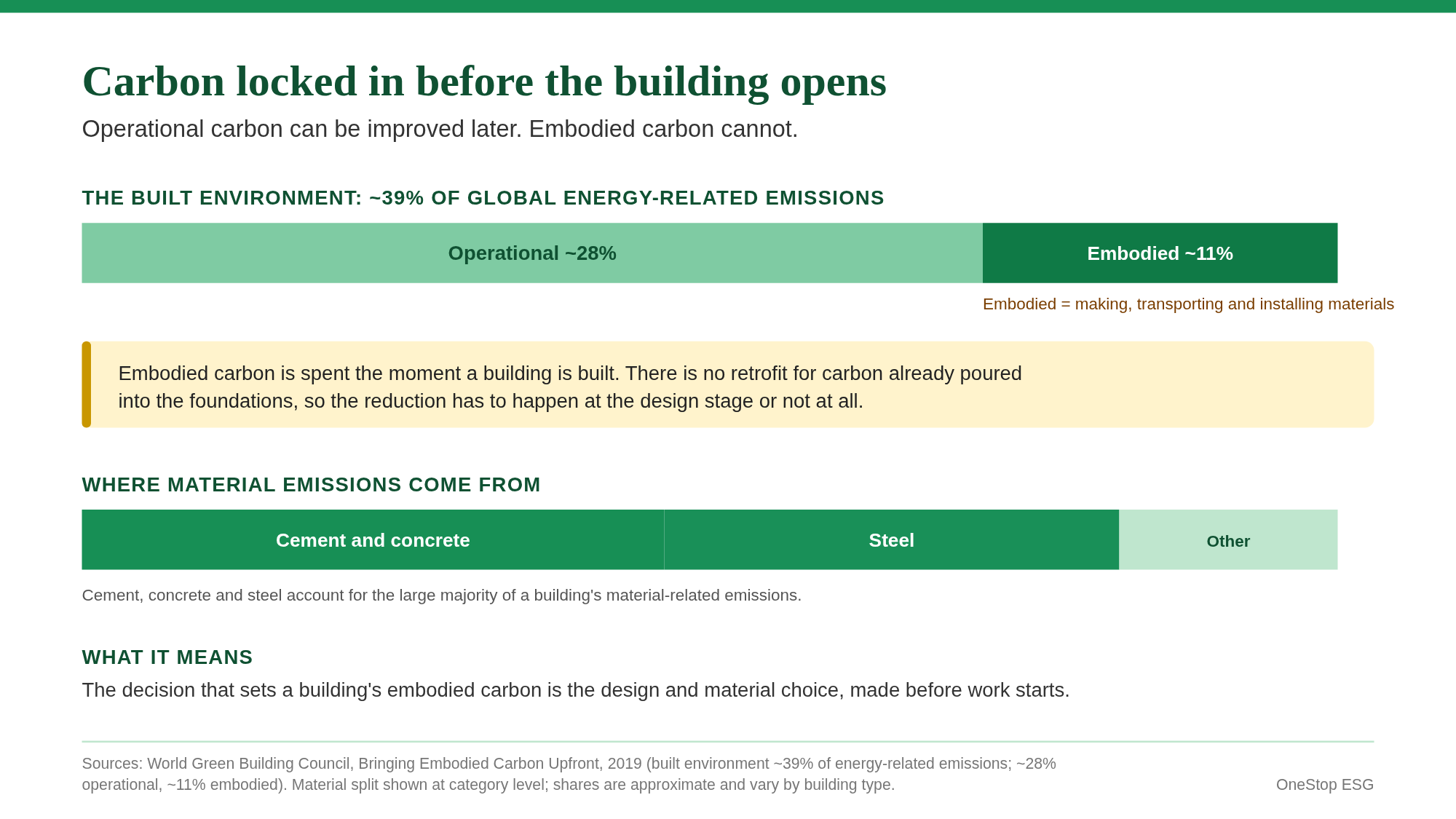
Figure: Construction carbon is locked in before the building opens. Source: World Green Building Council, Bringing Embodied Carbon Upfront, 2019.
The social pillar is unusually heavy because the work is dangerous. Construction is consistently among the most hazardous industries for worker injury and death, so occupational health and safety is a first-order ESG issue, not a compliance footnote. Alongside it sits labor risk in the materials supply chain, where forced labor can occur in the production of bricks, stone, and other inputs, and the treatment of a large, often migrant and subcontracted workforce on site. A project that lowers its carbon while injuring its workers has not improved its ESG position.
Governance covers the integrity of reported carbon data, the ethics of procurement and subcontracting, and the controls that stop a low-carbon claim from outrunning what the materials deliver. Because construction runs through long chains of subcontractors and suppliers, the governance challenge is largely oversight across parties the main contractor does not directly employ.
Regulation and frameworks that apply to construction
Construction's ESG rules are moving from voluntary targets toward building regulation, and the change is centered on carbon that was previously ignored: the carbon of the materials. What applies depends on where a project is built and where its contractor or developer reports.
The clearest regulatory shift is the move to count embodied carbon in law. In the European Union, the recast Energy Performance of Buildings Directive requires the whole-life-cycle global warming potential of new large buildings to be calculated and disclosed, which for the first time puts embodied carbon on the same regulatory footing as operational energy. Several cities and national governments have gone further with embodied-carbon limits on new construction. These rules matter because they reach the design stage, which is the only point at which embodied carbon can still be reduced.
Alongside regulation sit voluntary targets and disclosure standards. The World Green Building Council's embodied-carbon vision set sector targets for cutting upfront carbon, endorsed across the construction value chain, and has shaped how the industry talks about the problem. On disclosure, the SASB engineering and construction standard, maintained by the ISSB, sets the industry topics, covering environmental impacts of project development, workforce health and safety, and business ethics, and IFRS S2 carries climate reporting into a single standard. Larger contractors, developers, and materials producers also report under the Corporate Sustainability Reporting Directive where they fall within scope.
Where ESG risk concentrates
The risk that defines the sector is that the carbon decision is irreversible. Once a building is poured and framed, its embodied carbon is fixed for the life of the structure, so a builder that does not address it at design has missed the only window. This makes embodied carbon unlike almost every other ESG issue, where performance can be improved over time; here the reduction is available at one moment and then gone. A builder that treats carbon as something to manage during operation has misunderstood where its own emissions sit.
Safety risk carries the gravest human consequences. A site accident can kill or maim, and the industry's injury and fatality rates mean that safety failures are frequent as well as severe. Beyond the human cost, a poor safety record is a direct financial and reputational exposure, a cause of project delay and litigation, and increasingly a factor in whether a contractor is awarded work at all. Safety is the social issue on which a construction firm is judged first.
Supply-chain and materials risk sits across both pillars. The carbon of cement and steel is a supplier problem the builder specifies but does not produce, so cutting it depends on procurement and on the decarbonization of heavy industry upstream, covered from the extraction side in the guide to ESG in mining. Labor risk in materials production is a social exposure in the same chain. A builder that specifies without regard to how materials are made carries both the carbon and the labor risk of its choices.
Claim and data risk completes the picture. Whole-life carbon assessment is still maturing, baselines are inconsistent, and a low-carbon claim about a building that the assessment cannot support is a greenwashing exposure. The financing that funds projects increasingly tests the carbon numbers, and the lender-side view of that is covered in the guide to ESG in banking.
How builders implement ESG
Implementation in construction is front-loaded by necessity: the carbon work happens at design, and the safety work runs continuously through the build. It moves from design decisions to site management to reporting.
Design is where embodied carbon is won or lost. Builders and designers run whole-life carbon assessments early, choose lower-carbon materials and structural systems, reuse existing structures where possible, and reduce the sheer quantity of material a design requires, because the cheapest tonne of carbon is the one never specified. Carbon accounting and ESG data providers that handle material-level and whole-life data are the usual route, and decarbonization and energy efficiency providers support lower-carbon material and process choices.
Safety management runs through the whole project as a continuous system, not a checklist, because the risk is present every day work is underway. It is resourced as a life-safety function, and a firm's safety performance is tracked as closely as its cost and schedule. Choosing ESG KPIs that satisfy the SASB construction topics, the embodied-carbon requirements, and any jurisdictional regime at once avoids measuring the same things several ways.
Procurement and reporting then tie the project to its supply chain. Builders write carbon and labor requirements into material and subcontractor contracts, verify them, and aggregate the data into project and company disclosures. An ESG audit of the carbon and safety data is easier when both were built in from design and site mobilization. Firms without in-house capacity for whole-life carbon assessment or supply-chain due diligence typically engage ESG advisory and strategy firms and specialist assessors.
Common mistakes
-
Focusing on operational energy and ignoring embodied carbon, which is the part a builder most directly controls and cannot change later.
-
Leaving the whole-life carbon assessment until after the design is fixed, when the decisions that set embodied carbon have already been made.
-
Treating safety as a compliance requirement rather than a continuously managed life-safety system.
-
Specifying materials on cost and schedule alone, carrying their carbon and labor risk by default.
-
Making low-carbon claims about a building that the whole-life assessment cannot substantiate.
Conclusion
ESG in construction is a design-stage discipline backed by relentless site safety. A builder that measures and reduces embodied carbon before the structure is fixed, runs safety as a life-safety system rather than a checklist, and specifies materials with their carbon and labor risk in view can meet the rules now reaching the sector and defend its claims. A builder that waits until operation to think about carbon, or treats safety as paperwork, is exposed on exactly the issues the sector is judged on.
Frequently asked questions
What does ESG mean in construction?
It refers to how contractors, developers, and materials suppliers manage the carbon of what they build, above all the embodied carbon of materials, the safety of the people who build it, and the governance of their supply chains and claims. The environmental and safety pillars both carry unusual weight because the carbon decision is irreversible and the work is hazardous.
What is embodied carbon?
The emissions from making, transporting, and installing a building's materials, as opposed to the operational carbon from the energy it uses once occupied. Embodied carbon is fixed when the building is built and cannot be reduced afterward, which is why it has to be addressed at the design stage.
Why does embodied carbon matter more as buildings get efficient?
Because as operational energy use falls, through better insulation, efficient systems, and cleaner grids, the embodied carbon that was spent up front becomes a larger share of a building's whole-life emissions. It is the part that does not improve over time, so it rises in relative importance.
How is embodied carbon being regulated?
Increasingly through building law. The EU directive requires the whole-life carbon of new large buildings to be calculated and disclosed, and several cities and governments have set embodied-carbon limits on new construction, putting material emissions on a similar footing to operational energy.
Why is safety such a central ESG issue in construction?
Because construction is consistently among the most dangerous industries for injury and death, so occupational health and safety is a first-order material issue. A strong safety record is also increasingly a condition of winning work, which ties social performance directly to commercial outcomes.


