
An in-depth look at why ESG confidence is eroding in wealth management and what transparency, data rigor, and fiduciary discipline are required to rebuild investor trust.
For much of the past decade, ESG investing sat comfortably within the growth narrative of global wealth management. ESG strategies were positioned as both values-aligned and forward-looking, particularly attractive to younger high-net-worth investors and families thinking about intergenerational wealth transfer. Over the past two years, however, that confidence has visibly weakened.
This cooling is not a rejection of sustainability itself. It reflects growing unease about uncertainty, credibility, and trust at a time when markets have become more volatile and narratives around ESG have grown increasingly contested.
Wealth managers today are operating in a more demanding environment. Clients are no longer satisfied with broad commitments or high-level sustainability labels. They are asking harder questions about data quality, real-world impact, regulatory credibility, and portfolio resilience. The challenge for the industry is no longer whether ESG matters, but whether it can be delivered with the rigor, transparency, and trust that sophisticated investors now expect.
Market Reality
The slowdown in ESG allocations among high-net-worth and ultra-high-net-worth individuals has coincided with a period of heightened economic and geopolitical uncertainty. Rising interest rates, inflationary pressures, and geopolitical shocks have pushed many investors back toward wealth preservation as a primary objective.
The numbers reflect this shift clearly. In 2022, only 41 percent of HNWIs still considered ESG a priority, down from 52 percent the previous year. In Europe, the decline was steeper, with just 31 percent of wealthy investors viewing ESG as urgent. Through 2024, US sustainable funds recorded net outflows for nine consecutive quarters, totaling $19.6 billion.
Capgemini’s global wealth research captures the underlying dynamic. Sustainability remains part of many investors’ long-term worldview, but short-term priorities have changed. Capital preservation has moved ahead of impact considerations, particularly in regions experiencing economic stress.
The distribution of priorities explains much of the current hesitation. A clear majority of HNWIs rank protecting wealth as a critical objective, while fewer than half consider ESG impact a top priority. The gap is most pronounced in Europe, where ESG urgency has fallen sharply compared to previous years.
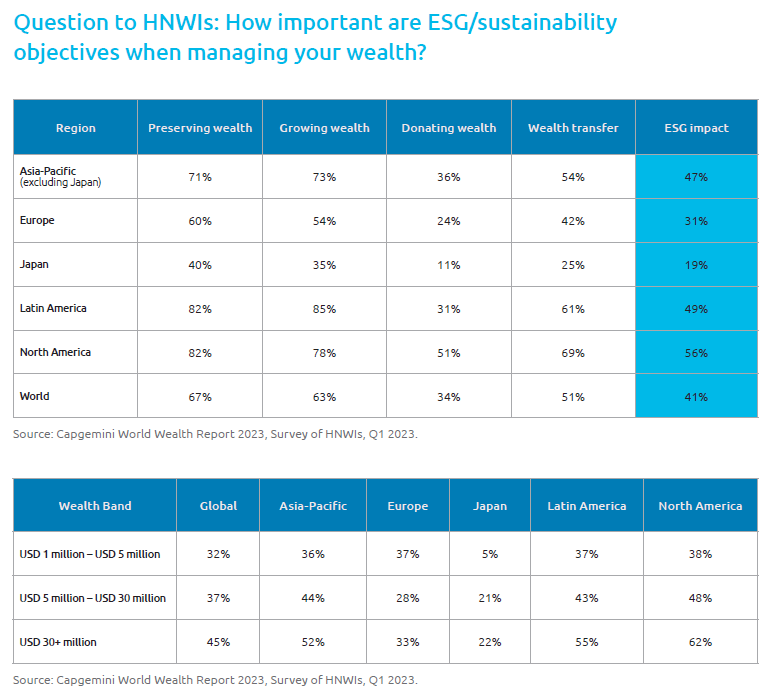
For affluent investors, this shift is not ideological. It is pragmatic. When capital markets become unstable, discretionary allocations often give way to defensive positioning. ESG strategies, particularly those perceived as long-term or impact-oriented, are more likely to be scrutinized or postponed.
Elias Ghanem, Global Head of the Capgemini Research Institute for Financial Services, shared, once individuals feel secure about their financial base, they are more willing to prioritise longer-term goals, including sustainability. In today’s uncertain environment, many investors are deliberately reinforcing that base before re-engaging.
💡In periods of market stress, ESG is not abandoned. It is deferred. Investors are delaying sustainability decisions until confidence in capital preservation improves.
Performance Anxiety and the ESG Narrative Reset
Performance concerns have re-emerged as a central theme. Several sustainability-focused funds underperformed broader benchmarks during recent market cycles, particularly as traditional energy and defence sectors rebounded. Today, 92 percent of HNWIs prioritise near-term financial returns over sustainability commitments, and two-thirds plan to reduce ESG exposure.
This is not an ideological reversal. Sophisticated investors understand market cycles. What they resist are claims of performance superiority that do not hold up under scrutiny.
As volatility increased, many clients reassessed how ESG strategies were being positioned. Was ESG framed as long-term risk mitigation, values alignment, or a substitute for performance? In many cases, the answer was unclear. The issue was not ESG itself, but misalignment between marketing narratives and portfolio behaviour.
ESG investing is now being evaluated with the same discipline as any other strategy. Clients want clarity on trade-offs, timelines, and downside risk. They expect advisors to explain why ESG portfolios behave differently in certain environments, not to gloss over uncomfortable realities.
This shift has implications for how wealth managers position ESG. It is not a promise of outperformance, but a framework for understanding long-term environmental, social, and governance risks. Framed with discipline, ESG can withstand periods of underperformance without losing credibility.
Trust Is Now the Binding Constraint in ESG Investing
If performance volatility explains part of the slowdown, trust explains the rest.
Confidence in ESG data has eroded faster than interest in ESG outcomes. Investors are increasingly aware that ESG ratings providers often score the same company very differently, with correlations of around 60 percent, compared to 99 percent for traditional credit ratings. Disclosure standards vary widely, and not all ESG-labelled products deliver the outcomes implied.
This scepticism is rational. 85% of investors now identify greenwashing as a serious concern. Awareness remains a challenge, but credibility has become the bigger one.
At the same time, Capgemini’s research highlights a critical distinction. While allocations have softened, demand for ESG information has not. Sixty-three percent of HNWIs say they will request ESG scores before investing, a behaviour that has remained consistent even as capital commitments have slowed.
As institutional investors, we have a duty to act in the best long-term interests of our beneficiaries. In this fiduciary role, we believe that environmental, social, and corporate governance (ESG) issues can affect the performance of investment portfolios and should therefore be considered alongside more traditional financial factors.
— Principles for Responsible Investment
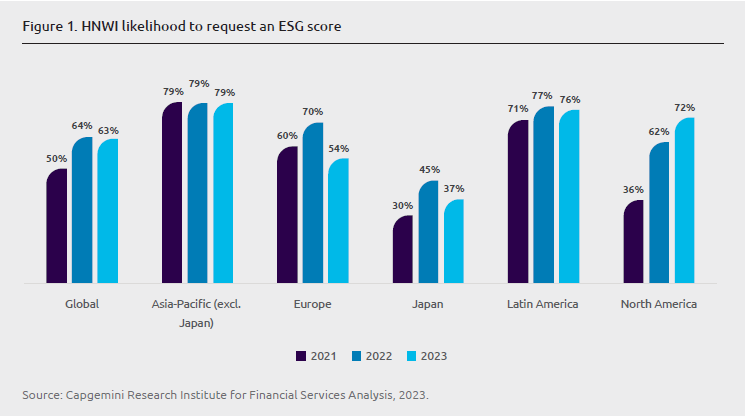
This divergence matters. Investors may hesitate to deploy capital, but they are not disengaging intellectually. They are asking for better information precisely because they want to trust it.
💡The appetite for ESG data is rising even as allocations slow. This signals a trust deficit, not fading interest.
Product Distribution to Interpretation
Historically, wealth managers acted primarily as product distributors. ESG offerings were positioned as thematic allocations or values-based add-ons.
That model is no longer sufficient.
Today’s clients expect wealth managers to act as interpreters of sustainability data. Advisors are increasingly expected to explain why ESG scores differ, what methodologies underpin them, and how sustainability risks translate into financial exposure.
Only 31 percent of wealth management firms can clearly demonstrate what their ESG-linked investments hold and how those assets perform against sustainability metrics. While 61 percent claim ESG integration across portfolios, the gap between stated practice and traceable execution remains significant. Forty percent of relationship managers acknowledge they need better information to discuss ESG impact credibly.
Several senior wealth executives have publicly acknowledged this shift, noting that ESG conversations have become less about selling products and more about managing expectations, explaining uncertainty, and helping clients understand what sustainability data can nand cannot reliably show today.
Rebuilding trust requires transparency about limitations as much as confidence in capabilities.
Data Quality and Regulation
As ESG investing matures, data quality has become the binding constraint. Investors increasingly demand traceable metrics, standardised disclosures, and independent verification. Sixty-four percent of institutional investors now require third-party assurance of sustainability reports before committing capital.
Regulatory divergence adds complexity. Europe’s mandatory disclosures are improving comparability, while political resistance in the US and uneven adoption across parts of Asia create uncertainty for global portfolios.
Technology will help, but it is not sufficient on its own. ESG credibility will not be rebuilt through dashboards alone. It will be rebuilt through disciplined interpretation, governance, and restraint in claims.
The Long View Still Favors ESG - If Done Properly
Despite near-term hesitation, the long-term case for ESG integration remains intact. Climate & Nature risk, social instability, and governance failures have measurable financial consequences. Ignoring them is not neutrality; it is an active risk decision.
The ESG finance market, valued at $7.02 trillion in 2024, is projected to reach $11.33 trillion by 2029, reflecting maturation rather than collapse. Speculative capital exits. Disciplined capital enters. Credibility replaces marketing.
The next phase of ESG in wealth management will be quieter, more analytical, and more demanding. It will reward firms that prioritise transparency over momentum and interpretation over promotion.
ESG will regain momentum not as a trend, but as a credible component of fiduciary responsibility. Those who treat it as such will earn trust that compounds over time and that, ultimately, is the most valuable asset in wealth management.
Link to Capgemini report here
Subscribe to our newsletter for more insights, case studies, and ESG intelligence.
Explore ESG Solutions on our marketplace - OneStop ESG Marketplace.
Keep abreast of the top ESG Events on OneStop ESG Events.
OneStop ESG Educate: Your go-to source for top ESG courses and training programs tailored to your needs.
Stay informed with the latest insights on OneStop ESG News.
.png%3Falt%3Dmedia%26token%3D27b9243a-80d8-466f-bd57-976c84d175e4&w=1920&q=75)


%252010th%2520Edition.png%3Falt%3Dmedia%26token%3D28295a93-506a-42b8-aef2-79cd319b0edc&w=3840&q=75)
Comments
Have a thought on this? Share it with other readers.