.jpg%3Falt%3Dmedia%26token%3D5197e127-9a8e-46ea-aa59-6196d0574e77&w=3840&q=75)
A global food and beverage company knew its supply chain depended on nature, but had never measured where that dependence became a financial risk. With Natcap, it traced the risk to its producers, deepening its understanding of its exposure as a buyer. The case study shows how supply-chain nature risk is located, why soil quality was the surprise, and why the hardest part was never the analysis.
Siobhan Stewart, Head of Delivery at Natcap, spoke exclusively with the OneStop ESG editorial team about how the company mapped nature-related risk across a commodity supply chain and translated the analysis into action within the business. The case study that follows is based on that in-depth discussion.
A nature-dependent supply chain, and a risk no one had measured
Natcap was approached by a global food and beverage company with a deep dependence on nature. It operates globally (in more than 60 countries) , and procures a range of agricultural commodities. The commodities it buys both depend on nature-for example, on water, soil and a stable climate, and impact the places they are grown. That two-way relationship sits at the heart of the business, and it had never been systematically measured.
Its sustainability team, responsible both for identifying sustainability-related risk drivers and for the company’s disclosures, wanted two things. To stay ahead on disclosure, certainly. But more pressingly, to get to grips with real physical risk exposure. The team needed to understand what that could mean in the future for three things in particular: the quantity of supply available, the price it would pay, and the quality it would receive.
The catch, Siobhan explained, is structural, and it shapes everything that follows. Most of this risk lives in the supply chain, not under the company’s direct operational control. The people who can act on it are the buyers and procurement teams, whose job is to buy efficiently, not to assess nature. So the question was never simply what the risk was. It was whether the risk was significant enough, and whether the business case could be made robust enough, to convince procurement to do something differently.
Why the free tools weren’t enough
On climate, the company was already sophisticated, having run scenario analyses and built a good grasp of the temperature and water-related risks across its sourcing countries. On nature, it had made a start with the free tooling that is widely available. That tooling often gives global estimations rather than place-based estimates. The moment a company wants information good enough to drive an internal decision, Siobhan noted, this stops being enough.
“As soon as you want decision-useful information, the level of granularity has to increase.”
Siobhan Stewart, Head of Delivery, Natcap
That, she said, is the gap the work set out to fill: making the analysis robust and location-specific enough to actually move decisions inside the business.
Locating the risk
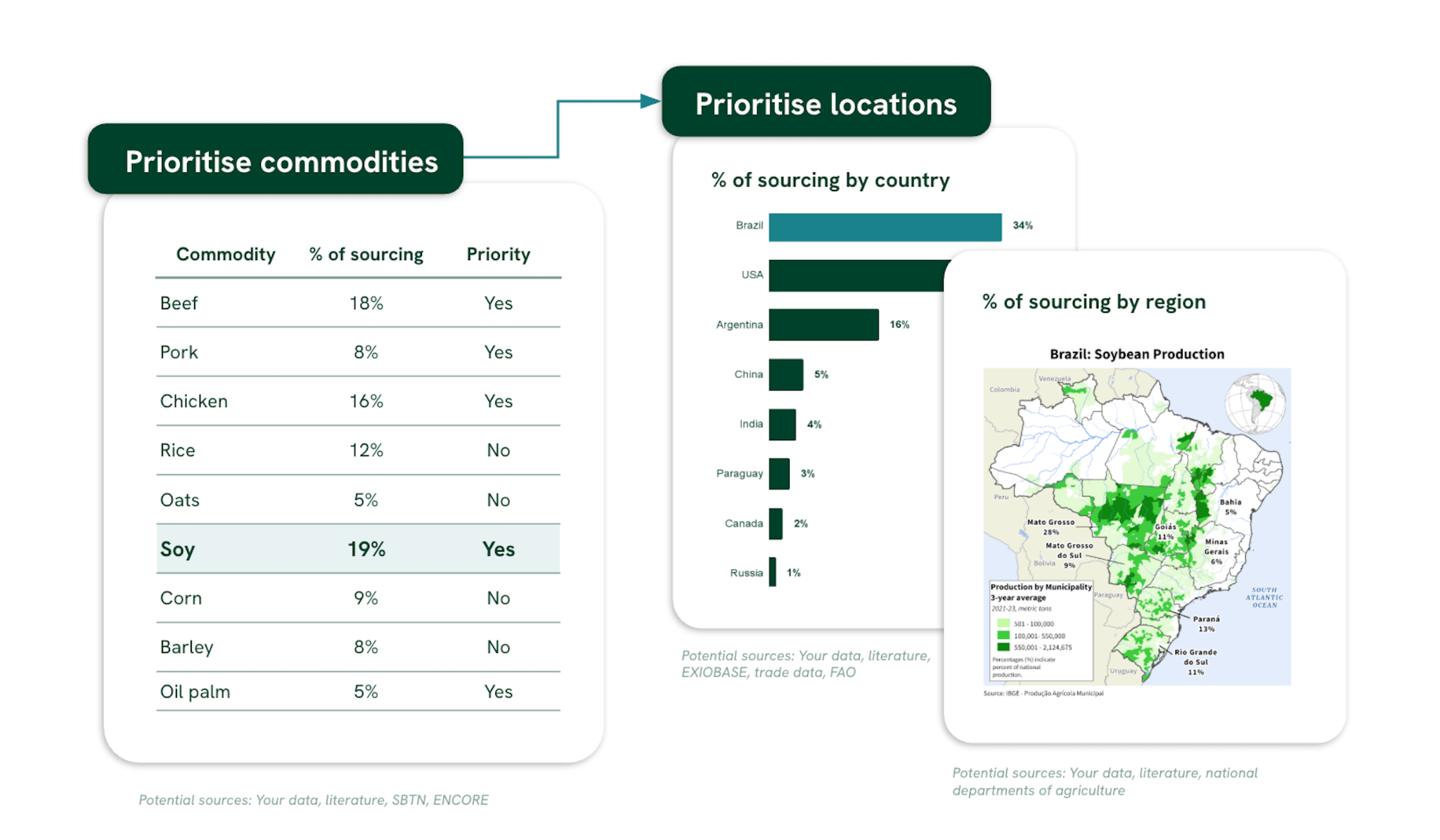
Natcap follows a TNFD-aligned process: locate, evaluate, assess, prepare. Because the work assesses commodity risk, everything is anchored at the extraction point, namely what is happening where the crop is grown, and how that flows through to financial risk for the buyer.
The first task is the one that is most tempting to take for granted: working out where the commodities are actually grown. Location is everything for nature, Siobhan said; analyse the wrong place and the answer changes. Traceability is where the rigour starts.
For a subset of volumes, the company had already traced commodities back to origin. Regulation such as the EU Deforestation Regulation has pushed many companies to do this for the in scope crops it covers, which gave the team a strong starting point. For the rest, the team knew only the export point. Something might arrive from Brazil, or from somewhere in India, without any precise knowledge of where it was grown. To overcome this, Natcap works in layers. Trade-flow datasets first narrow the likely sourcing countries and regions; crop-specific growing-area datasets then identify which areas within those regions actually produce the crop. The result is not a claim of certainty but a transparent, agreed assumption that the client signs up to: that a company’s wheat most likely comes from these regions, and within them, these growing areas.
The process is deliberately iterative. If a commodity cannot be traced but it is clear that sourcing it from a particular area would carry severe consequences, that is the signal to go and get better tracing data. The analysis becomes an information hierarchy, Siobhan said: each result tells the company what to find out next.
Impacts, dependencies, and turning hotspots into a number
With sourcing locations established, the team looks at two distinct things, because they lead to different kinds of risk: how each crop impacts the place it is grown, and how it depends on the nature at that place. Impacts, where production damages an ecosystem, can translate into transition risks such as new regulation or reputational exposure. Dependencies, such as needing water, fertile soil or a stable climate, translate into physical risks: if the nature a crop relies on degrades, production suffers.
On the impact side, Natcap uses best in class datasets, such as Ecoinvent, to establish, per tonne of production, how much land and water a commodity requires and what it emits to soil, air and water. This allows Natcap to provide evidenced estimations of absolute impact. The team does this across each impact driver, and applies thresholds so the output is comparable, telling a buyer whether, for example, for land use or for deforestation, it should be more worried about soy or about grapes.
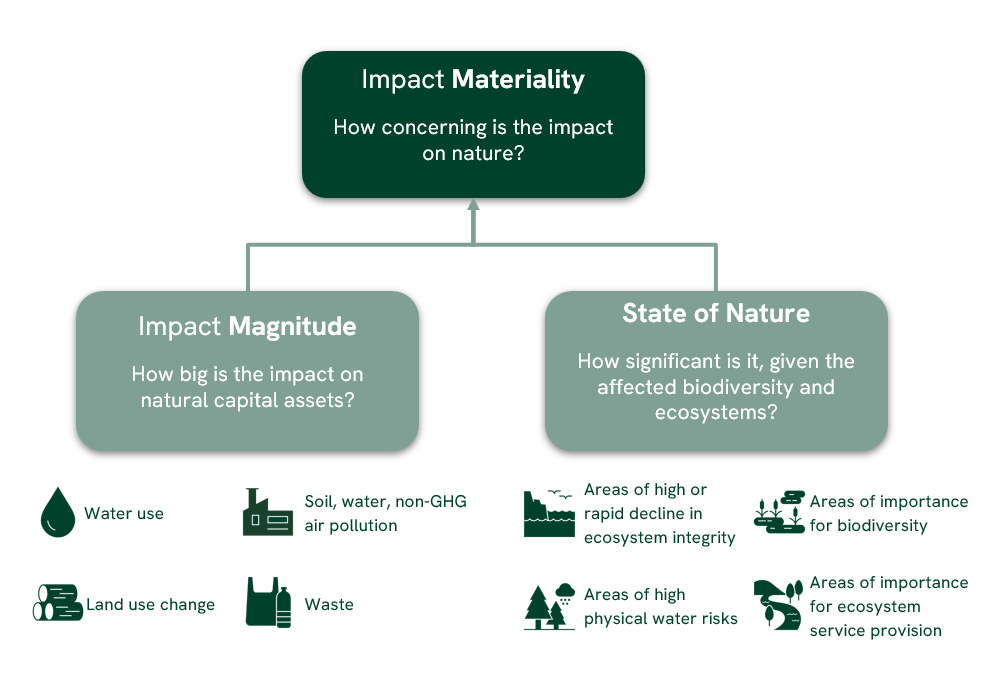
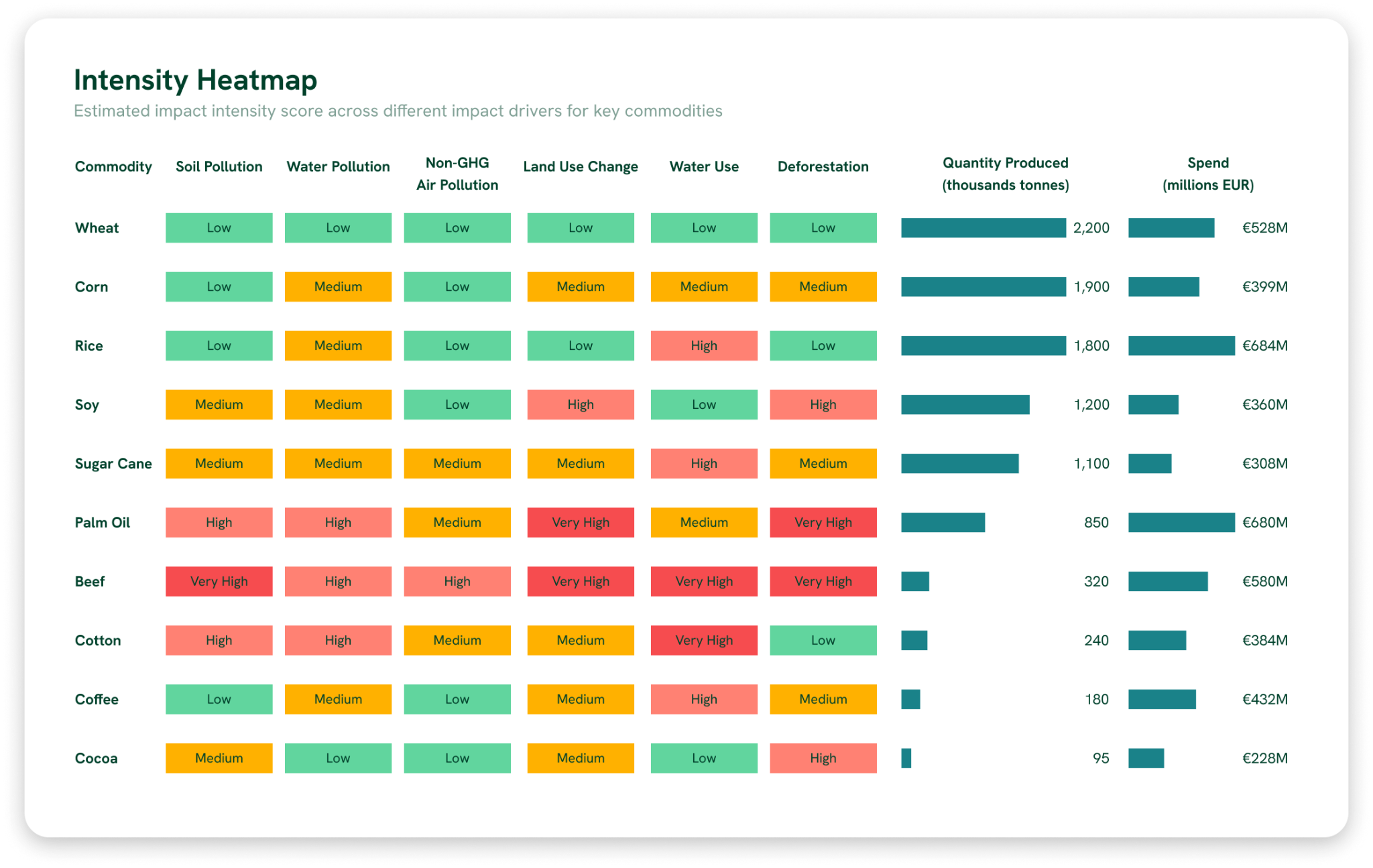
On the dependency side, the team turns to the academic literature to understand how a crop’s yield responds to a change in the ecosystem services it relies on. Looking at plant environmental traits and yield loss datasets, it can ask, in effect, how vulnerable a commodity is to a loss in an ecosystem service. This gives customers a clear hotspot view of how damaging each crop is to where it is grown, and how vulnerable it is to the nature it depends on. It says nothing about risk yet, Siobhan was careful to note, but it does show plainly where impact and dependency are concentrated.
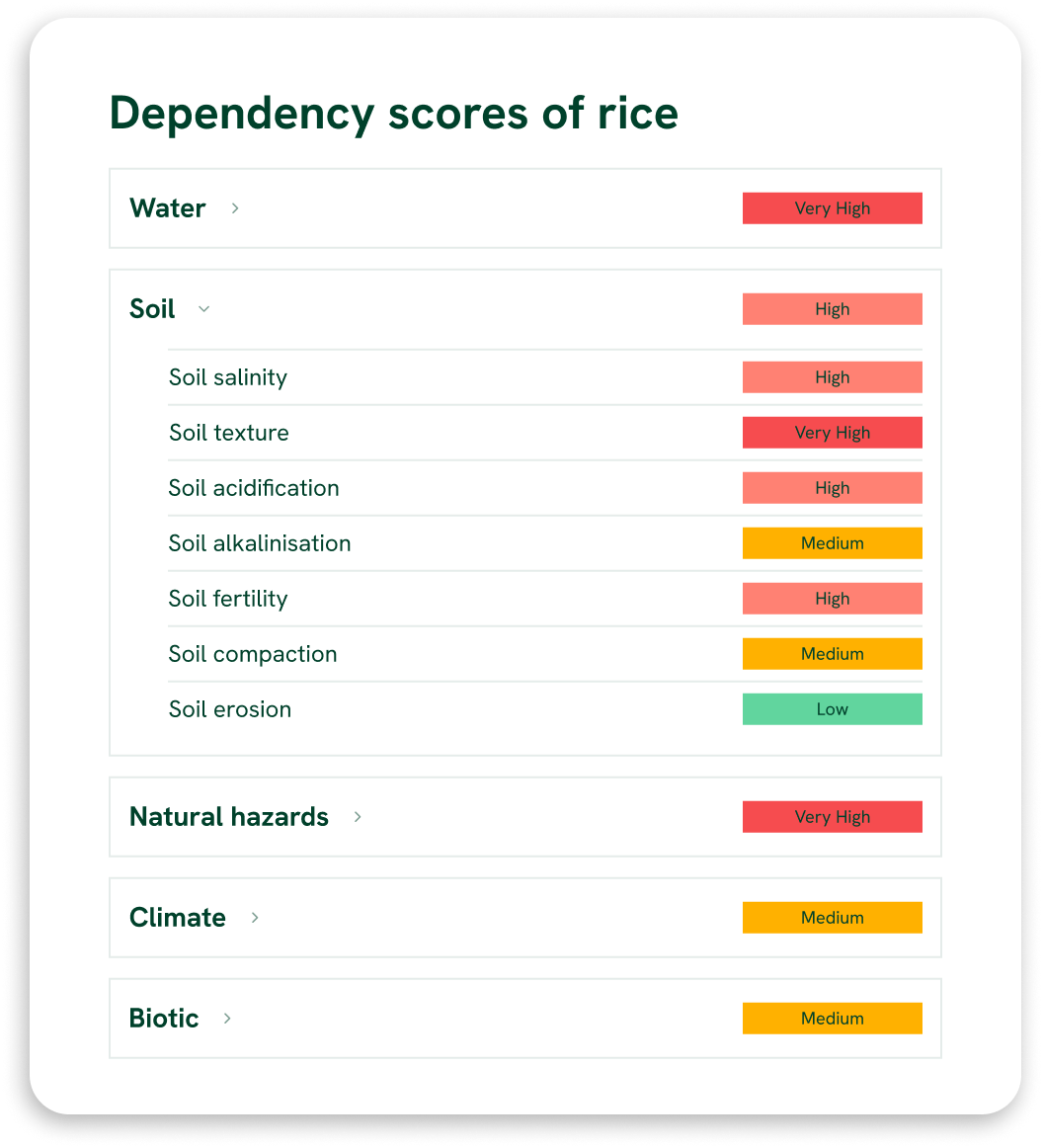
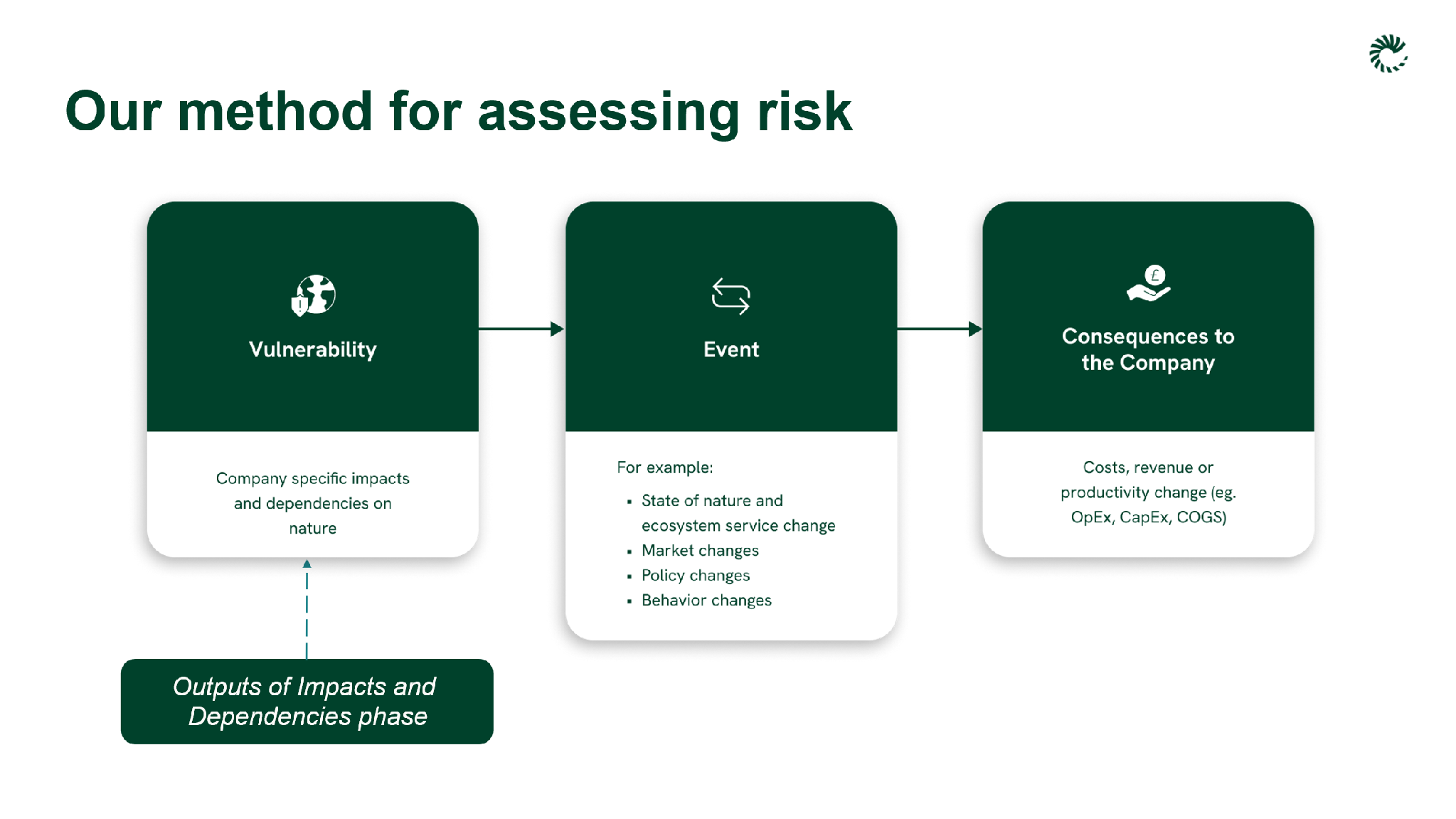
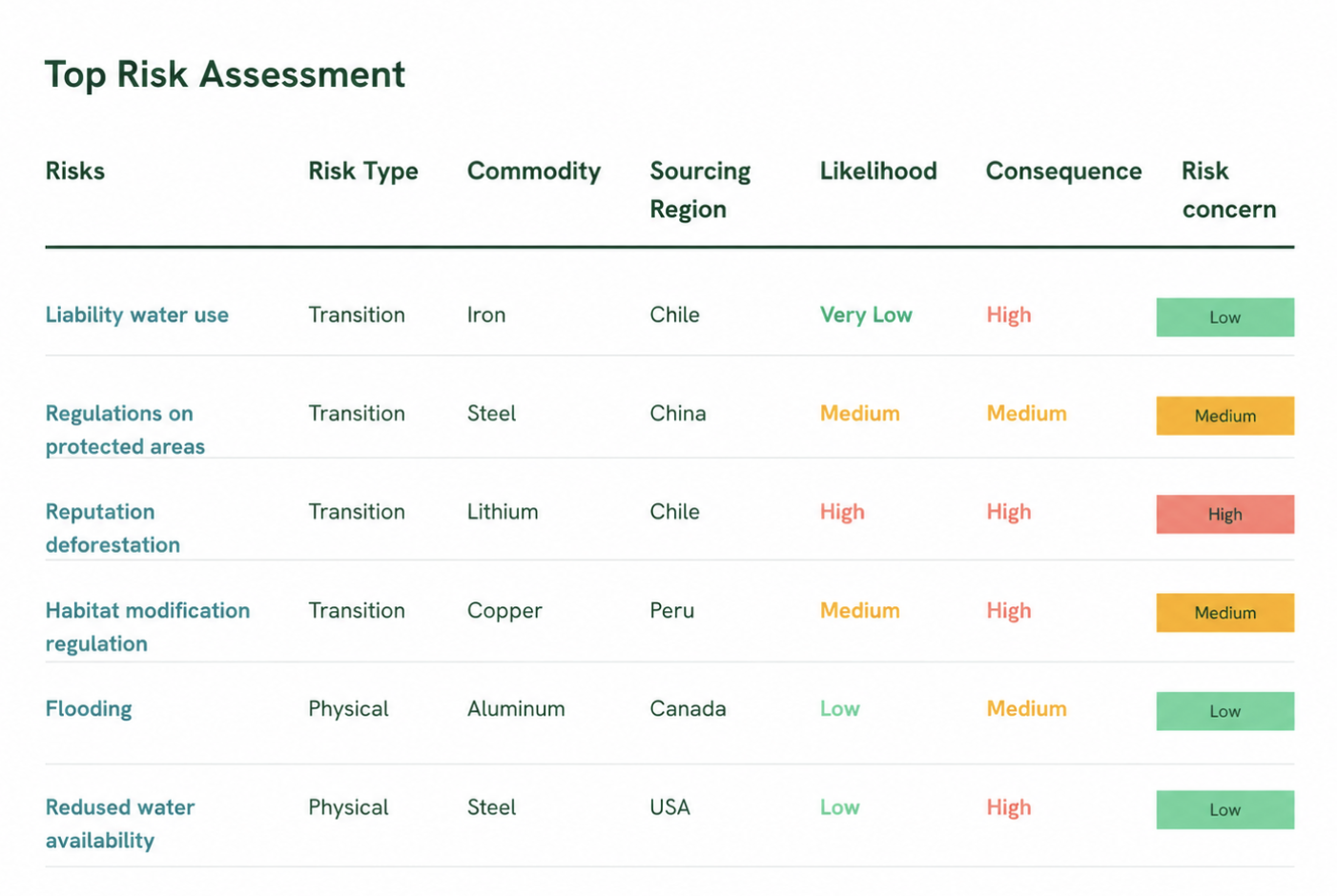
Risk itself, as Natcap treats it, is a combination of the likelihood of a risk, and the financial consequence should it occur. For likelihood, each crop’s dependency is combined with the hazards present where it is grown: global hazard datasets are overlaid onto the sourcing areas. Taking water, for example, the question is how water-stressed a growing area is and how dependent the crop is on water there. Together those say how likely a risk is to be felt.
Financial consequence is more bespoke. Natcap models it in two steps. First comes the consequence to the producer: lost productivity, or rising input costs. Then that consequence is played through the supply chain to what the company itself cares about as a buyer - which might be price volatility or even continued availability of supply. The aim, Siobhan said, is to trace a clear line from a nature event in a growing region all the way back to the buyer’s exposure.
The part most companies underestimate
What corporates consistently get wrong about a project like this, in Siobhan’s experience, is assuming the analysis is the hard part. It is not. The hard part is the engagement required to make it land.
An outside-in view of nature risk has to be made true to the business before anyone will act on it. Tell a procurement team it is exposed to a given risk, she said, they may rightly reply that a ten-year contract has fixed the price, or that they can switch sources easily. So the numbers have to be both clear and right: clear enough to communicate to busy teams for whom this is not the day job, and right enough to survive contact with commercial reality. That means engaging the people who know that reality: the risk team, the finance team, the buying teams, sometimes a team no one has spoken to before. It takes time, and it takes trust. This is not a one-off analysis that can simply be pushed through a business.
“You have to say something real, convincing and clear to a team that has something else to do with their day.”
Siobhan Stewart, Head of Delivery, Natcap
What the analysis found
A great deal of what robust analysis does, Siobhan said, is validation: turning “we think soy deforestation is a problem” into “here is how much of a problem, and therefore here is what can be done about it.” For a business that could not make the internal case before, having defensible numbers behind a known concern is, on its own, valuable. Three areas stood out.
On deforestation, both soy and palm carry significant exposure, much of it tied to proximity to biodiverse and protected areas. That carried real implications both for the producers operating there and for what a company of this size would need to do to mitigate it.
On water, availability was already a known concern for certain commodities like cocoa. What was less well understood was which regions carried the greatest exposure. The analysis put specificity where there had only been a general sense of risk.
The risk hiding in the soil
The genuine surprise was soil. Climate risks, and the bigger regulatory risks, are at least on most companies’ radar; soil fertility and erosion are not. Intensely farmed landscapes were showing losses to soil quality that could have real implications for production into the future.
Soil is a risk that hides in plain sight, Siobhan explained, because the symptom gets treated before the cause is seen. Producers facing declining fertility often turn to fertiliser, which props up yields in the short term while degrading the soil over the long term. Even where yields have not fallen, the cost can show up as rising input costs.
“Soil fertility sneaks under the radar, and treating the symptom with fertiliser application can increasingly degrade the soil.”
Siobhan Stewart, Head of Delivery, Natcap
From measurement to action
The output was built to be acted on, not just disclosed. The distinction matters more than it sounds.
Because every data point, calculation and method was documented and handed over, the disclosure is audit-ready: the client can pass the platform and methods straight to an auditor. But the real difference between a company that reports and one that acts, Siobhan said, is granularity. In a period of genuine uncertainty about regulatory requirements, many companies have understandably been cautious about what they disclose and how robust it needs to be. Before anyone commits capital to a mitigation action, or asks a team to change what it does, they will be asked a great many questions. That demands real confidence in the method, clarity about what is and is not covered, and an honest read on the level of certainty, because the person carrying the analysis into the business has to defend it.
For this client, the work kicked off a major engagement programme that is still ongoing. Natcap built engagement packs for every commodity analysed, each setting out the key risks and a set of potential mitigation actions, and these are now being taken to the individual buying and purchasing teams.
Owning the analysis
What Natcap is really trying to do, Siobhan said, is close a gap it kept seeing and that no one had quite cracked: strong supply-chain traceability, paired with a robust view of nature risk that can sit alongside climate risk, not just today but under future scenarios, and then translated into financial implications real enough to support a return-on-investment case for mitigation.
It is also built to be owned. The first year tends to be advisory-heavy, because there is a great deal to explain. By the second, clients are increasingly running the analysis themselves: querying the platform, building the internal case, telling the right story to the right team. As sourcing changes through the year, they re-run it themselves rather than paying a consultant to repeat last year’s work; a new supplier means updating the data and re-running, not commissioning a fresh project. That, Siobhan said, is the point of an automated, subscription-based approach: the cost does not recur in the same way, and the capability ends up inside the business.
Pictures are intentionally blurred to maintain confidentiality.
Key takeaway
Asked for the single most important takeaway from the project, Siobhan offered two. The first is that nature-related risk carries financial consequences within a five-year horizon that simply had not been accounted for before: real risk, found and quantified, not a compliance abstraction. The second is the one she would leave readers with:
“Sustainability teams can’t do any of this alone.”
Siobhan Stewart, Head of Delivery, Natcap
A central sustainability team can surface the risk, she explained, but it will never own the delivery. It is a buying team, or an operations manager, who has to act. The most valuable thing Natcap can be, in the end, is the toolset that lets a sustainability team make the business case to whichever part of the business it needs to convince: that a site should use less water, or that a commodity faces price volatility because pests are expected across its current sourcing regions. That argument needs data underneath it. That is what the work is for.
About this case study
This case study is based on an interview conducted by the OneStop ESG editorial team with Siobhan Stewart, Head of Delivery at Natcap.
The client described has been anonymised at Natcap’s request. Identifying details, including sector, scale and sourcing geographies, are presented in general terms, and certain figures are pending confirmation from Natcap at the time of writing.
Nothing in this case study is intended to, or should be taken to, represent that the company described is compliant with, or has satisfied, any current or future TNFD, CSRD or other sustainability-related disclosure, reporting or assurance requirement. Natcap was responsible for the methodology described; references to methodologies, metrics or analytical outputs should not be taken as endorsements by the client of any specific framework or outcome.
Subscribe to our newsletter for more insights, case studies, and ESG intelligence.
Keep abreast of the top ESG Events on OneStop ESG Events.
OneStop ESG Educate: Your go-to source for top ESG courses and training programs tailored to your needs.
Stay informed with the latest insights on OneStop ESG News.
Discover meaningful career opportunities on OneStop ESG Jobs.


%252010th%2520Edition.png%3Falt%3Dmedia%26token%3D28295a93-506a-42b8-aef2-79cd319b0edc&w=3840&q=75)
Comments
Have a thought on this? Share it with other readers.