.jpg%3Falt%3Dmedia%26token%3D39193368-e8d9-4b1d-ab0f-c23cdf329939&w=3840&q=75)
Sustainability communication is everywhere. What matters now is relevance. This article examines how leadership gets noticed through context, credibility, and audience.
Sustainability became part of mainstream business as regulatory requirements expanded, investor scrutiny increased, and environmental and social risks moved onto board agendas. These pressures pushed sustainability from a voluntary consideration into a strategic one. Over time, reporting, disclosures, and public commitments became the way organisations documented, compared, and responded to those expectations.
Being visible still matters. Organisations need to communicate what they are doing and why it matters.
What has changed is the environment that communication now operates in.
Sustainability communication has expanded rapidly. There is more reporting, more events, and more content than ever before. For many senior decision-makers, the challenge is no longer access to information, but deciding what is relevant and credible. The question has shifted from whether organisations are communicating to whether that communication is landing with the people who actually use it.
For organisations working in sustainability, including solution providers, educators, event organisers, corporates, and financial institutions, the challenge today is not choosing between communication and substance. It is making sure the two reinforce each other.
Shift from Exposure to Credibility
Sustainability audiences have matured.
Senior professionals still value communication and transparency, but they are far more selective about what they engage with. Content is no longer judged only on its message, but also on its source, framing, and usefulness in real decision-making contexts.
This helps explain why some familiar visibility strategies now deliver weaker results than they once did.
- One-off press releases are seen, but quickly forgotten
- Generic ESG awards attract attention, but not always confidence
- Broad, untargeted events generate attendance, but limited influence
- Broad listings increase visibility, but often lack the context decision-makers need.
Communication remains essential. Without credibility, relevance, and context, visibility alone rarely translates into trust or impact. In practice, this shift has changed how organisations evaluate sustainability communication. Investors, alongside boards and senior management, are asking more pointed questions about how sustainability information links to risk, capital allocation, and long-term performance. Organisations that provide credible, decision-ready information are better able to engage these audiences in substantive discussions.
What Sustainability Leaders Actually Look For Today
Across finance, industry, policy, and academia, sustainability leaders are looking for platforms that combine communication with credibility.
Three elements consistently stand out.
- Curation, where quality matters more than volume
- Audience relevance, with readers who influence decisions
- Editorial framing, where insight comes before promotion
They want to engage in conversations that reflect real trade-offs and constraints across capital allocation, regulation, risk management, and long-term strategy, not just polished narratives.
The question, for us, was not how to add more content to an already crowded space, but how to design a platform that respected the way sustainability decisions are actually made.
Why OneStop ESG Exists
OneStop ESG was built after observing how sustainability decisions are actually made, and how hard it had become to find context in one place.
There was no shortage of content. Reports were getting longer, events more frequent, and announcements more polished. But for people actually working on sustainability decisions, it was becoming harder to find material that was useful, comparable, and grounded in real constraints.
Much of what existed focused on visibility rather than context. Information was available, but often disconnected from how decisions around capital, risk, regulation, and implementation are actually made.
OneStop ESG grew from that experience. The aim was not to add more noise, but to create a place where sustainability work could be discussed with enough context to be taken seriously.
That meant bringing together long form editorial, curated news, and a practical way to discover tools, services, and learning options, all in one place, and all aimed at people who have to turn sustainability ideas into action.
The Audience Behind the Platform
OneStop ESG’s readership spans senior management, sustainability leaders, finance professionals, policymakers, and practitioners responsible for turning sustainability commitments into execution. Many sit at the intersection of strategy and delivery, shaping how sustainability priorities translate into capital allocation, governance, and long-term business decisions.
Engagement is driven by depth rather than clicks. Readers come for analysis, stay for perspective, and return for continuity.
The snapshot below reflects the current scale and composition of the OneStop ESG ecosystem.
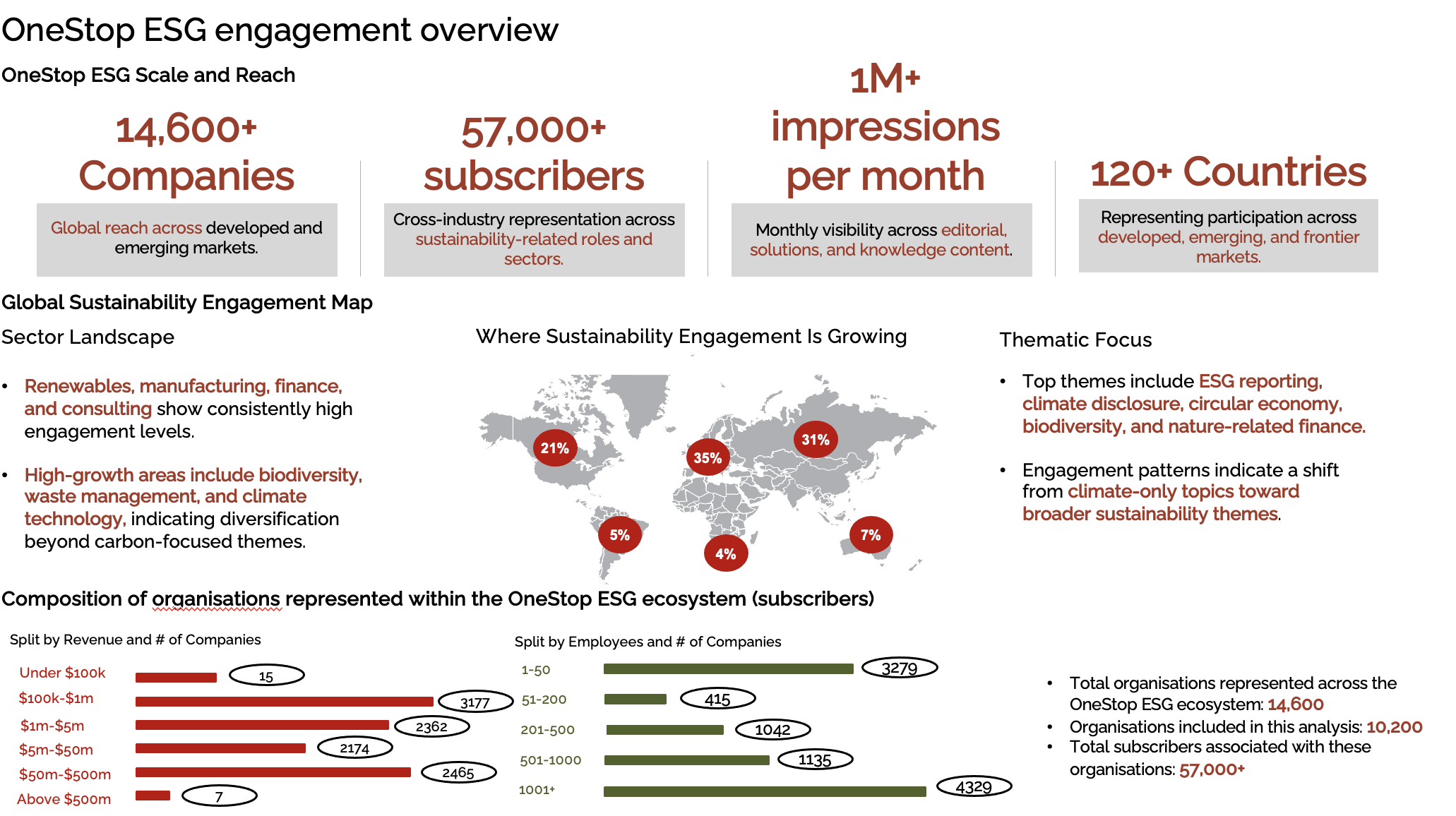
Overview of OneStop ESG audience reach and ecosystem composition
The overview above summarises the scale, geographic spread, and organisational composition of the OneStop ESG ecosystem. It reflects engagement across sectors, regions, and company sizes, based on aggregated platform and subscriber data. The intention is not to highlight reach alone, but to show the breadth and maturity of the audience engaging with sustainability content on the platform.
Content to Discovery
For many readers, engagement with OneStop ESG does not stop at content. As sustainability roles become more specialised, professionals increasingly use the platform to explore solution providers, tools, and services relevant to their specific mandates.
Buyers and practitioners use the OneStop ESG solutions marketplace to understand what is available, compare approaches, and identify providers aligned with their sector, geography, or stage of maturity. The marketplace currently includes more than 800 solution providers. Engagement is often driven by active needs, such as preparing for reporting requirements, evaluating technology options, or exploring implementation support.
The marketplace supports this transition from insight to exploration, allowing audiences to move from understanding sustainability challenges to identifying practical options in a structured and transparent environment.
Different Entry Points, One Ecosystem
Audiences engage with OneStop ESG in different ways, depending on their role and immediate needs. Some arrive through editorial content and use the platform to stay informed. Others engage through events to exchange perspectives, and build professional relationships.
- Educators and learners use the platform to explore courses and training options as sustainability roles evolve and reskilling becomes more important. Students, mid-career professionals, and senior leaders use it to understand market expectations, identify learning pathways, and track how skills and roles are changing.
- Professionals at different stages of their careers also use the platform to explore job opportunities and understand how sustainability capabilities are valued across sectors.
Together, content, events, education, the solutions marketplace, and jobs form a connected ecosystem. Each entry point serves a different purpose, but all are anchored in the same principle: relevance, credibility, and practical value for people working on sustainability decisions.
Why Organisations Use OneStop ESG
- Solution Providers - For sustainability solution providers, visibility matters. But visibility in the right context matters more. Being featured within a trusted editorial environment allows solutions to be understood, compared, and evaluated, rather than reduced to marketing claims.
- Educators and Institutions - Universities, training providers, and professional bodies use OneStop ESG to communicate with practitioners who influence adoption, curriculum relevance, and institutional partnerships. The platform also reaches students, mid-career professionals, and senior leaders seeking credible courses, certifications, and upskilling pathways in sustainability. This connects learning with real-world application and career progression.
- Event Organisers - In a crowded events landscape, communication drives registrations, but relevance drives participation. Event organisers use OneStop ESG to reach audiences who help shape agendas, contribute informed perspectives, and carry conversations forward beyond the event itself. This leads to more meaningful discussions, stronger panels, and engagement that extends beyond a single session.
- Corporates and Financial Institutions - For large corporates and financial institutions, sustainability communication carries reputational risk alongside opportunity. Banks, asset managers, insurers, and corporate leaders increasingly need to explain not only their commitments, but how those commitments translate into governance, capital allocation, and real-world outcomes. OneStop ESG provides a credible editorial environment to communicate progress, challenges, and strategy in a way that supports transparency without superficial signalling.
Why Editorial Context Matters
In sustainability, where a story is told increasingly matters as much as what is being said.
Editorial context strengthens communication by providing credibility through association, longevity beyond a single campaign, and discovery driven by relevance rather than algorithms.
OneStop ESG’s role is not to reduce communication. It is to ensure that sustainability communication lands with clarity, confidence, and credibility.
A Different Definition of Visibility
Sustainability leadership today is not about choosing between visibility and substance. It is about combining both.
It is about being visible in the conversations that shape capital flows, standards, regulation, and real-world outcomes.
OneStop ESG exists to support that balance. Not by reducing communication, but by ensuring it is relevant, credible, and grounded in how sustainability decisions are actually made.
Subscribe to our newsletter for more insights, case studies, and ESG intelligence.
Explore ESG Solutions on our marketplace - OneStop ESG Marketplace.
Keep abreast of the top ESG Events on OneStop ESG Events.
OneStop ESG Educate: Your go-to source for top ESG courses and training programs tailored to your needs.
Stay informed with the latest insights on OneStop ESG News.


%252010th%2520Edition.png%3Falt%3Dmedia%26token%3D28295a93-506a-42b8-aef2-79cd319b0edc&w=3840&q=75)
Comments
Have a thought on this? Share it with other readers.