
The TNFD Status Report 2026 shows nature-related disclosure doubling to more than 1,000 organisations, even as the information is only beginning to shape how companies and investors make decisions.
The TNFD Status Report 2026 records a sharp rise in nature-related assessment and disclosure as nature becomes a more established part of investor analysis and corporate risk management. Companies and investors are also examining how this information can inform business strategy and capital allocation.
Nature is moving closer to business and finance
Companies dependent on water, land, forests and agricultural commodities face economic consequences when the natural systems supporting production come under pressure. The Taskforce on Nature-related Financial Disclosures (TNFD) is tracking how those dependencies are entering corporate reporting and investor analysis. Its 2026 Status Report identifies more than 1,000 organisations across 58 industries and 56 jurisdictions making some form of disclosure aligned with its recommendations.
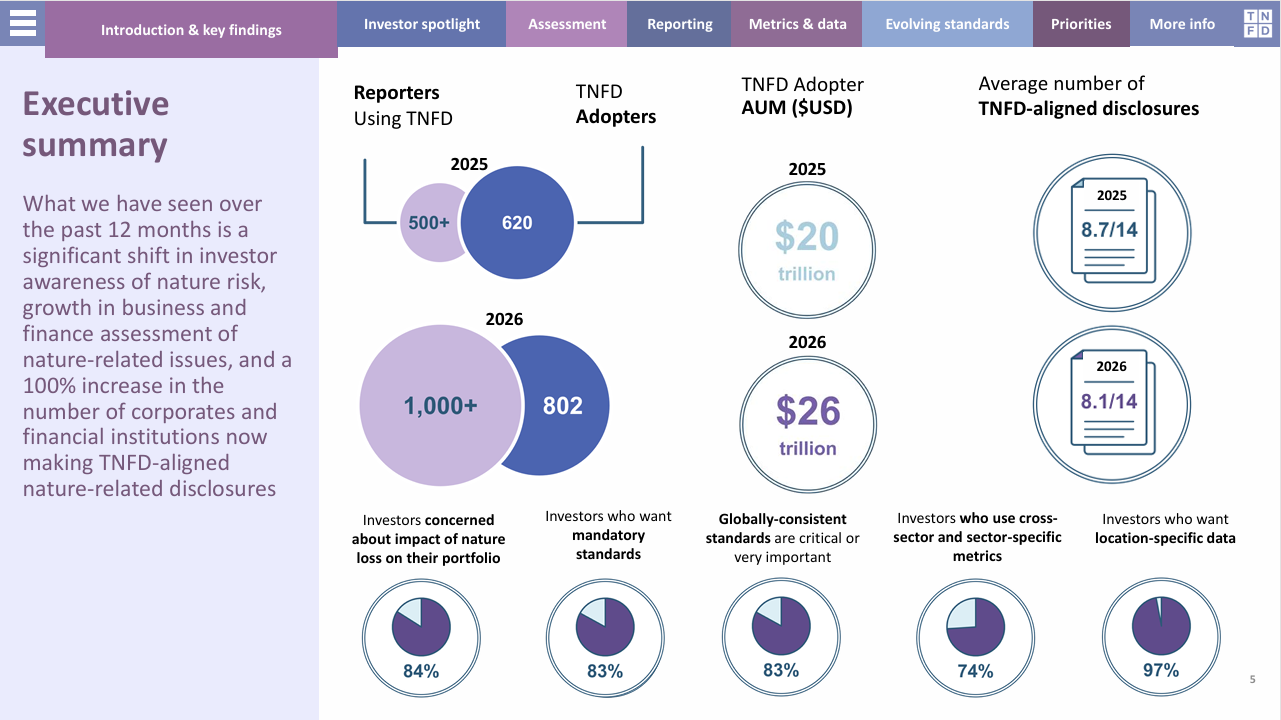
Formal TNFD Adopters increased from 620 in 2025 to 802 in 2026, with estimated assets under management represented by adopters reaching $26.6 trillion. Adopters are organisations that have committed to reporting against the recommendations. The report separately tracks organisations already publishing information aligned with at least one recommended disclosure.
Investors are paying closer attention to the financial consequences of nature-related exposure. Among 74 investor respondents, 88% selected understanding portfolio nature-related risk as an important reason behind their organisation’s focus on nature and biodiversity. Eighty-one per cent selected reducing portfolio nature-related impacts, while 50% pointed to investment opportunities. National and international regulation ranked lower as reasons to act.
That attention is reaching companies through stewardship, the engagement between investors and the businesses they own. Eighty-four per cent of the same investor sample said nature was included in guidance used to engage investee companies. Respondents also reported expectations around assessing dependencies and impacts, engaging suppliers and strengthening board oversight. Meeting those requests can involve sustainability, procurement, risk and finance teams, with management drawing together information about operations and supply chains.
Nature-related reporting is expanding
Neural Alpha’s analysis, commissioned by TNFD, scanned around four million reports from 10,000 public and private organisations. It identified 1,154 organisations making at least some TNFD-aligned disclosures in 2026, compared with 542 in 2025. The average number of recommended disclosures identified per report fell from 8.7 of 14 to 8.1. TNFD links this partly to the increase in first-time reporters, whose reports generally cover fewer disclosures than those published by organisations in their second or third reporting cycle.
Nature assessment is also becoming part of the work behind these disclosures. Among 285 survey respondents, 76% had conducted a LEAP assessment. LEAP is TNFD’s approach to locating interactions with nature, evaluating dependencies and impacts, assessing risks and opportunities, and preparing a response. Dependencies describe the natural resources and ecosystem services a business relies on, while impacts describe how its activities affect nature.
Among respondents describing the scope of their assessments, more than half covered all markets in which they operated. Twenty-three per cent examined direct operations together with upstream and downstream value chains. Such assessments help companies identify which locations and activities require management attention, rather than relying entirely on company-wide environmental indicators.
Some respondents were also using nature-related scenarios and incorporating nature considerations into climate transition planning. The report notes that most organisations have two or fewer full-time employees working on nature-related assessment and reporting, sometimes supported by external expertise. Assessing facilities, suppliers and sourcing regions therefore involves decisions about where to concentrate limited internal resources.
How investors are using nature-related information
Nature-related information is being used most frequently in investor engagement and risk management. Among 40 investor respondents that had conducted a LEAP assessment on some or all of their portfolios, 73% said it had informed stewardship and 60% risk management. The corresponding figures were 23% for capital allocation and 10% for portfolio construction.
An assessment can help an investor question management about water availability, commodity sourcing or land use, and identify exposures that require closer monitoring. Incorporating the information into investment decisions also involves estimating how those exposures could affect financial performance. A dependency on freshwater, for example, needs to be understood in relation to production requirements, the availability of alternative supplies and the costs of disruption.
Respondents described difficulties at both stages of this analysis. Among 206 participants answering the assessment challenges question, 69% identified problems linking dependencies and impacts to business risks, including financial effects. The same proportion pointed to difficulties measuring and quantifying dependencies and impacts. Half reported uncertainty about which tools, datasets or methodologies to use.
Investors are also examining nature-related opportunities. TNFD records activity across fixed income, equity funds and sustainability-linked lending. Among 68 investor respondents, 74% expected private capital investment in nature-related opportunities to increase between twofold and fivefold over the next five years. A further 6% expected growth of between fivefold and tenfold. These expectations concern private capital investment generally, rather than commitments by those institutions to increase their own spending by equivalent amounts.
Asked to select the three biggest barriers to scaling nature finance, respondents most frequently chose:
- Policy, regulation and the market environment: 71%.
- Data, metrics and disclosure: 62%.
- Commercial and financial barriers: 60%.
The report also records concerns about the availability of investment models that can operate at scale and offer suitable risk-adjusted returns. Better disclosure can help investors assess an opportunity, although the commercial terms and underlying investment model remain separate considerations.
The challenge of nature data
Nature-related assessment requires attention to location. The same volume of water withdrawn in two different basins can have different consequences depending on local availability and competing demand. Land conversion also needs to be understood in relation to the ecosystem affected, while commodity exposure depends partly on where and how materials are produced. A company-wide total may not provide enough information to assess those differences.
Investor responses reflect this need for detail. Seventy-four per cent of 69 respondents said they use a combination of cross-sector and sector-specific metrics. Among 71 respondents, 97% agreed or strongly agreed that they need location-specific information about clients’ and portfolio companies’ nature-related dependencies, impacts, risks and opportunities to assess their own risk.
TNFD’s recommended metrics include water withdrawal and consumption in water-scarce areas, changes in land, freshwater and ocean use, high-risk natural commodities and pollution. Other metrics address financial exposure to nature-related physical and transition risks. Collecting this information can require records held at individual facilities, river basins, sourcing regions and suppliers, with different levels of detail available across a business.
TNFD’s comparison of Bloomberg, LSEG and MSCI shows broader coverage of established climate indicators, such as Scope 1 greenhouse gas emissions, than many nature-related measures. Several nature metrics have limited representation across the platforms examined, while others lack a directly comparable measure. Investors may consequently receive detailed information from one company without having an equivalent dataset against which to compare its peers.
Some of the required information already exists. The report’s analysis of CDP disclosures finds companies reporting measures similar to TNFD’s recommendations, including water discharges, water withdrawals in stressed areas and commodity sourcing. Bringing that information into consistent reporting and investment datasets involves work on definitions, coverage and measurement methods, as well as collecting new data.
Nature reporting and international standards
TNFD describes differing national approaches to sustainability reporting, including the reconsideration of some requirements and continued development of others. Its survey records investor and company preferences within that environment. Among 87 investor respondents, 83% said mandatory nature-related disclosures would help their organisation identify and assess dependencies, impacts, risks and opportunities. Among 259 report preparers, 68% gave the same response.
Preferences differed over how requirements should be organised. Fifty-five per cent of investor respondents wanted globally consistent mandatory requirements aligned with Target 15 of the Kunming-Montreal Global Biodiversity Framework by 2030. Another 39% preferred a combination of mandatory requirements and voluntary standards across jurisdictions. Among report preparers, 45% preferred globally consistent mandatory requirements and 43% favoured a mixed system. These are respondents’ preferences, rather than a timetable of requirements already agreed by governments.
TNFD attributes the demand for consistency to investors’ need to compare information and companies’ desire to understand reporting expectations. Its own work is becoming more closely connected with other reporting organisations. The Taskforce says its technical guidance development on corporate assessment and reporting is complete, with 18 sector guides issued. It estimates their coverage at 60% of SASB sectors and 56% of global GDP.
The report sets out several planned standards developments:
- LEAP 2.0: The report places its release in October 2026.
- An ISO standard based on LEAP: TNFD records approval of the proposal in September 2026, with development expected to begin in the fourth quarter of 2026 and conclude in 2028.
- ISSB proposals: The report anticipates an October 2026 Exposure Draft from the International Sustainability Standards Board on its proposed approach to nature-related risks and opportunities.
TNFD also describes continued collaboration with the Global Reporting Initiative and organisations working on nature measurement and target setting. These activities concern guidance, assessment methods and reporting standards. They do not, by themselves, make TNFD disclosure mandatory. Companies’ legal obligations depend on the requirements adopted in the jurisdictions where they operate.
What this means for companies
The work begins with identifying where operations and supply chains depend on nature and where business activities affect it. A manufacturer might examine water availability around individual facilities, while a food company might assess agricultural sourcing, soil condition and land conversion. An infrastructure business could examine ecosystem conditions around major assets. Financial institutions face the additional task of assessing these exposures across portfolios containing many sectors and locations.
Companies can organise the assessment around three practical areas:
- Locations and suppliers: Identify facilities, sourcing regions and suppliers with material dependencies or impacts, including exposure to water stress, land conversion and ecosystem degradation.
- Financial effects: Examine how those exposures could affect production, costs, revenues, assets and business continuity, recording the assumptions and limits of the analysis.
- Management decisions: Connect the findings with procurement, enterprise risk management, capital planning and climate transition strategies, with responsibility assigned to the relevant teams.
Existing information can provide a starting point. Water records, supplier data, environmental assessments and operational risk registers may help establish where a more detailed assessment is needed. The purpose and scope of the work will differ between a business examining its own facilities and an investor assessing hundreds of portfolio companies.
The investor findings indicate the kind of information companies are being asked to provide: the location of material dependencies, how management is responding and the methods used to assess exposure. A manufacturer could use a water assessment to estimate interruption costs or compare alternative supply arrangements. An investor needs enough comparable information to assess those exposures across companies. Wider use in capital allocation will depend on better location-specific data and a stronger connection between nature-related exposure and financial performance.
Sources
TNFD 2026 Status Report, September 2026, including its reporting analysis and investor findings.- TNFD 2026 Status Report – TNFD
Subscribe to our newsletter for more insights, case studies, and ESG intelligence.
Keep abreast of the top ESG Events on OneStop ESG Events.
OneStop ESG Educate: Your go-to source for top ESG courses and training programs tailored to your needs.
Stay informed with the latest insights on OneStop ESG News.
Discover meaningful career opportunities on OneStop ESG Jobs.
Daniel Dun
Senior Advisor
Daniel is a finance professional with experience across commodities trading, investment banking, and private credit, having worked with firms like Glencore and BTG Pactual across global markets. He has worked on carbon offset products and project finance, with a focus on sustainability and capital markets. He has also supported product management at BlockFi, helping bridge DeFi and traditional finance. Daniel holds a Master’s degree in Economics.
.png%3Falt%3Dmedia%26token%3Dee102746-65b1-4218-a93c-6fc6b794b213&w=1920&q=75)
.png%3Falt%3Dmedia%26token%3D81dd6042-d456-462f-8688-5749530f93e5&w=1920&q=75)
.jpg%3Falt%3Dmedia%26token%3D2895b3c5-2a5d-4b28-965a-004b589f14fa&w=1920&q=75)


%252010th%2520Edition.png%3Falt%3Dmedia%26token%3D28295a93-506a-42b8-aef2-79cd319b0edc&w=3840&q=75)
Comments
Have a thought on this? Share it with other readers.