
Since 2020, more sustainability providers have launched in measurement than in decarbonisation. Drawing on 1,611 providers, 2,124 green jobs and 12 months of engagement data, this report maps a market heading for a shake-out, focused on large enterprises and asking more often for data skills.
OneStop ESG Intelligence · October 2026
OneStop ESG lists more than 1,600 sustainability solution providers, from heat pump makers to carbon accounting software firms. Since 2020, more new providers have gone into measurement and reporting than into any other area. The EU rules that fuelled that growth have since narrowed, and most of these software firms are young and small, which points to consolidation. Nearly all providers say they serve large enterprises, while fewer than a third say they serve small companies. In the jobs market, ESG data management now appears in almost a quarter of the green job postings we analysed.
This report draws on OneStop ESG’s view of the market from three sides: the providers that sell solutions, the organisations looking for them, and the people and skills behind the work.
About this analysis
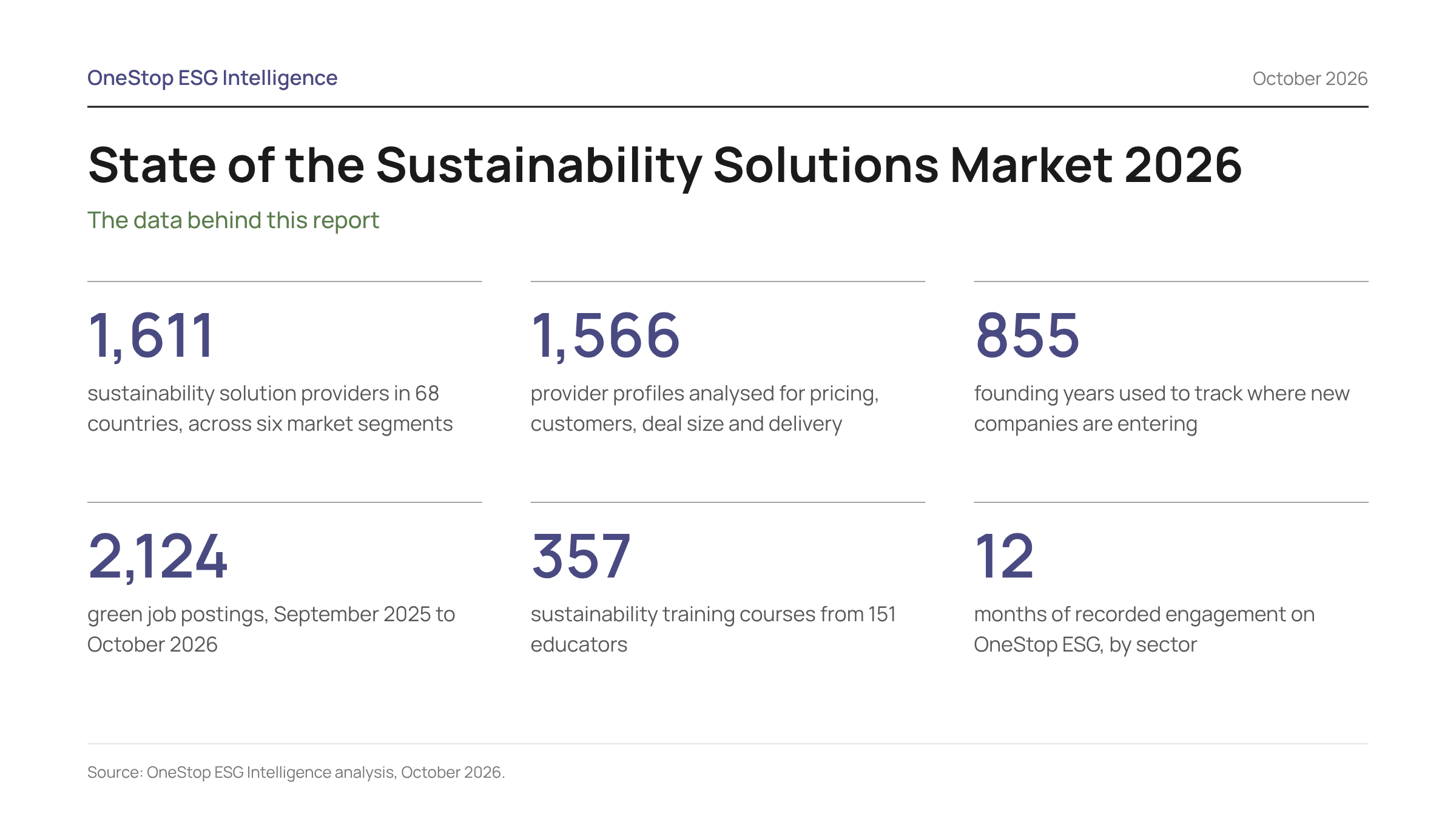
- 1,611 sustainability solution providers on OneStop ESG, headquartered in 68 countries, across six market segments
- 1,566 provider profiles analysed for pricing, customers, deal size and delivery
- 855 providers with a founding year, used to track where new companies are entering
- 2,124 green job postings from September 2025 to October 2026
- 357 sustainability training courses from 151 educators
- 12 months of recorded engagement on OneStop ESG, by sector
Unless stated otherwise, figures come from OneStop ESG data. No individual provider is named.
Key findings
- The newest companies are in measurement, and a shake-out is coming. Since 2020, more providers have launched in measurement and reporting (34%) than in decarbonisation (30%).
- Measurement, reporting and consulting draw the most attention. Together they accounted for 49% of recorded engagement on OneStop ESG over the past 12 months.
- Two very different business models. 80% of measurement providers sell subscriptions. 41% of decarbonisation providers say a typical deal is worth more than $100,000.
- Prices are hard to compare. 86% of providers give prices only on request, and nearly a third have fewer than 50 customers.
- The market has an enterprise focus. 96% of providers say they serve companies with more than 1,000 staff. Only 29% say they serve companies with fewer than 100.
- Data skills are appearing more often in green jobs. ESG data management now appears in 23% of the job postings we analysed, up from 17%.
1. A young market, built around clean energy hardware
Decarbonisation is the largest segment, with 40% of providers. Measurement and reporting has 23% and circular and sustainable operations 15%. Advisory and strategy, and food and agriculture, have 8% each, and carbon removal and offsets 5%. More than half of all providers (56%) sell hardware or physical products. The busiest areas are renewable energy, clean transport, carbon accounting and ESG strategy consulting.
Where a provider is based says a lot about what it sells. Of providers based in China, 91% sell hardware, and so do 61% of US-based providers. In the UK and Germany, software makes up 44% and 46% of providers. Yet 64% of providers say they serve customers worldwide, so check where a provider actually has people and projects.
The market is also young. Of providers that disclose a founding year, 65% started in 2015 or later, and 59% employ 100 people or fewer. Carbon removal and offsets is the least mature segment: 70% of its providers describe themselves as growth stage and only 3% are listed. Yet new companies keep arriving. Of providers founded since 2020, 10% work in carbon removal and offsets, against 4% of those founded before 2015.
2. The newest companies are in measurement, and a shake-out is coming
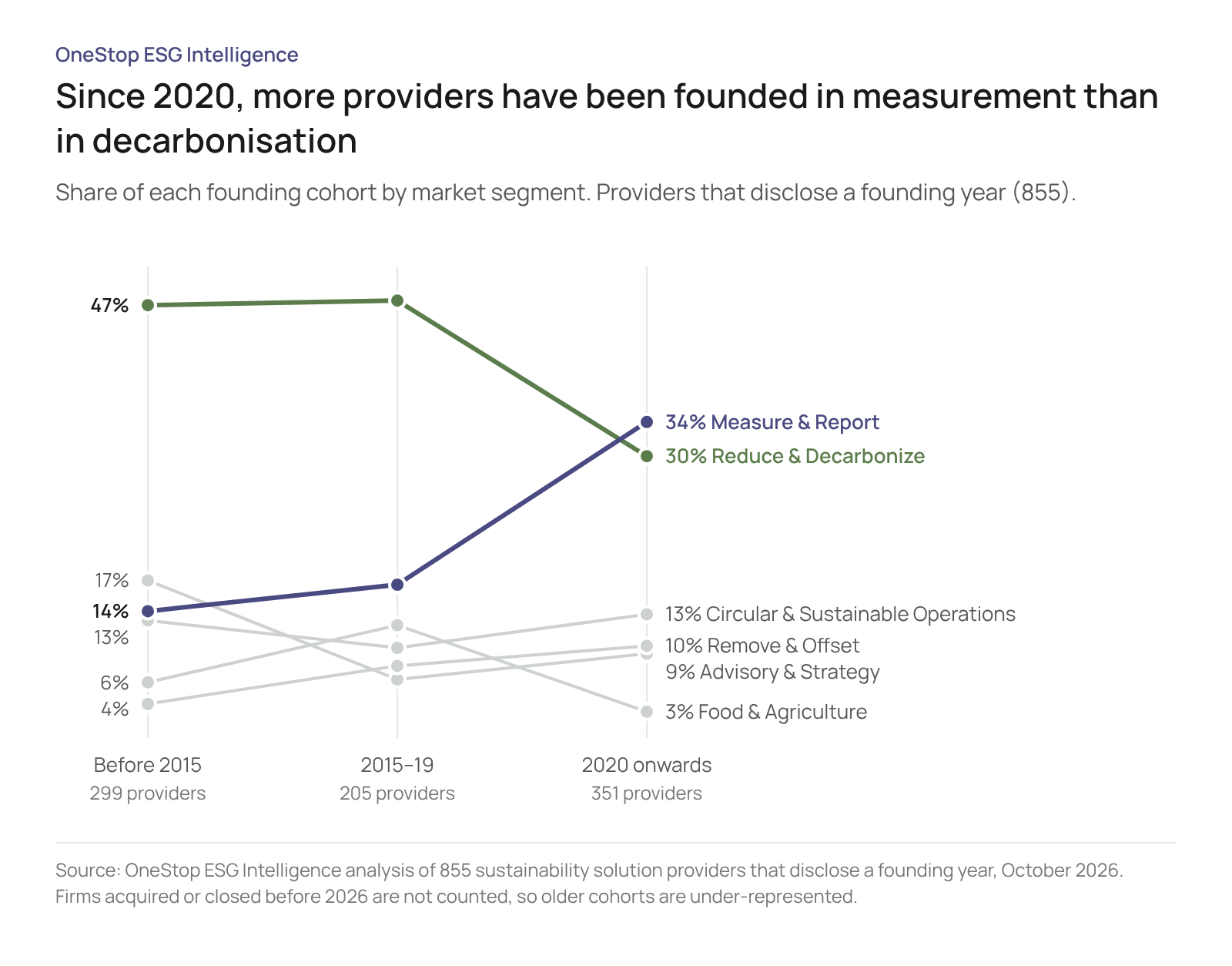
Of providers founded before 2015, 47% work in decarbonisation and 14% in measurement and reporting. Of those founded since 2020, 34% work in measurement and reporting, ahead of decarbonisation at 30%. The typical carbon accounting provider was founded in 2021, and the typical ESG reporting provider in 2022. Food and agriculture has gone the other way. It accounts for 12% of providers founded in 2015–19 but only 3% of those founded since 2020.
This wave followed regulation: the EU’s Corporate Sustainability Reporting Directive (CSRD), the ISSB standards that a growing number of countries are adopting, and California’s climate disclosure laws. Since then, the EU rules have narrowed and some US rules have stalled, but the providers built for them are still here.
Expect a shake-out. Our data counts more than 220 providers of carbon accounting, ESG reporting and ESG data software. Most are young, private and small: 51% of measurement providers describe themselves as growth stage, and a quarter have fewer than 50 customers. Their products are also converging. Of the 127 carbon accounting providers, nearly half (49%) are also listed for at least one other service, most often ESG reporting. Wider market research points the same way: IDC’s May 2026 analysis counts more than 500 vendors in sustainability management software, with acquisitions accelerating through 2024 and 2025. Before signing a multi-year software contract, ask what happens to your data if the provider is acquired.
3. Two very different business models
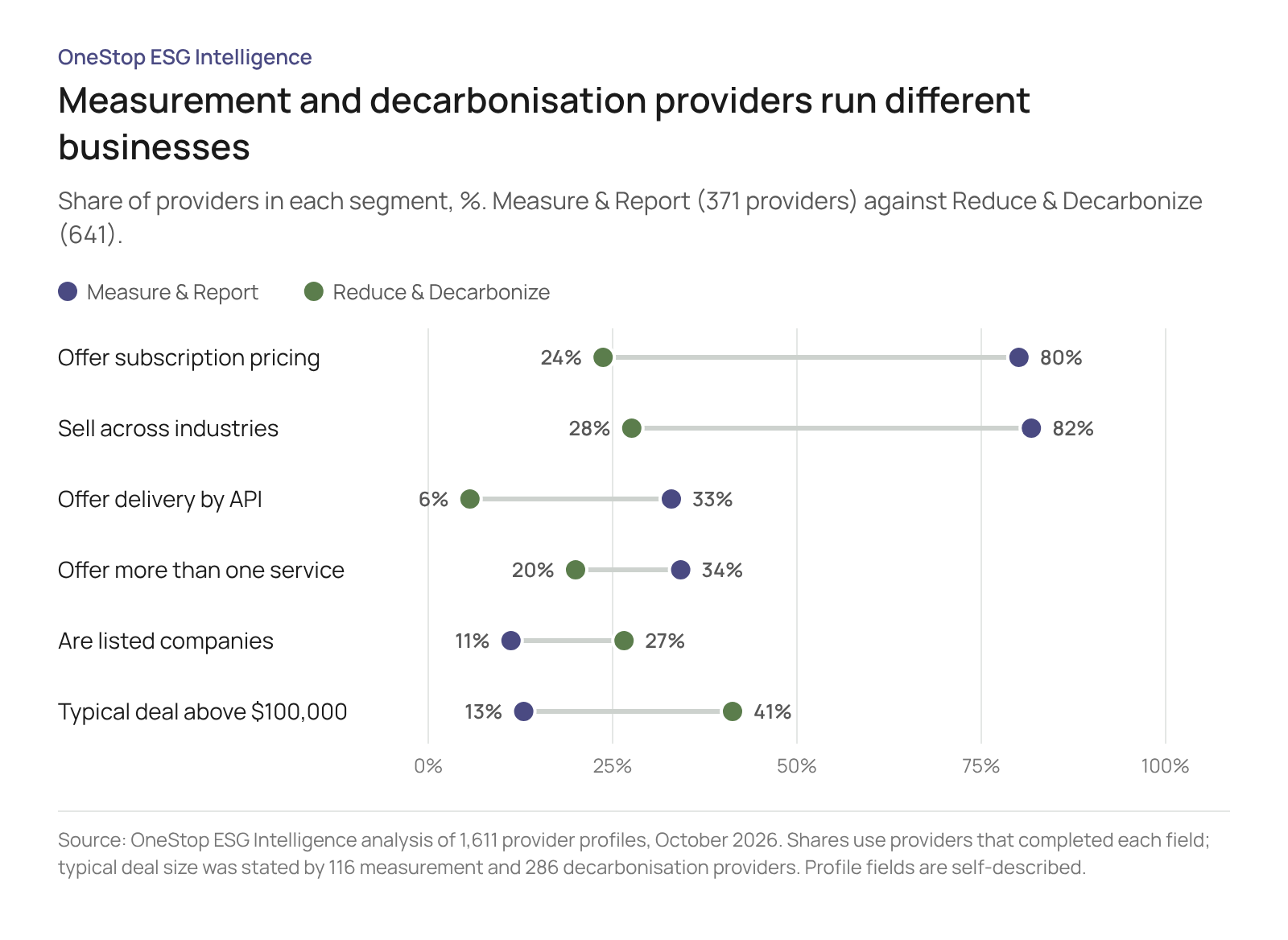
Measurement is a recurring-revenue software business that sells to every sector. 80% of measurement providers offer subscription pricing, 82% sell across industries and a third deliver data by API. Deals are modest: two-thirds of measurement providers that state a typical deal size put it below $50,000.
Decarbonisation is a project business with large deals and a sector focus. Only 24% of decarbonisation providers offer subscriptions and 28% sell across industries. Of those that state a typical deal size, 41% put it above $100,000. And 27% of decarbonisation providers are listed companies, against 11% in measurement.
Two points matter for anyone choosing a provider: First, prices are hard to compare: 86% of providers say they price on a quote basis. Second, many providers are small: nearly a third have fewer than 50 customers. For software, look for security certification: among measurement providers that list certifications, 55% hold ISO 27001 and 52% SOC 2.
4. The market’s enterprise focus
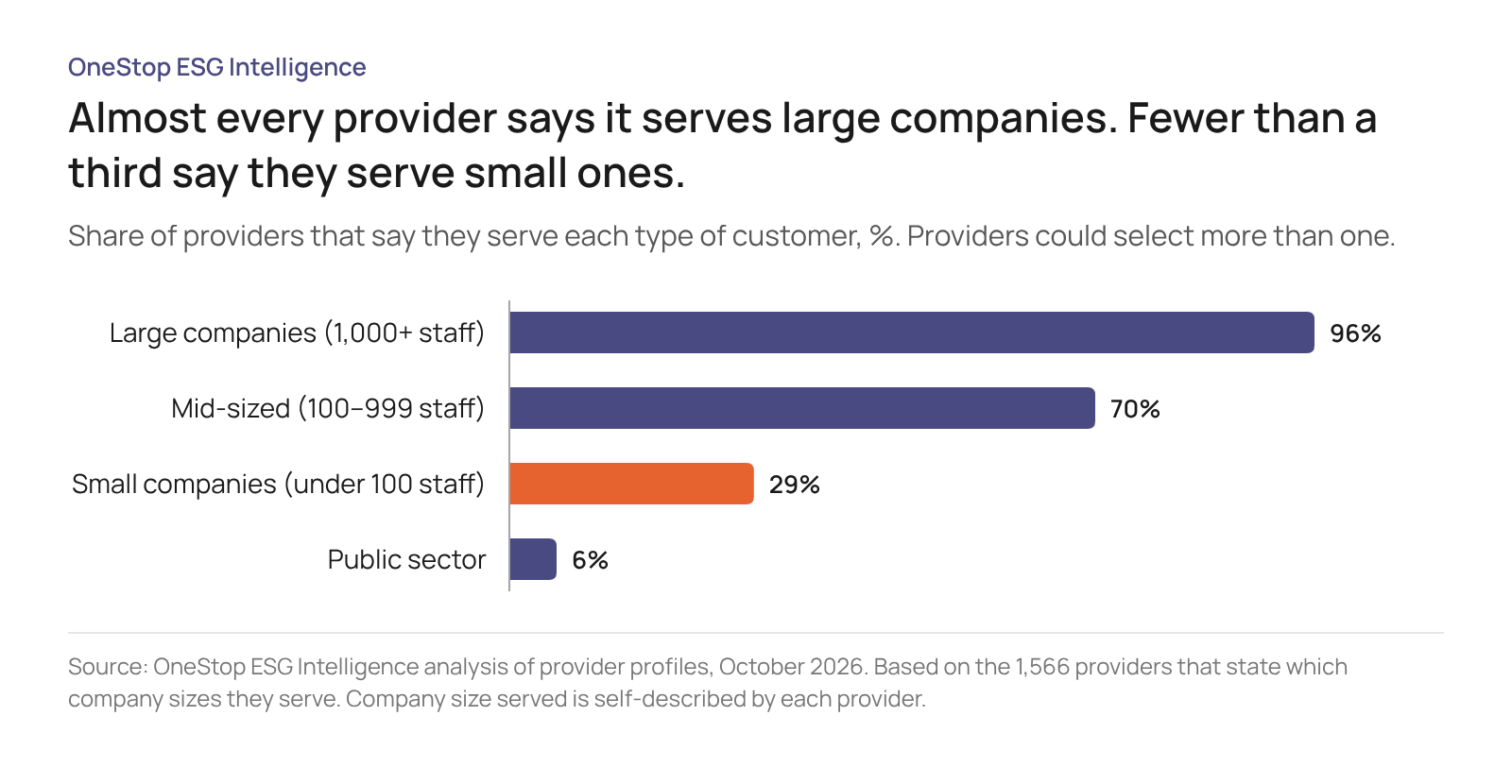
Nearly all providers (96%) say they serve companies with more than 1,000 employees, and most list several customer sizes. Only 29% say they serve companies with fewer than 100. Food and agriculture is the exception: two-thirds of its providers say they serve smaller customers. These are the customers providers say they target, not a measure of their actual customer mix, but the focus is clear.
This matters more after the 2026 rule changes. The revised CSRD, which entered into force at EU level in March 2026 and is now being transposed into national law, applies to EU companies with more than 1,000 employees and €450 million in turnover. Those are the customers most providers already target. The same rules limit what those companies can ask of suppliers with fewer than 1,000 employees to the voluntary SME standard (VSME). That gives smaller suppliers a standard set of data to provide, and many have no one in-house to produce it. Few providers say they serve companies of that size, which points to a potential opening.
Positioning is also tilted towards Europe. Among measurement providers that list the frameworks they align with, 75% cite CSRD and only one cites California’s rules. Yet the first Scope 1 and 2 emissions reports under California’s SB 253 are due on 10 November 2026 from companies with more than $1 billion in revenue.
5. Where organisations’ attention went
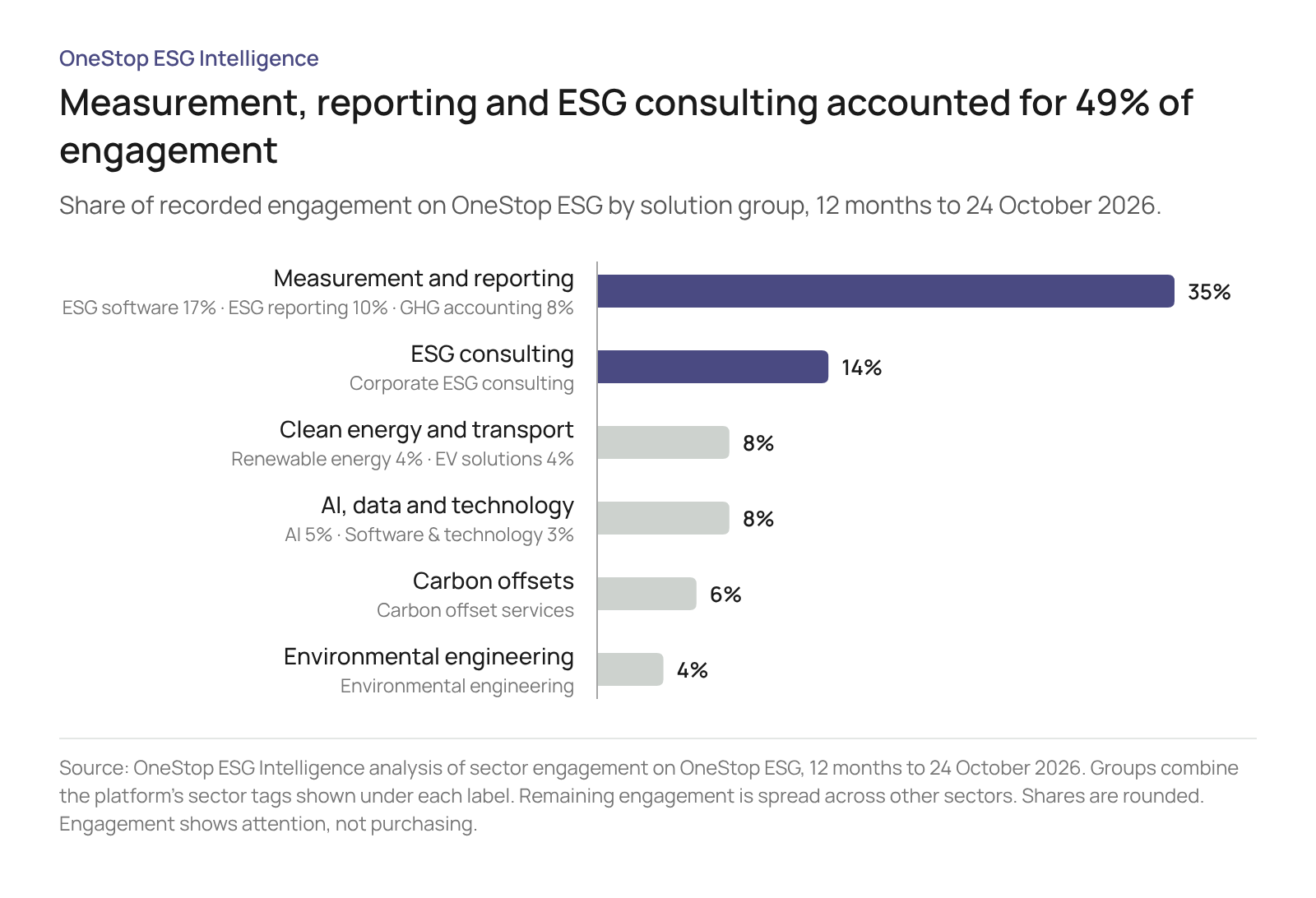
Over the 12 months to 24 October 2026, measurement and reporting solutions (ESG software, ESG reporting and GHG accounting) accounted for 35% of recorded sector engagement on OneStop ESG, and ESG consulting for a further 14%: 49% in total. Clean energy and transport drew 8%, AI, data and technology 8%, carbon offsets 6% and environmental engineering 4%.
These figures show which solutions attracted attention, not purchasing decisions or industry-wide demand. Future editions will examine whether the patterns persist and how searches turn into deeper engagement with providers.
6. Data skills are appearing more often in green jobs
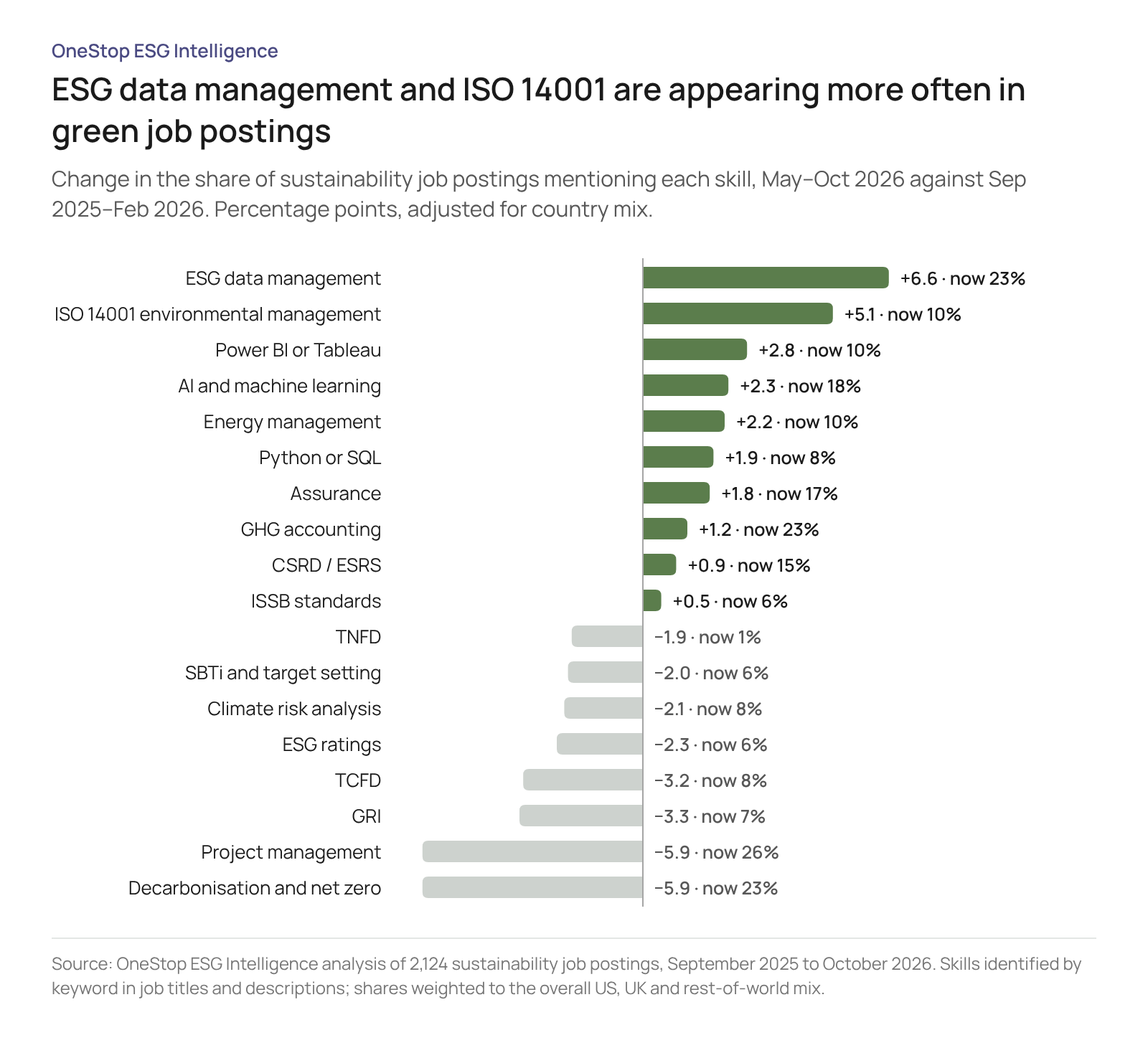
Across the 2,124 green job postings we analysed, ESG data management showed the largest increase. It appeared in 23% of postings between May and October 2026, up from 17% between September 2025 and February 2026. Mentions of ISO 14001 environmental management doubled from 5% to 10%.
Framework-specific skills are fading. Mentions of TCFD fell from 11% to 8% and GRI from 10% to 7%, as reporting moves to ISSB and the EU’s ESRS standards.
The sample also includes more junior roles. Entry-level postings rose from 3% to 10% of the total and mid-level from 31% to 42%, while senior and executive roles fell.
Course catalogues lean the other way. Of 357 sustainability courses, 18 (5%) are categorised under data, ratings and measurement, while 56% sit under strategy, governance or climate and carbon, and 12% are at an advanced level. Course categories do not capture every skill a programme teaches, but dedicated data courses are a small share of what is on offer. Beyond our data, LinkedIn’s Global Green Skills Report 2026 found that the share of green hiring grew 25% year on year, while the share of workers with green skills grew 13%.
7. Our outlook for 2027
- Consolidation in measurement. Expect fewer independent carbon accounting and ESG reporting providers by the end of 2027.
- A move to smaller customers. Providers will offer VSME-ready packages for mid-sized and smaller suppliers, priced well below today’s typical measurement deal.
- Assurance as a medium-term opportunity. California will accept its first reports in November 2026 without third-party assurance, with assurance requirements phasing in over later reporting years. Demand for verification is likely to build from there, and specialists are still few.
- Data as the core skill. ESG data management will overtake GHG accounting as the technical skill most often asked for in green job postings.
We will score each of these predictions in the next edition.
What this means
For companies choosing providers: There is a broad range of potential suppliers to assess in decarbonisation and carbon software, but real choice depends on your technical requirements, location and each provider’s delivery capability. Compare quotes, ask for references and check what happens to your data if a provider is acquired.
For providers: Measurement is crowded and consolidating, so scale and integration will matter. Potential openings include smaller companies, US reporting and, over the medium term, assurance.
For professionals: Data-management, systems and operational skills are appearing more often in job postings, while dedicated data courses remain a small share of training.
About the data
The analysis covers 1,611 sustainability solution providers on OneStop ESG across 68 countries, analysed in October 2026. Each provider is counted once, in its main market segment. Pricing, customer, deal-size and delivery figures come from provider profiles and reflect what providers state, and each share is based on the providers that completed that field. Founding trends use the 855 providers that disclose a founding year. Engagement data is the share of recorded engagement by sector on OneStop ESG over the 12 months to 24 October 2026. The platform’s sector tags are combined into the groups shown in chart 5. These groups do not map exactly to the six market segments, so engagement shares are not compared directly with provider shares. Engagement shows attention, not purchasing. Job data covers 2,124 postings, with skill shares weighted to the US, UK and rest-of-world mix to limit the effect of shifts in where jobs are posted. References to regulation reflect rules in force in October 2026. External sources cited: IDC (May 2026) and LinkedIn’s Global Green Skills Report 2026 (October 2026).
About OneStop ESG Intelligence
OneStop ESG Intelligence is OneStop ESG’s research programme. It tracks the sustainability solutions market from three sides: the providers that sell solutions, the organisations looking for them, and the jobs and training that build the workforce. This is the first edition of a regular series. Each edition will update these findings, score our predictions and add new data.
Subscribe to our newsletter for more insights, case studies, and ESG intelligence.
Keep abreast of the top ESG Events on OneStop ESG Events.
OneStop ESG Educate: Your go-to source for top ESG courses and training programs tailored to your needs.
Stay informed with the latest insights on OneStop ESG News.
Discover meaningful career opportunities on OneStop ESG Jobs.


Comments
Have a thought on this? Share it with other readers.