
The redesigned OneStop ESG Marketplace adds AI search, use-case browsing, richer profiles and client reviews to help buyers find and compare providers.
A company may know the sustainability problem it needs to solve without knowing which provider, technology or service to look for. It might need to measure its carbon footprint, install solar across several sites, improve supply-chain transparency or find support for sustainability reporting.
The OneStop ESG Marketplace relaunched on 28 September 2026 with AI search, use-case browsing, expanded company profiles, case studies and client reviews. The Marketplace now brings together 1,600+ companies across six use cases, 28 categories and 90 subcategories, giving buyers several ways to move from a business requirement to relevant solution providers.
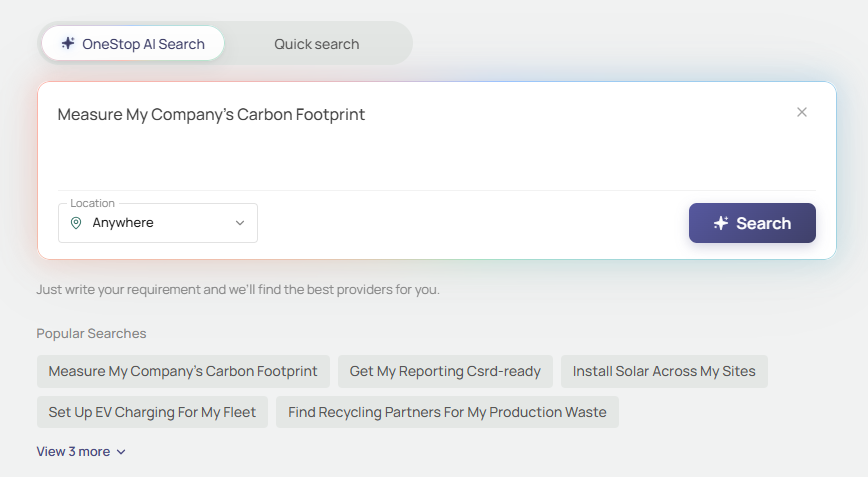
OneStop ESG Marketplace AI search for providers that can help measure a company’s carbon footprint.
1. Search by what you need
OneStop AI Search lets users describe a sustainability requirement in their own words rather than beginning with a company name or having to know exactly which category it belongs to.
A user might search “Measure My Company’s Carbon Footprint” or “Install Solar Across My Sites.” The Marketplace then surfaces providers related to that requirement. If you already know the company or product you are looking for, Quick search provides a more direct route.
2. See how AI search works
Measuring a company’s carbon footprint
Suppose a sustainability team is preparing an emissions inventory. Instead of beginning with a long list of carbon accounting companies, it can search “Measure My Company’s Carbon Footprint.”
The results provide a starting set of relevant providers. Filters help narrow the search, while individual company profiles provide more information on the available offerings. The questions can then become more specific: does the solution cover corporate emissions accounting, supplier data or decarbonisation planning? Is it software, advisory support or a combination of the two? Which industries and geographies does the company serve?
The search begins with the business requirement and helps turn it into a more focused provider shortlist.
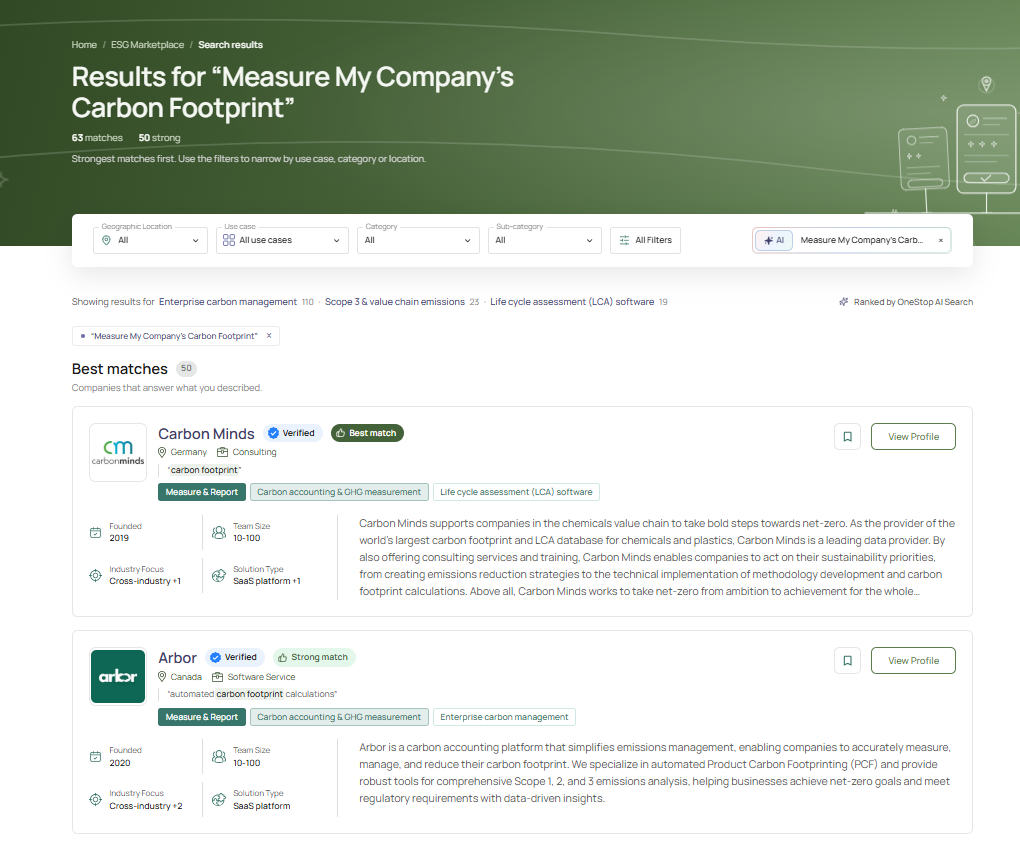
AI search results showing sustainability providers relevant to a company carbon footprint requirement.
Installing solar across multiple sites
The same process works for a different requirement. An operations team could search “Install Solar Across My Sites” and then assess whether the suggested providers work with commercial properties, support projects across multiple locations, and offer services such as design, installation, monitoring or maintenance.
The requirement changes, but the process remains straightforward: describe the problem, review relevant providers, narrow the options and open the profiles that appear most suitable.
3. Browse by use case
AI search is one way to start. Buyers can also browse according to the type of sustainability work they are undertaking.
The six use cases are Reduce & Decarbonize, Measure & Report, Circular & Sustainable Operations, Food & Agriculture, Advisory & Strategy, and Remove & Offset. Each leads into more specific categories and subcategories.
A company working on emissions reduction might begin with Reduce & Decarbonize, while a reporting team could go directly to Measure & Report. Someone researching recycling, water or materials may start with Circular & Sustainable Operations.
The numbers also give a sense of the depth within these areas. Measure & Report currently includes 387 companies across nine categories, with filters covering industry, geography, certifications and reporting frameworks.
This route is useful when the broad objective is known but the organisation is still deciding which type of solution it needs.
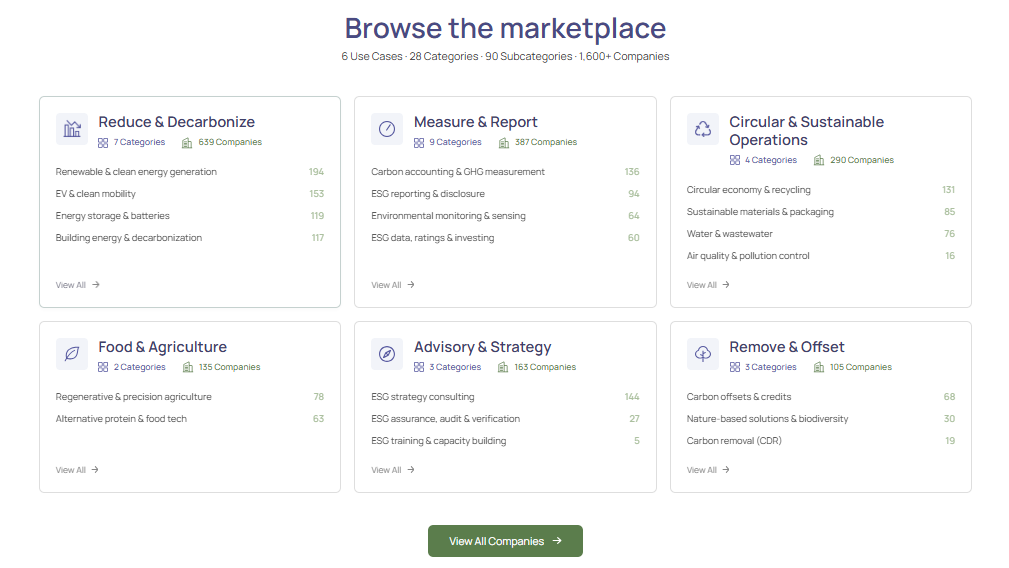 OneStop ESG Marketplace organised into six sustainability use cases, 28 categories and 90 subcategories.
4. Compare company profiles
Finding a company is only part of the research. The redesigned profiles bring more information about a provider into one place, helping buyers understand what it offers before making contact.
Depending on the information available, a profile may include products and services, industries served, geographic coverage, customer size, deployment model, pricing approach, reporting frameworks and other company information. Some listings also display structured fields such as Industry Focus, Solution Type, Frameworks and Geography, making key details easier to scan.
For a software buyer, that may mean checking how a platform is deployed, which organisations it is designed for and which reporting requirements it supports. Someone looking for consulting support may focus more on industry experience, service scope and geographic coverage.
Individual products and services can also be presented separately, giving buyers a clearer view of a specific offering rather than relying only on a general company description.
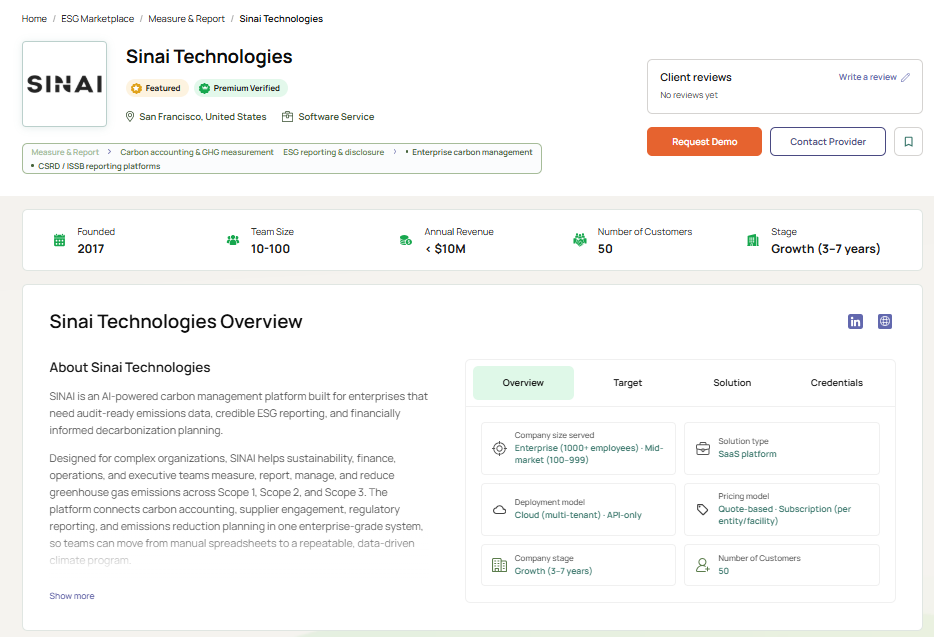 OneStop ESG company profile showing structured provider information, products and services.
5. Check previous projects
Where available, case studies provide another way to assess a provider. Rather than looking only at which organisations a company has worked with, buyers can focus on the work itself: what problem was the client trying to solve, what was included in the project, what did the provider deliver and what outcomes were reported?
A case study involving a similar industry, business problem or project scope may be particularly useful. It gives the buyer more context for deciding whether the provider’s previous experience is relevant to the requirement at hand.
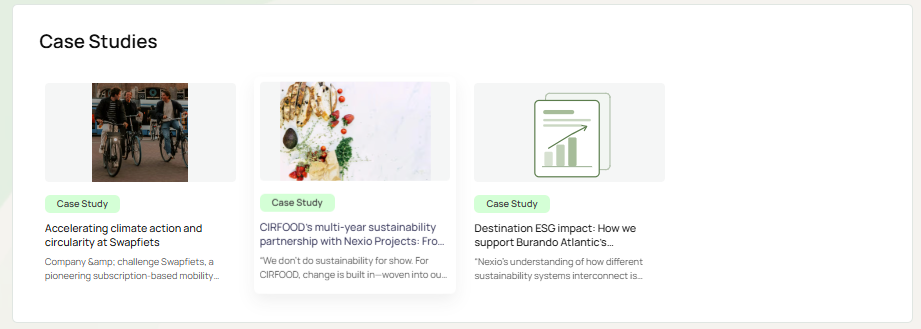
Provider case study on the OneStop ESG Marketplace showing previous project experience.
6. Read or leave client reviews
Provider profiles have a Client reviews section. Where reviews have been published, buyers can consider that feedback alongside the company’s profile, products, services and case studies.
Past clients can also contribute. Open the profile of a company you have worked with, select Write a review and submit feedback about your experience. Every submitted review is checked and verified before it is published.
For buyers, reviews add another perspective when assessing a provider. For companies, they give existing clients a way to share their experience and add independent feedback to the profile.
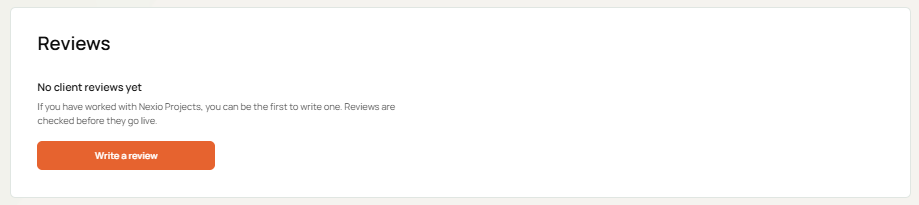
Client reviews and Write a review option on a OneStop ESG Marketplace provider profile.
7. Contact the providers you want to speak with
Once the research has narrowed the field, provider profiles include Request Demo and Contact Provider options.
By this stage, the buyer has already had the opportunity to understand the company’s offering, look at relevant project experience and read client feedback where available. The discussion can therefore begin with questions about a particular product, service, project or business requirement rather than simply asking what the company does.
8. Are you a sustainability solution provider?
Sustainability solution providers can get listed on the OneStop ESG Marketplace and present their offering to businesses researching relevant products and services.
If your company is already listed, review the profile and make sure it clearly explains what you offer, who you serve, where you operate and the type of work you have completed. Add individual products or services where relevant, include useful case studies and invite clients you have worked with to leave a review.
A more complete profile gives prospective buyers more information when deciding whether your company fits their requirements.
Get listed on the OneStop ESG Marketplace and complete your company profile.
Frequently asked questions
What is the OneStop ESG Marketplace?
The OneStop ESG Marketplace helps businesses find and compare sustainability solution providers across areas including decarbonisation, measurement and reporting, circular operations, food and agriculture, advisory services, and carbon removal and offsets.
Is the OneStop ESG Marketplace free for buyers?
Yes. The OneStop ESG Marketplace is free for buyers to use. Users can search for providers, browse sustainability use cases and review company profiles without paying for access. Providers can choose paid listing and visibility options.
What is the difference between OneStop AI Search and Quick search?
OneStop AI Search is designed for buyers who know the problem they need to solve but may not know which provider or solution to look for. Describe the requirement in your own words and the Marketplace surfaces relevant providers.
Quick search is for users who already know the company or product they want to find and want a more direct route to relevant results.
Do I need to know which type of sustainability solution I need?
No. You can start with a business requirement using AI search or browse through six use cases, 28 categories and 90 subcategories to understand the types of solutions available.
Can I search for a company I already know?
Yes. Quick search is designed for users who already know the company or product they want to find.
Can I contact providers through the Marketplace?
Yes. Provider profiles include Request Demo and Contact Provider, allowing buyers to move from research to a direct conversation.
How do client reviews work?
Company profiles have a Client reviews section. If you have worked with a provider, select Write a review on its profile to submit feedback. All submitted reviews are checked and verified before they are published.
How can my company get listed?
Sustainability solution providers can apply to List your company on the OneStop ESG Marketplace. After logging in, providers can complete the company onboarding process and submit their information.
Once listed, companies can build out their profiles with information about their products, services and previous work, add case studies where relevant, and invite clients to leave reviews. Providers can also choose paid listing and visibility options.
Start your search
The redesigned Marketplace gives buyers several ways to move from a sustainability requirement to relevant companies. Describe what you need with AI search, browse by use case, compare provider profiles, review previous projects and client feedback, then contact the companies that fit your requirements.
Explore the OneStop ESG Marketplace.
Daniel Dun
Senior Advisor
Daniel is a finance professional with experience across commodities trading, investment banking, and private credit, having worked with firms like Glencore and BTG Pactual across global markets. He has worked on carbon offset products and project finance, with a focus on sustainability and capital markets. He has also supported product management at BlockFi, helping bridge DeFi and traditional finance. Daniel holds a Master’s degree in Economics.

.png%3Falt%3Dmedia%26token%3D257ff9e2-98db-47c7-b0ac-0cf448f5a44d&w=1920&q=75)


%252010th%2520Edition.png%3Falt%3Dmedia%26token%3D28295a93-506a-42b8-aef2-79cd319b0edc&w=3840&q=75)
Comments
Have a thought on this? Share it with other readers.