%2520(1).jpg%3Falt%3Dmedia%26token%3Ded0728eb-7a29-4350-8c48-3d4e069ad6d8&w=3840&q=75)
Biodiversity credits are a new way for companies and communities to fund real, measurable efforts that protect and restore nature worldwide.
The loss of biodiversity today is accelerating, with wildlife populations dropping by 69 percent (WWF Living Planet Report 2022) since 1970 and more than one million species now facing the possibility of extinction. Meanwhile, conservation efforts struggle to keep pace with what’s needed, and the world faces a gap of nearly 700 billion dollars each year between available funding and nature’s requirements. This shortage has prompted companies and governments to explore new ways to protect nature, and at the heart of these discussions are biodiversity credits.
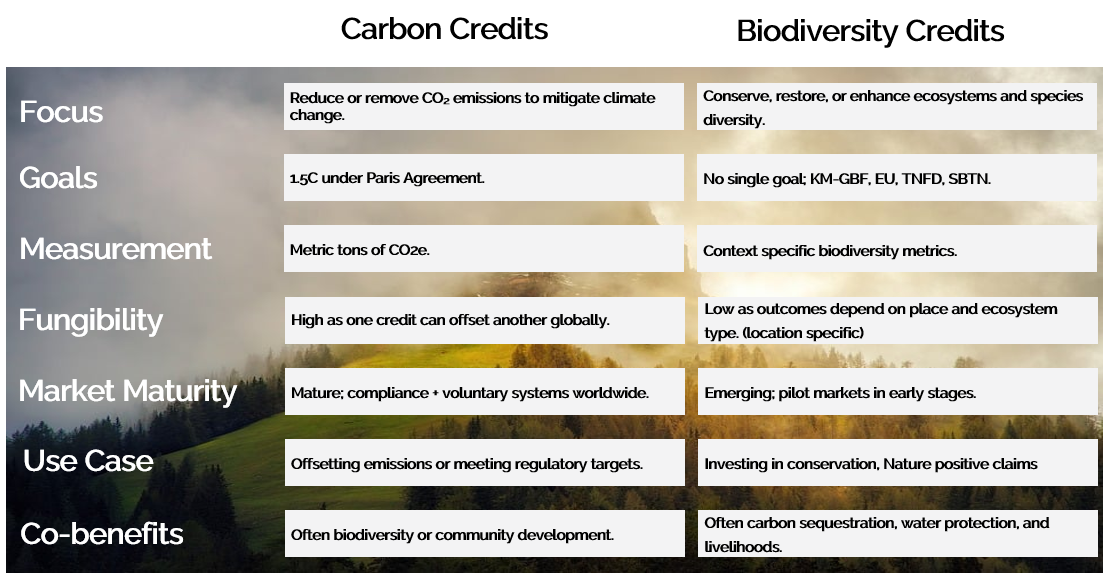
Unlike traditional carbon credits, biodiversity credits are a different kind of tool for funding conservation. Rather than just making up for emissions somewhere else, these credits funnel private funding directly into projects that restore or safeguard nature in specific locations. With nature becoming a growing concern for corporate risk, biodiversity credits provide organizations with a practical way to put sustainability strategies into action.
The European Commission has signaled increasing attention to biodiversity markets, with consultation papers and policy dialogues underway to explore how nature credit mechanisms could be integrated into broader sustainability finance frameworks.
💡 The biodiversity credit market is entering a new phase.. There are now 53 active or developing projects worldwide, and official European support means new infrastructure is coming together quicker than experts predicted. A decisive moment was the 2022 Kunming-Montreal Global Biodiversity Framework, when 196 governments committed to mobilize 200 billion dollars each year for nature by 2030.
What Are Biodiversity Credits?
A biodiversity credit is like a certificate showing that some land or water has been protected or restored. The credit means someone has taken real steps to help animals, plants, or habitats thrive. The big difference from carbon credits is that you can’t make up for losing nature in one place by helping it somewhere else. Each location is special and each project is unique.
When a company buys a biodiversity credit, its money pays for conservation, like keeping a rainforest safe or bringing back wetlands. This means the company can show real results and the project gets funding.
Credits come in many forms and prices. The simplest kind might mean a hectare (about two football fields) of forest is cared for, maybe by a local community, for a whole year. This can cost between 8 and 10 dollars. More complicated credits cover projects that help rare animals or plants and can cost a lot more.
The approach has been gaining recognition, and discussions with Colombian regulatory bodies are ongoing regarding validation and broader application. The project continues to develop and expand, with credits being prepared for wider issuance.
The Project Developer Landscape
Biodiversity credits have drawn in conservation groups, Indigenous communities, innovative entrepreneurs, and organizations experienced in carbon markets. Verra which is the world’s biggest standard setter for voluntary carbon launched its Nature Framework in October 2024, introducing credits based on net biodiversity improvements in designated areas. This system recognizes that biodiversity must be measured locally, and these nature credits aren’t for offsetting damage done elsewhere.
"When we began, we thought of this as carbon 2.0," said Dame Amelia Fawcett, co-chair of the International Advisory Panel on Biodiversity Credits. "But we quickly realized that essential principles from the carbon market cannot be directly applied to biodiversity credits. Most importantly, while carbon emissions in one region can be offset by carbon removal in another, it is now widely recognized that international offsetting is not a viable approach for biodiversity."
This insight shapes the current standards. Plan Vivo, another trusted organization, is evaluating around ten biodiversity projects and expects to issue credits within the year. The Biodiversity Credit Alliance, formed in the wake of the Kunming-Montreal Framework, is developing new standards and supporting market expansion. Companies like rePLANET have validated their credit methodologies, and GlaxoSmithKline, for instance, has committed to purchasing biodiversity credits tied to cloud forest conservation in Honduras valued at 5 dollars for each biodiversity unit and 10 dollars for carbon supporting a twelve-year restoration effort.
Integrity Challenge
Momentum in the market hasn’t come without criticism. Some researchers question whether biodiversity credits meaningfully address conservation goals or just open more doors for greenwashing. Concerns range from how “additionality” is proven (ensuring projects wouldn’t occur without credit funding) to issues of “leakage” (habitat protection in one area merely shifting destruction elsewhere), and challenges securing project permanence.
Regulators are responding. The European Commission’s 2025 roadmap stresses the importance of integrity, calling for robust monitoring, reporting, and verification. Modern technology, including environmental DNA analysis, remote sensors, and aerial imagery, are being adopted to make sure reported outcomes reflect reality.
Angeli Patel, Executive Director at the Berkeley Center for Law and Business, shares that safeguards and transparency are essential, they’re the only path to building broader public trust, especially in a space where overstating ESG results can quickly backfire.
💡 High-integrity credits, those involving Indigenous people and local communities command significant premiums on the market, sometimes 15 to 300 percent higher than average. Those projects deliver both ecological gains and meaningful social outcomes.
Market Drivers and Corporate Use Cases
Several trends are fueling demand for biodiversity credits. Regulatory requirements are tightening worldwide, with Europe and other regions now asking for companies to disclose and measure their nature footprint. Buying credits is one way for companies to demonstrate progress.
In many cases, restoring biodiversity also helps with climate goals. Mangrove restoration, for example, not only stores carbon but also protects coastal fisheries and communities from storms. Wetland revival can both shelter wildlife and trap sizable carbon stocks. Because some projects can now issue both carbon and biodiversity credits, the financial case for investing is stronger than ever.
Some companies, especially those reliant on agricultural supply chains, are buying credits to ensure local ecosystem stability. If a confectioner relies on fruit growers, investing in credits linked to pollinator protection safeguards future harvests. Businesses facing water scarcity can fund watershed restoration and document their contribution through credits.
Major early adopters include GlaxoSmithKline, which is helping to protect Honduras cloud forest home to 24 species found nowhere else on Earth. Nordic banks and finance groups have started purchasing credits from projects near their core markets, but overall adoption is still led by select European and Latin American firms.
Standards
Wide acceptance of biodiversity credits depends on robust standards. Beyond Verra’s Nature Framework, Colombia’s Cercarbono developed the first voluntary methodology working with Indigenous communities and using an Indicator Species approach rooted in local knowledge.
Strong standards now require independent verification, additionality checks, double-counting prevention, and rigorous reporting. Projects must use up-to-date technology for monitoring and validation, and results are checked against baseline data and control sites.
The European Commission’s plan calls for unified credit mechanisms and co-benefits for both biodiversity and broader ecosystem services. It also insists that credits only be issued upon certification, that strong governance and transparency systems prevent greenwashing, and that credits can’t be counted twice.
EU Environment Commissioner Jessika Roswall captured the philosophy well: "This is not about turning nature into a commodity, but about recognising and rewarding actions that restore and sustain nature." The EU has begun consultations, bringing together experts from government, science, communities, and industry to shape future standards.
Challenges
Challenges remain. The market is fragmented with diverse methodologies and regional differences. Current annual transactions are just 8 million dollars far below most forecasts for quick scaling.
Verification and additionality are still challenging, and critics point to how developers can sometimes choose the most favorable valuation method, risking overstatement of actual benefits. Strong community engagement is also non-negotiable: the best projects employ fair benefit sharing and protect Indigenous rights, but poor contracting and middlemen pose real risks lessons learned from past offset markets.
Finally, the funding gap looms large. Even if the market exceeds expectations, biodiversity credit transactions alone can’t replace public funding or direct government investment. Much wider action is needed to reverse nature loss at the scale required.
What's Next
2025 is shaping up as a defining year. Verra’s Nature Framework is launching with a digital-first strategy, and will open to all eligible projects by year’s end. The European Commission’s roadmap lays out a stepwise pathway, aiming for scaled nature credit markets by 2027. Savimbo in Colombia achieved certification of its indicator methodology and put the first credits on global exchanges.
What matters now is whether market demand grows, standards converge, and if real, lasting conservation results follow. As these questions are answered over the next few years, ESG and Sustainability leaders can use biodiversity credits to demonstrate authenticity and impact. Early adopters will set the standard, support future regulation, and advance institutional expertise, shaping not just their firms but the mechanisms themselves.
But as always, caution and integrity matter. Companies should seek projects proven to deliver genuine ecological and social results not just numbers on paper. Used right, biodiversity credits can help businesses back nature with real investment, but they’re no substitute for broader sustainability action.
With new rules, smarter technology, and policy alignment, biodiversity credits are poised to take a meaningful role in conservation finance within the next five years. Their true value will depend on whether the sector keeps community engagement, scientific rigor, and transparency at its core.
Subscribe to our newsletter for more insights, case studies, and ESG intelligence.
Explore ESG Solutions on our marketplace - OneStop ESG Marketplace.
Keep abreast of the top ESG Events on OneStop ESG Events.
OneStop ESG Educate: Your go-to source for top ESG courses and training programs tailored to your needs.
Stay informed with the latest insights on OneStop ESG News.
Discover meaningful career opportunities on OneStop ESG Jobs.

.png%3Falt%3Dmedia%26token%3D3179e468-a3a8-4bf4-a2bf-f82a785f24f6&w=1920&q=75)
.png%3Falt%3Dmedia%26token%3D4dc26fee-df98-49a6-9aea-3359cd3da6e8&w=1920&q=75)


%252010th%2520Edition.png%3Falt%3Dmedia%26token%3D28295a93-506a-42b8-aef2-79cd319b0edc&w=3840&q=75)
Comments
Have a thought on this? Share it with other readers.