
What waste management consulting firms do, and why they matter
Waste management consulting firms help cities, companies, and utilities design and operate systems for collection, recycling, organics, treatment, and disposal of solid and hazardous waste. They combine planning, engineering, policy, economics, and increasingly digital tools to reduce landfill dependence, increase recycling and recovery, manage landfill gas and leachate, and support circular-economy goals.
The market is led by large environmental and engineering consultancies such as AECOM, WSP, Tetra Tech, Ramboll, GHD and SLR, along with pure-play waste specialists like SCS Engineers, Eunomia and MSW Consultants. At the same time, a new wave of firms is reshaping how organisations plan and run waste systems. This wave includes GBB, WIH Resource Group, Ricardo, and Global Trash Solutions, as well as digital and AI players like Greyparrot and Clearago, and operator-backed advisory from Veolia and SUEZ.
Why 2026 is a pivotal year for waste consulting demand
Three regulatory and market shifts in 2026 are driving unusually high demand for waste-management advisory services, particularly around compliance, infrastructure planning, and producer-responsibility reporting:
EU Packaging and Packaging Waste Regulation (PPWR) enters into force on 12 August 2026, imposing recyclability requirements, reuse targets, a PFAS ban in food packaging, and stronger EPR obligations across all EU member states (O’Melveny, April 2026).
California’s SB 54 permanent regulations were approved by the Office of Administrative Law on 1 May 2026, with producer fee schedules expected later in the year and the requirement to join a Producer Responsibility Organization by 1 January 2027 (CalRecycle; Mayer Brown, February 2026).
The US EPA published the third iteration of its interim PFAS destruction and disposal guidance on 20 April 2026, with a 60-day public-comment period ending 29 June 2026, and is targeting April 2026 for finalising nine PFAS compounds as RCRA hazardous constituents (Faegre Drinker, May 2026; BCLP, February 2026).
Operator-side consolidation is also reshaping the buyer landscape. In April 2026, GFL Environmental announced the $4.64 billion acquisition of Secure Waste Infrastructure, expected to close in the second half of 2026 (Recycling Today, April 2026). Republic Services has signalled another roughly $1 billion in tuck-in acquisitions for 2026, after spending $1.1 billion in 2025 (Waste Dive, February 2026). Together, these shifts mean buyers of consulting services are facing a more concentrated operator market, tighter regulatory deadlines, and growing demand for evidence-based advice on EPR, PFAS, and circular-economy strategy.
How this list was compiled
This guide draws on three categories of sources: (a) industry trade publications and analyst overviews, primarily Waste Dive, Waste360, Recycling Today, and Resource Recycling; (b) regulatory and government sources including the US EPA, CalRecycle, the UK Department for Environment, Food and Rural Affairs (Defra), the European Commission, and the Maine Department of Environmental Protection; and (c) firm-disclosed materials including company websites, annual reports, and project track records published between January 2025 and May 2026. Law-firm regulatory briefings from Mayer Brown, DLA Piper, BCLP, O’Melveny, and Faegre Drinker were used to confirm 2026 compliance timelines.
We have prioritised firms with (a) demonstrable waste-sector specialisation, (b) a multi-year operating history, and (c) a public track record of municipal, industrial, or infrastructure-scale engagements. Firms are grouped into established leaders (broad engineering and advisory firms with mature waste practices) and new-age and specialist firms (boutique, regional, digital, and operator-backed advisors). Numbering within each section is reading order, not a strict ranking. The closing alignment table maps client situations to the most relevant providers.
The waste consulting landscape at a glance
The matrix below positions all 19 firms covered in this guide by firm scale (boutique through global) and waste-sector specialisation (pure-play through diversified). The four resulting clusters describe distinct engagement profiles and pricing models, which are summarised in the fee-range table that follows.
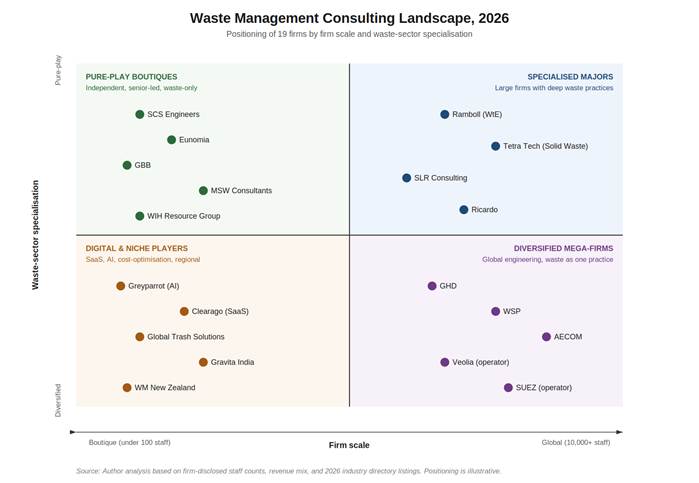
Waste management consulting landscape, 2026: positioning of 19 firms by firm scale and waste-sector specialisation
Indicative fee ranges by firm tier (2026)
Waste-consulting fees are rarely published, but they cluster predictably by firm tier. The table below presents an author-constructed estimate based on (a) published blended consulting rates in the management and environmental-consulting markets (Slideworks, Consulting Success, ConsultFees, March 2026), (b) publicly disclosed federal contract rate cards (GSA), and (c) typical scope ranges reported by buyers in trade press. Treat these as planning bands, not quotes.
|
Firm tier |
Example firms |
Indicative blended rate |
Typical engagement size |
Engagement model |
|
Global mega-firm |
AECOM, WSP, Tetra Tech, Ramboll, GHD |
$250–$500 / hour |
$150K–$2M+ per project |
Fixed-fee or T&M, multi-disciplinary teams |
|
Specialised major |
SCS Engineers, SLR, Ricardo |
$200–$400 / hour |
$50K–$500K per project |
Fixed-fee, senior-led with engineering bench |
|
Pure-play boutique |
GBB, Eunomia, MSW Consultants, WIH |
$200–$350 / hour |
$25K–$250K per project |
Fixed-fee or retainer, senior-led |
|
Cost-optimisation boutique |
Global Trash Solutions |
Savings-share (typically 30–50% of year-one savings) |
Implementation often $0 upfront |
Performance-based |
|
Digital / SaaS |
Greyparrot, Clearago |
Subscription, $10K–$200K+ / year per site |
Multi-year platform contract |
Annual or multi-year SaaS |
|
Operator-affiliated advisory |
Veolia, SUEZ |
Often bundled with operations contract |
Varies; tied to implementation |
Advisory plus implementation |
Quick comparison of leading waste management consulting companies
|
Firm |
HQ |
Core focus in waste |
Target clients |
Geographic coverage |
Notable strength |
|
SCS Engineers |
Long Beach, USA |
Solid & hazardous waste, landfills, LFG, organics, WtE |
Municipalities, waste firms, industry, PE |
Primarily US with global projects |
One of the US’s top solid-waste consulting firms, with waste as primary business (~80% of revenue) |
|
Tetra Tech (Solid Waste) |
Pasadena, USA |
Solid-waste planning, landfill/LFG, organics, PFAS/leachate |
Cities, counties, utilities, private operators |
Global, strong North America |
Long-term focus on solid-waste operations and compliance with strong technical depth |
|
Ramboll (Waste Infrastructure & WtE) |
Copenhagen, Denmark |
Waste infrastructure, WtE, organics/AD, circular systems |
Municipalities, utilities, developers |
Global (projects in 55+ countries) |
World-leading WtE consultant with 2,500+ projects and 200+ units delivered or retrofitted |
|
AECOM |
Dallas, USA |
Solid-waste planning, facilities, environmental services in infrastructure programmes |
Governments, utilities, integrated waste players |
Global |
Top global environmental consultancy with strong waste and resource-recovery capability |
|
WSP |
Montreal, Canada |
Waste and resource-management strategies and audits within environmental practice |
Municipalities, corporates, infrastructure owners |
Global |
Strategic waste-management and minimisation programmes integrated with climate and ESG |
|
GHD |
Sydney, Australia |
Waste, resource recovery, landfills, contamination |
Councils, utilities, industry |
ANZ with global projects |
Leading ANZ solid-waste and materials-recovery engineering capability |
|
SLR Consulting |
UK HQ |
Sustainable waste-management and circular-economy strategies |
Energy, industry, municipalities, investors |
Global |
Full spectrum from minimisation and reuse to energy recovery and disposal |
|
Eunomia Research & Consulting |
UK / NZ |
Waste & recycling policy, strategy, EPR and circular-economy design |
Governments, producers, NGOs |
UK, Europe, NZ and beyond |
Leading evidence-based advisor on waste minimisation, recycling, and EPR |
|
MSW Consultants |
USA |
Data-driven optimisation of public-sector waste and recycling systems |
Municipalities, agencies, NGOs, large generators |
US-focused |
Deep expertise in waste characterisation, route optimisation, and zero-waste plans |
|
Gershman, Brickner & Bratton (GBB) |
USA |
Solid-waste planning, MRF, composting, WtE and sustainable development parks |
Municipalities, private waste operators, developers |
Primarily North America with global work |
Long-standing pure-play solid-waste consultant with custom, independent solutions |
Top waste management consulting companies (established leaders)
1. SCS Engineers
SCS Engineers is an employee-owned environmental engineering, consulting, and construction firm whose primary practice is waste management, covering solid and hazardous waste, landfill gas, organics, and related environmental services. Waste management represents the majority of its experience and revenue, and the firm positions this as its core business.
Key features
- Solid-waste planning: waste-generation and characterisation studies, integrated solid-waste management plans, programme design and monitoring.
- Landfill and landfill-gas engineering, organics and diversion programmes, and waste-to-energy and renewable-energy projects.
- Design-build and OM&M services for waste facilities, including LFG systems and environmental controls.
Industries served
- Municipalities and regional waste authorities.
- Private waste-management companies and infrastructure investors.
Pros
- One of the US’s top solid-waste consulting firms, with around 80% of revenue from solid-waste materials-management projects.
- Deep operational understanding of haulers, MRFs, landfills, organics, and compliance, going well beyond high-level planning.
Cons
- Primarily North American focused, though it undertakes international work.
- Best suited to MSW and LFG projects rather than broader ESG strategy.
Best for
Cities, counties, and private waste operators needing end-to-end solid-waste and landfill solutions, from planning through design-build and long-term operations.
2. Tetra Tech (Solid Waste)
Tetra Tech’s solid-waste practice focuses on long-term operational, compliance, diversion, and revenue-generation needs of solid-waste systems. Its engineers and scientists leverage local knowledge and sustainable approaches to support existing operations and future growth.
Key features
- Landfill engineering, closure design, and air-quality and landfill-gas (LFG) services.
- Organics management and diversion strategies, including composting and processing facilities.
- Transfer, recycling, and processing-facility design; leachate and PFAS management; and evaluation of alternative waste-disposal technologies.
Industries served
- Municipalities, counties, and regional authorities.
- Private solid-waste operators and infrastructure owners.
Pros
- Strong technical depth and regulatory experience in solid-waste engineering and compliance.
- Global presence supporting multi-site and cross-border programmes.
Cons
- Part of a large organisation; governance and procurement processes can feel heavy for smaller clients.
- Less focused on upstream circular-policy design than some boutiques.
Best for
Local governments and operators needing robust engineering, compliance, and diversion support for landfills, organics, and PFAS-affected waste systems.
3. Ramboll (Waste Infrastructure & Waste-to-Energy)
Ramboll is widely recognised as a world-leading waste-to-energy and waste-infrastructure consultant, with more than 50 years of thermal-waste treatment experience. It has worked on WtE projects in 55 countries and delivered consulting services for close to 200 new units and retrofits, covering over 2,500 major WtE projects.
Key features
- Planning, engineering, procurement, and contract management for WtE plants and wider waste-infrastructure systems.
- Advisory on organics, anaerobic digestion, bioenergy, and renewable-carbon solutions.
- Support to maximise resource efficiency, circularity, and regulatory compliance in waste infrastructure.
Industries served
- Municipal and regional authorities.
- Utilities, project developers, and industrial parks.
Pros
- Unmatched track record in WtE and waste-infrastructure development worldwide.
- Strong understanding of technologies, suppliers, and facility operations across the waste value chain.
Cons
- Focused on infrastructure projects; less suited to purely organisational zero-waste or contract-optimisation work.
- Typically engaged on large, capital-intensive projects.
Best for
Clients developing WtE, organics, and circular-infrastructure projects that require advanced engineering and international best practice.
4. AECOM
AECOM is a global infrastructure and environmental consultancy repeatedly ranked among the top environmental and sustainability firms worldwide. Its waste-management work is embedded in larger environmental and infrastructure programmes, from municipal solid-waste planning to facility design and remediation.
Key features
- Solid-waste master-planning and integration of waste systems into urban and regional infrastructure.
- Engineering for landfills, transfer stations, recycling centres, and treatment facilities.
- Environmental permitting, impact assessment, and remediation for waste-related sites.
Industries served
- National and local governments.
- Utilities, integrated waste organisations, and infrastructure developers.
Pros
- Ability to combine waste-management consulting with transport, water, energy, and environmental design at scale.
- Strong credentials for donor-funded and public-sector mega-programmes.
Cons
- Not a pure-play waste consultancy; may focus more on infrastructure than on granular operational optimisation.
- Large-firm processes and pricing may not suit smaller municipalities.
Best for
Governments and large clients needing waste-management embedded in major infrastructure or environmental programmes.
5. WSP
WSP is a top global environmental and sustainability consultancy, with waste-management consulting integrated into its broader environment, infrastructure, and climate services. A 2026 market listing notes WSP’s specialisation in waste-management consulting, strategic advice, waste audits, and waste-minimisation programmes.
Key features
- Development of waste strategies and management plans, including audits and minimisation initiatives.
- Integration of waste, recycling, and circular-economy considerations into infrastructure and corporate sustainability programmes.
Industries served
- Municipalities and regional agencies.
- Corporates and infrastructure owners addressing waste within broader ESG programmes.
Pros
- Global footprint with strong environmental, climate, and resilience practices.
- Ability to link waste strategies directly to climate-risk, adaptation, and ESG frameworks.
Cons
- Waste is one of many service lines; less specialised than pure-play waste consultancies.
- Project depth can vary by geography.
Best for
Clients wanting strategic waste-management and circular-economy advice integrated into broader sustainability and infrastructure plans.
6. GHD
GHD is a global engineering and environmental consultancy with strong waste, contamination, and resource-recovery services, especially in Australia and New Zealand. Industry assessments list GHD among leading environmental and sustainability consulting firms.
Key features
- Solid-waste and resource-recovery planning; transfer-station and processing-facility design.
- Landfill design, leachate management, and contaminated-site remediation.
Industries served
- Local governments and regional councils.
- Utilities, mining, and industrial clients.
Pros
- Deep roots in ANZ waste and resource-recovery markets, with strong regulatory understanding.
- Balanced mix of environmental engineering and planning.
Cons
- Brand and footprint strongest in ANZ and selected markets.
- For high-level circular-policy work, clients may combine GHD with policy-oriented boutiques.
Best for
ANZ and regional clients needing engineering-led waste and resource-recovery solutions backed by local experience.
7. SLR Consulting
SLR is a global environmental and sustainability consultancy frequently cited as a leading provider in environmental services. It offers comprehensive sustainable waste-management services from minimisation and reuse through to recycling, composting, energy recovery, and final disposal.
Key features
- Waste-minimisation, reuse, recycling, and composting strategy development.
- Energy-recovery and disposal solutions integrated into circular-economy approaches.
Industries served
- Energy and industrial clients.
- Municipalities and infrastructure owners.
Pros
- Integrates circular-economy principles into practical waste-management strategies.
- Global footprint with sector-specific expertise across resources and infrastructure.
Cons
- Smaller than mega-firms; may have limited capacity on very large national programmes.
- May focus more on strategy than on detailed design-build.
Best for
Organisations wanting sustainability-driven waste strategies that align waste flows with circular-economy and ESG objectives.
8. Eunomia Research & Consulting
Eunomia is an independent environmental consultancy recognised as New Zealand’s foremost waste and recycling consultancy and a leading advisor on waste-minimisation and regulation in the UK and EU. It supports public and private clients with policy, strategy, and programme design across waste, recycling, and resource efficiency.
Key features
- Waste and recycling support, including service and facility research, cost modelling, market analysis, feasibility, and business cases.
- Policy and strategy work on waste-levy design, EPR schemes, and circular-economy frameworks.
- Data-driven waste and recycling strategies and prevention initiatives.
Industries served
- National, regional, and local governments.
- Private-sector organisations seeking improved waste and resource efficiency.
Pros
- Strong reputation for evidence-based waste policy and strategy, including national-level work.
- Deep experience in zero-waste, EPR, and marine-plastics and litter strategies.
Cons
- Primarily focused on UK, Europe, and NZ markets.
- Not a design-build firm; best paired with engineering partners for infrastructure.
Best for
Governments and corporates needing advanced waste-policy, EPR, and recycling-system design, especially in Europe/NZ contexts.
9. MSW Consultants
MSW Consultants is a management-consulting firm that specialises in the waste and recycling industries, providing data-driven solutions to optimise programmes for public and private clients. It focuses on improving efficiency and diversion, particularly for municipal systems.
Key features
- Waste-characterisation studies, collection-system audits, and route optimisation.
- Zero-waste plans, recycling and composting-programme design, and vendor-performance analysis.
Industries served
- Federal, state, and municipal clients.
- NGOs and private-sector generators.
Pros
- Highly focused on waste-system analytics and optimisation, not generic environmental consulting.
- Tailored, data-driven recommendations that improve operational performance and diversion rates.
Cons
- US-centric; limited presence outside North America.
- Not an engineering firm; facility design must be done by others.
Best for
Municipalities and agencies seeking optimised collection, diversion, and zero-waste strategies, grounded in detailed data and analytics.
New-age and specialist waste-management & circular-economy firms
10. Gershman, Brickner & Bratton (GBB)
Gershman, Brickner & Bratton (GBB) is an international solid-waste management consulting firm founded in 1980 that helps public- and private-sector clients develop customised, technically and economically sound solid-waste solutions.
Key features
- Strategic solid-waste planning, including integrated systems, technology assessments, and procurement support.
- Collection-route optimisation, waste-characterisation, and MRF, composting, and energy-from-waste planning.
- Expertise in C&D waste, sustainable development parks, and emerging conversion technologies.
Industries served
- Municipalities and regional waste agencies.
- Private waste operators, developers, and industrial/commercial generators.
Pros
- Over four decades of solid-waste-only consulting experience, with a reputation for independent and objective advice.
- Deep specialisation across the MSW value chain, from planning through implementation and community outreach.
Cons
- Boutique size (11–50 employees); capacity for very large, multi-country programmes may be limited.
- Primarily North American–based.
Best for
Public and private clients seeking bespoke solid-waste strategies, MRF/WtE planning, and route optimisation with a highly specialised, independent advisor.
11. WIH Resource Group
WIH Resource Group (WRG) is a boutique consultancy providing waste-management, recycling, transportation, and financial consulting, plus expert-witness services. Since 2005 it has completed more than 1,100 consulting projects, with around 70% of clients returning for additional work.
Key features
- Cost-of-service, benchmarking, and financial analysis for waste and recycling programmes.
- Programme development and implementation for collection, transfer, recycling, and landfill operations.
- Route auditing, fleet and alternative-fuel advisory, and expert-witness services in solid waste, recycling, and transportation.
Industries served
- Municipalities, counties, and regional authorities.
- Private waste and recycling firms, transport operators, and law firms.
Pros
- Senior team with deep operational, financial, and industry background, including ex–Waste Management Inc. executives.
- Strong niche in operational optimisation and expert-witness assignments, valuable where disputes or litigation may arise.
Cons
- Boutique scale; not designed for very large engineering or design-build roles.
- Largely North America–focused.
Best for
Clients needing cost-of-service studies, operational improvement, M&A, and expert-witness support in waste and recycling.
12. Ricardo – Waste and Resource Management
Ricardo’s Waste and Resource Management team has worked for over 35 years with local authorities, national governments, waste-management companies, and businesses on resource-efficiency and waste strategies. It supports decisions from strategy and policy through to procurement and operations.
Key features
- Strategy development and policy advice to reduce waste, increase recycling, and decarbonise operations.
- Evidence-based support to local authorities on procuring waste-management services, drawing on extensive project experience.
- Technical advice on waste-operations management, performance monitoring, and the impacts of carbon pricing and ETS on EfW and waste systems.
Industries served
- Local and national public-sector bodies.
- Waste-management companies and private-sector organisations.
Pros
- Four decades of resource-efficiency and waste-policy experience in over 25 countries, including national governments and major corporates.
- Deep understanding of how climate-policy instruments (ETS, carbon pricing) affect waste and EfW economics.
Cons
- Primarily UK/European-anchored; limited permanent presence in some emerging markets.
- Focuses on strategy, policy, and procurement more than detailed facility design.
Best for
Authorities and companies needing evidence-based waste strategies, procurement support, and climate-policy impact analysis on waste and EfW operations.
13. Global Trash Solutions (GTS)
Global Trash Solutions is a US-based commercial waste-management consulting firm focused on cost reduction and service optimisation for multi-site businesses. It claims average savings of 30–40% on clients’ waste and recycling costs by auditing services and renegotiating with haulers.
Key features
- Free analysis of waste streams, service levels, vendor contracts, and costs.
- Identification of optimised pickup frequencies, container configurations, recycling options, and alternative haulers.
- Implementation support and ongoing monitoring, typically paid from realised savings rather than upfront fees.
Industries served
- Retail, restaurant chains, hospitality, healthcare, industrial, and commercial portfolios.
Pros
- Strong, savings-linked commercial proposition, with documented 30–40% average cost reductions for clients.
- Detailed understanding of US hauler contracts, fees, and service practices.
Cons
- Focused mainly on cost optimisation, not on engineering or regulatory strategy.
- North America–centric; limited global visibility.
Best for
Large commercial and multi-site organisations seeking fast, measurable waste-cost savings and contract optimisation, often alongside other technical advisors.
14. Greyparrot (AI waste analytics)
Greyparrot is a waste-tech company providing AI-based waste analytics for sorting and recycling facilities. Its “waste intelligence” platform uses computer vision on sorting lines to identify material composition in real time, helping increase recovery, improve process control, and provide data for EPR and ESG reporting.
Key features
- AI models to recognise hundreds of waste items and materials on conveyor belts.
- Dashboards and analytics on composition, contamination, and recovery performance at MRFs and sorting plants.
Industries served
- MRFs, recycling plants, and waste operators.
- Producers, brands, and regulators needing granular data on packaging flows.
Pros
- Pure software/AI approach that can be layered on top of existing plants without major hardware changes.
- Provides data and transparency that complement traditional consulting on system design and policy.
Cons
- Focused on sorting analytics, not end-to-end waste-system planning.
- Still scaling; some markets may have limited local support.
Best for
MRFs, producers, and brands that want AI-driven optimisation and reporting layered onto existing waste-operations and consulting relationships.
15. Clearago (digital container-management SaaS)
Clearago is a Berlin-based company offering a B2B SaaS platform for digitised waste-management, built on top of a network of more than 300 container-service providers. Its platform helps large multi-site customers digitise ordering, tracking, and invoicing for containers while monitoring volumes, costs, and emissions.
Key features
- Centralised management of containers, orders, invoices, and service history across many sites.
- Data and dashboards on waste volumes, costs, and CO₂ emissions to support optimisation and reporting.
Industries served
- Large property portfolios, commercial and industrial multi-site customers.
- Container and waste-service providers using the platform to manage clients.
Pros
- Digitises a traditionally paper-based area, increasing transparency and control for large waste generators.
- Acts as a bridge between multiple service providers and corporate waste owners.
Cons
- Primarily a software platform; for strategy and engineering, clients still need consulting partners.
- Currently centred on German/European markets.
Best for
Multi-site commercial and industrial clients needing digital oversight and analytics over container-based waste services.
16. Gravita India – Circular Economy Solutions
Gravita India, known for lead and other metal recycling, offers circular-economy solutions and consulting to help businesses shift from linear to regenerative models. Its services cover material-flow analysis, circular product and supply-chain design, reverse logistics, and integration of recycling infrastructure into business operations.
Key features
- Diagnostics of resource flows and waste streams within industrial operations.
- Advisory on closed-loop supply chains, product design for recyclability, and reverse logistics.
- Implementation support via in-house recycling capabilities and partnerships.
Industries served
- Metals, manufacturing, auto, battery, and other heavy-industrial sectors.
- Indian businesses and global clients with Indian supply chains.
Pros
- Combines on-the-ground recycling infrastructure with strategic circular-economy consulting in India.
- Strong fit for clients transitioning from linear to circular in emerging-market contexts.
Cons
- Regional focus; best suited to India and associated value chains.
- More recycling- and material-specific than broad municipal-waste planning.
Best for
Industrial and FMCG clients with Indian exposure seeking practical circular-economy roadmaps plus execution capacity.
17. WM New Zealand – Specialist waste-management consulting
A 2026 market overview highlights WM New Zealand as a key waste-management consulting provider specialising in solid- and hazardous-waste collection, treatment, disposal, and minimisation. It emphasises integrated, accountable management of hazardous waste and recycling, with consulting embedded in operations.
Key features
- Consulting on design and optimisation of waste-collection, treatment, and recycling systems.
- Hazardous-waste management services focused on minimising environmental impact and liability.
Industries served
- Public-sector clients and local authorities in New Zealand.
- Industrial and commercial generators of hazardous and solid waste.
Pros
- Regionally grounded expertise aligned with New Zealand’s evolving circular-economy goals.
- Combination of operational capability with advisory.
Cons
- Regional focus; not a global consultant.
- Less suited to large multinational portfolios outside the country.
Best for
Public and private clients in New Zealand needing specialist hazardous- and solid-waste advisory backed by operational know-how.
18. Veolia – Operator-affiliated advisory
Veolia is one of the world’s largest waste-management and resource-recovery operators, handling the full waste life cycle from collection to recycling, treatment, and energy recovery. In addition to operations, it offers consulting and engineering services to help industrial clients and municipalities optimise waste flows, reduce costs, and implement circular-economy solutions.
Key features
- End-to-end industrial-waste solutions, from collection and sorting to recovery and safe disposal.
- Optimisation of waste flows and cost structures for industrial customers, including hazardous and non-hazardous waste.
- Advisory and project development for recycling, energy recovery, and circular-economy programmes.
Industries served
- Municipalities and local authorities.
- Industrial sectors such as manufacturing, healthcare, and services.
Pros
Global technology portfolio and proprietary processes, plus ability to move from strategy to implementation using its own assets.
Cons
- As an operator, Veolia may be perceived as less independent in vendor or technology selection.
- Advisory is often tied to Veolia-operated solutions.
Best for
Authorities and industrials wanting implementation-ready waste and circular-economy solutions from a global operator with in-house advisory capability.
19. SUEZ – Operator-affiliated advisory
SUEZ is a global waste and water company that manages the full waste life cycle and positions itself as a partner for circular-economy projects, promoting repair, reuse, recycling, and energy recovery. It provides consulting and project-development support alongside operations to help integrate circular-economy principles in territories and industrial sites.
Key features
- Consulting and solutions for waste prevention, reuse, recycling, energy recovery, and impact reduction.
- Support for eco-design, sustainable sourcing, industrial and territorial ecology, and building local circular loops.
- Design and deployment of resource centres and reuse schemes in partnership with social-economy actors.
Industries served
- Local authorities transitioning to circular-economy models.
- Industrial and commercial customers seeking higher recovery and recycled content in value chains.
Pros
- Strong circular-economy positioning, backed by extensive operational experience in reuse, recycling, and WtE at scale.
- Ability to co-design and operate infrastructure such as MRFs, resource centres, and recovery facilities.
Cons
- Operator role can limit perceived independence in technology/vendor choices.
- Advisory work often linked to deploying SUEZ solutions.
Best for
Authorities and corporates wanting operator-backed circular-economy and waste-reduction programmes, where implementation capacity is as important as strategy.
How to choose the right waste management consulting company
When evaluating firms, weigh these five factors, then use the alignment table below to narrow to a shortlist.
1. Clarify project scope and waste streams. Determine whether your focus is MSW, C&I waste, C&D, organics, hazardous waste, or a mix, then narrow to firms with demonstrable experience in those streams. SCS Engineers, Tetra Tech, and GHD are strong for integrated municipal solid-waste systems; Ramboll excels in WtE and organics infrastructure; Eunomia and Ricardo are well-suited to upstream policy and minimisation.
2. Decide on life-cycle coverage vs. point expertise. If you need full life-cycle support (planning, permitting, design-build, and operations), look at SCS, Tetra Tech, GHD, and Ramboll. For policy, strategy, optimisation, and digital, Eunomia, MSW Consultants, SLR, Ricardo, GBB, WIH, Greyparrot, Clearago, Global Trash Solutions, Gravita India, and operator-backed advisory from Veolia and SUEZ can be more targeted.
3. Match geographic footprint and regulatory familiarity. Different regions have very different regulations on landfills, EPR, waste levies, and organics. GHD and Eunomia bring strong ANZ and UK/NZ perspectives; Ricardo, SLR, WSP, and Ramboll are strong in Europe; SCS, Tetra Tech, GBB, WIH, MSW, and Global Trash Solutions cover North America; Gravita India and WM New Zealand add regional depth in India and NZ.
4. Consider circular-economy, climate, and digital ambitions. For zero-waste and circular-economy roadmaps, Eunomia, SLR, WSP, Ricardo, Gravita India, and SUEZ bring strong policy and circular-design capabilities. For digital and data-driven optimisation, Greyparrot, Clearago, and operator-platform solutions (e.g., Veolia and SUEZ digital tools) can complement traditional consulting.
5. Align budget, size, and culture. Large firms (AECOM, WSP, Tetra Tech, Ramboll, GHD) bring scale and breadth but may come with higher fees and more formal processes. Mid-sized and boutique firms such as SCS, GBB, WIH, Eunomia, MSW, SLR, Ricardo, Global Trash Solutions, and regional players like Gravita India and WM New Zealand often provide leaner, senior-led engagement models.
Explore OneStop ESG Marketplace: ESG Software
Client-type alignment table
|
Client type |
Recommended type of provider |
Why |
|
City or county designing an integrated MSW system (collection, MRFs, organics, landfill) |
SCS Engineers, Tetra Tech, AECOM, GHD, GBB |
Strong MSW planning, landfill, and diversion engineering plus long experience in public-sector procurement and operations. |
|
Municipality or region targeting zero-waste / high diversion and EPR |
Eunomia, MSW Consultants, SLR, WSP, Ricardo |
Deep policy, data, circular-economy, and programme-design expertise for waste-minimisation, EPR, and high-diversion systems. |
|
Utility or IPP developing WtE or organics/AD infrastructure |
Ramboll, SCS Engineers, Tetra Tech, GHD |
Leading engineering and advisory in WtE, organics, and bioenergy, plus landfill/LFG integration. |
|
Private waste or recycling company optimising operations and contracts |
SCS Engineers, WIH Resource Group, MSW Consultants, Global Trash Solutions, Clearago, Greyparrot |
Combines operational optimisation, routing, and cost-of-service analytics with contract savings and digital/AI tools. |
|
Industrial or FMCG company pursuing circular-economy and cost optimisation |
Ricardo, SLR, Gravita India, Veolia, SUEZ |
Advisory on circular design and resource-efficiency plus operator-backed recycling and recovery solutions. |
|
National government or donor designing waste policy and funding programmes |
Eunomia, Ricardo, AECOM, WSP, Ramboll |
Experience with national waste strategies, levies, EPR, and infrastructure-planning frameworks as well as climate-linked policy. |
Frequently asked questions
What does a waste management consultant cost?
Fees vary widely by firm tier and engagement model. As a 2026 planning band, expect blended hourly rates of roughly $250 to $500 at global mega-firms (AECOM, WSP, Tetra Tech, Ramboll, GHD), $200 to $400 at specialised majors (SCS, SLR, Ricardo), and $200 to $350 at pure-play boutiques (GBB, Eunomia, MSW, WIH). Typical project engagements run from around $25,000 for a focused waste audit at a boutique up to $2 million or more for a large multi-disciplinary master-planning programme. Cost-optimisation firms like Global Trash Solutions typically work on a savings-share basis, taking a percentage of year-one savings rather than charging upfront. Digital and SaaS platforms such as Greyparrot and Clearago are sold on annual subscription, generally $10,000 to $200,000+ per site per year, depending on plant size.
How do I choose between a large engineering firm and a boutique?
The trade-off is scale versus seniority and focus. Large firms (AECOM, WSP, Tetra Tech, Ramboll, GHD) are best when you need multi-disciplinary teams across waste, water, transport, and climate, or when the project involves donor-funded or public-sector procurement that favours large established vendors. Boutiques (GBB, Eunomia, MSW, WIH, Ricardo) tend to deliver more senior-led engagement, sharper specialisation on a single waste stream or policy area, and faster turnarounds. Many sophisticated buyers run a boutique alongside a large firm: the boutique sets strategy and policy; the large firm handles engineering and permitting.
What is EPR and why is it driving consulting demand in 2026?
Extended Producer Responsibility (EPR) makes producers financially responsible for the end-of-life management of the packaging and products they place on the market. 2026 is a tipping-point year: seven US states (Maine, Oregon, California, Colorado, Minnesota, Maryland, Washington) now have packaging EPR programmes at various stages of implementation, the EU’s Packaging and Packaging Waste Regulation enters into force on 12 August 2026, and the UK’s revised pEPR scheme has moved from flat base fees in 2025-2026 to recyclability-adjusted fees from 2026-2027. The compliance burden of registration, data reporting, fee payment, and eco-modulation is driving demand for advisors like Eunomia, Ricardo, SLR, and WSP that combine policy, data, and packaging-design expertise.
Do I need an engineering firm or a policy advisor?
If your project produces or modifies physical infrastructure (a landfill cell, MRF, WtE plant, organics facility, transfer station), you need an engineering firm with permitting and design-build capability: SCS, Tetra Tech, Ramboll, GHD, AECOM, or GBB. If your project sets the rules, incentives, or strategy that shape the system (EPR scheme, waste levy, zero-waste plan, procurement strategy), you need a policy and strategy advisor: Eunomia, Ricardo, MSW Consultants, or SLR. Most large programmes need both, ideally with the strategy work done first.
How is PFAS regulation affecting waste consulting in 2026?
PFAS handling is becoming a board-level liability issue for landfill operators, MRFs, and biosolids managers. In April 2026 the US EPA published the third iteration of its interim PFAS destruction and disposal guidance and is targeting April 2026 for finalising nine PFAS compounds as RCRA hazardous constituents. The Department of Defense is also mandating phase-out of aqueous film-forming foam (AFFF) at military installations by October 2026. Firms with strong PFAS technical practices, particularly Tetra Tech, SCS Engineers, AECOM, and Ramboll, are seeing rising demand for waste characterisation, leachate management, and corrective-action planning.
Can AI tools replace traditional waste consultants?
Not yet, and probably not in any near-term horizon for strategy and engineering work. AI platforms such as Greyparrot for sorting analytics and Clearago for container-management data are excellent at one specific job: producing real-time, auditable data on what is actually flowing through a plant or a site portfolio. That data complements traditional consulting by making system design and policy decisions evidence-based rather than estimated. The most common 2026 pattern is a specialist consultant (e.g., MSW Consultants or GBB) using Greyparrot or Clearago data as the input to a system-redesign or contract-renegotiation engagement.
How long does a typical waste consulting engagement take?
Short audits and benchmarking studies (waste characterisation, cost-of-service review, contract renegotiation) typically run 6 to 12 weeks. Strategic plans (integrated solid-waste management plans, zero-waste roadmaps, EPR readiness) usually take 3 to 9 months. Major capital-project advisory (WtE plant feasibility through procurement support) can run 12 to 36 months or longer. Operator-affiliated advisory from Veolia or SUEZ is often multi-year because it is tied to an operations contract.
Are operator-backed advisors like Veolia and SUEZ independent enough?
This is the central trade-off with operator-affiliated advisory. Veolia and SUEZ bring unmatched operational depth and the ability to move directly from strategy into implementation using their own assets, which is genuinely valuable when speed and execution matter more than independent vendor selection. The trade-off is that their recommendations are likely to favour their own technologies, sites, and contract structures. For sensitive procurement, vendor-neutral technology selection, or any situation where independence is a regulatory or governance requirement, pair an independent advisor (Eunomia, Ricardo, GBB, SLR, MSW Consultants) with the operator rather than relying on operator advisory alone.
Subscribe to our newsletter for more insights, case studies, and ESG intelligence.
Keep abreast of the top ESG Events on OneStop ESG Events.
OneStop ESG Educate: Your go-to source for top ESG courses and training programs tailored to your needs.
Stay informed with the latest insights on OneStop ESG News.
Discover meaningful career opportunities on OneStop ESG Jobs.


