Most of the ESG investment debate over the past three years has been conducted at the level of abstraction where nobody can be proven wrong. Critics point to underperforming ESG indices. Advocates point to fund flows. Both sides trade in aggregates, and aggregates obscure more than they reveal.
The more useful question has always been specific. Not whether ESG investing works as a category, but which ESG investments worked, why, and what the actual numbers looked like. Fund performance tells you about factor exposures and fee structures. Individual capital allocation decisions tell you about investment thesis, execution, and outcomes.
This piece profiles six investments where capital was deployed into ESG-aligned opportunities and the results, both financial and environmental, are on the record. They span activist engagement, renewable infrastructure, pension fund dealmaking, sovereign debt, water infrastructure, and circular economy business models. Together, they offer something the broader ESG debate has been missing: specifics.
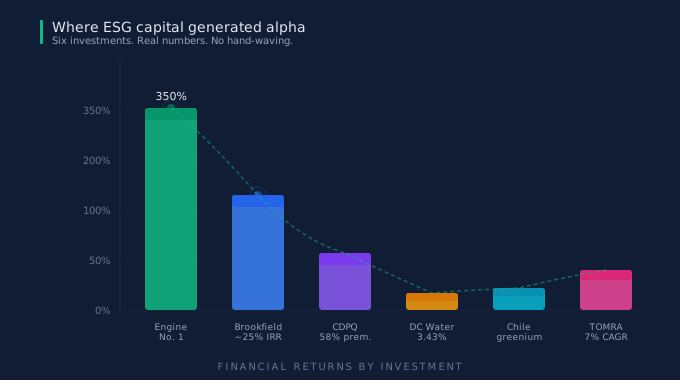
Engine No. 1 and ExxonMobil: $40 Million, 350% Return
In late 2020 and early 2021, Engine No. 1, a start-up activist fund, accumulated roughly $40 million in ExxonMobil stock, representing a 0.02% stake. The firm mounted a proxy campaign arguing that Exxon's strategy was destroying long-term shareholder value through capital indiscipline and failure to position for the energy transition. In May 2021, Engine No. 1 won three of four contested board seats, with decisive support from large index fund holders including BlackRock and Vanguard.
The board refresh brought directors with energy transition experience and, according to Engine No. 1, drove increased capital discipline and accountability from management. In 2024, Engine No. 1 sold its ExxonMobil position, reporting a 350% return on its initial investment. Since the campaign launched, Exxon outperformed its oil and gas peers by approximately 2.5 times.
The environmental story is more contested. Exxon has not pivoted to renewables. Critics, including a University of Chicago Business Law Review analysis, have called Engine No. 1's climate impact "an illusion." That critique deserves acknowledgment. But the financial thesis, that governance failures were dragging on value, proved correct. The investment worked because the engagement targeted operational underperformance, not ideology.
Brookfield Renewable: Infrastructure-Scale Returns from Clean Energy
Brookfield Renewable Partners operates one of the world's largest portfolios of renewable power assets, spanning hydroelectric, wind, solar, and storage across multiple continents.
In 2024, Brookfield reported record results. Across its platform (including institutional co-investors), it deployed $12.5 billion in capital ($1.8 billion net to Brookfield Renewable) and completed asset sales generating approximately $2.8 billion in proceeds (over $1 billion net to Brookfield Renewable) at an average internal rate of return of roughly 25%, nearly double its stated target range of 12% to 15%. Since 2020, Brookfield has generated nearly $6 billion in total asset sale proceeds ($2.3 billion net) at an average IRR of approximately 22% and a 2.1 times multiple on invested capital. These are private equity-grade returns from infrastructure assets.
Brookfield's development pipeline stands at approximately 200,000 megawatts, and the company is commissioning new renewable capacity at a pace tracking toward 10,000 megawatts per year. In 2024 alone, it issued approximately $6.5 billion in green financings, bringing aggregate green issuances to $21.5 billion.
Brookfield Renewable's asset recycling programme has delivered a 22% average IRR since 2020 on clean energy assets, complicating the claim that ESG-aligned infrastructure investments require investors to accept concessionary returns. The evidence from the largest pure-play renewable operator in public markets suggests the opposite: disciplined acquisition, operational improvement, and well-timed monetisation of contracted clean energy assets have consistently exceeded conventional infrastructure return benchmarks.
The structural reason this works: Brookfield acquires at infrastructure-risk pricing, improves assets operationally, and sells derisked, contracted cash flows to lower-cost-of-capital buyers at premium valuations. Long-dated power purchase agreements, increasingly driven by corporate demand from technology companies for data centre power, create the contracted revenue streams that support this playbook.
CDPQ and Innergex: A Pension Fund's C$10 Billion Clean Energy Bet
In February 2025, CDPQ, the C$473 billion Quebec pension manager, announced a definitive agreement to acquire Innergex Renewable Energy for C$13.75 per share in cash. The deal, completed in July 2025, represented a total enterprise value of C$10 billion and a 58% premium over Innergex's closing price, or 80% above its 30-day volume-weighted average. The offer was backed by Hydro-Québec, Innergex's largest shareholder at 19.9%, and supported by C$1.2 billion in new senior bank financing.
What CDPQ acquired is a portfolio of 91 operating renewable energy facilities across Canada, the United States, France, and Chile, with a net installed capacity of 3,737 megawatts: 42 hydroelectric facilities, 36 wind farms, 10 solar farms, and 3 battery storage facilities. Innergex also holds 16 projects under development with an additional 915 megawatts of net capacity.
The deal matters for two reasons. First, CDPQ has held positions in Innergex since 1995, meaning this is a 30-year relationship culminating in full ownership. The pension fund is not speculating on renewables; it is converting a long-held conviction into a controlling stake at a moment when it believes public market pricing undervalues contracted clean energy cash flows. Second, the take-private structure removes Innergex from the short-term pressures of public equity markets, allowing CDPQ to pursue longer development timelines on projects that may take years to generate returns but offer decades of contracted revenue.
Whether the 58% premium proves to be well-timed or expensive will only become clear over the next decade. But the signal is worth reading: one of the world's most sophisticated institutional investors has decided that direct ownership of renewable infrastructure is worth a significant premium over public market pricing.
DC Water's Environmental Impact Bond: Pricing Climate Risk, Getting Paid
In 2016, Washington DC's water utility issued the nation's first Environmental Impact Bond: a $25 million, tax-exempt private placement sold to Goldman Sachs Urban Investment Group and Calvert Impact Capital. The bond paid a 3.43% coupon and financed the installation of 25 acres of green infrastructure to reduce combined sewer overflows into Rock Creek.
What made the EIB structurally novel was its outcome-linked payment mechanism. If green infrastructure reduced stormwater runoff by more than 41.3%, DC Water would pay investors a $3.3 million outcome bonus. If runoff reduction fell below 18.6%, investors would return $3.3 million to DC Water. If performance fell in between, no contingent payment was due.
In spring 2021, DC Water completed the mandatory tender and fully repaid the bond. Post-construction monitoring confirmed that the green infrastructure reduced stormwater runoff by nearly 20%, meeting performance targets. Investors received their 3.43% coupon without contingent payment in either direction.
The financial return was modest. The impact return was significant: reduced sewage overflow into a major urban waterway, new green spaces, a local green jobs programme, and proof of concept that attracted follow-on environmental impact bonds in Atlanta, Buffalo ($54 million), and Hampton, Virginia. This investment worked because it solved a genuine pricing problem. DC Water needed to spend on infrastructure but faced uncertainty about green versus grey alternatives. The EIB was a $25 million experiment that de-risked a $2.7 billion programme.
Chile's Sovereign Green Bonds: Lower Borrowing Costs for a Nation
In 2019, Chile became the first sovereign issuer of green bonds in the Americas, launching a programme that has since grown to make Chile the largest emerging market sovereign issuer of labelled sustainable bonds, with cumulative issuances reaching $55 billion across green, social, sustainability, and sustainability-linked instruments.
The financial case is unusually clear. Chile's green bonds were issued at yields with negative issue premiums, meaning they priced below secondary market levels for conventional sovereign debt. Investors with ESG mandates showed greater willingness to pay, resulting in lower borrowing costs. By the end of 2022, roughly 31% of Chile's government debt was in ESG instruments, up from zero before 2019. Proceeds funded renewable energy installations, photovoltaic systems on public buildings, and water resource management infrastructure.
In 2022, Chile went further, issuing the world's first sovereign sustainability-linked bond: a $2 billion, 20-year instrument that was more than four times oversubscribed. This instrument ties the sovereign's borrowing cost to specific climate targets, creating a direct financial incentive for policy delivery.
What made Chile's programme work was sequencing and credibility. The country built a verified framework, established a track record with conventional green bonds, then graduated to sustainability-linked instruments with genuine financial consequences. For emerging market sovereigns watching, the lesson is that green bond issuance is not a cost; it is a debt management strategy that can expand the investor base and improve pricing.
TOMRA Systems: A Circular Economy Business That Compounds
TOMRA is a Norwegian technology company that makes money from the circular economy: reverse vending machines for beverage container recovery, sensor-based sorting systems for recycling, and grading technology for food processing.
Over the past 20 years, TOMRA has more than quadrupled the size of its business, growing revenue at roughly 7% annually while paying dividends consistently above 40% of earnings per share. In 2024, the company reported total revenues of €1.348 billion, with fourth-quarter revenue of €398 million (up 12% year on year), and adjusted EBITA of €78 million in Q4 (up 46%). Cash flow from operations reached €235 million for the full year, up from €137 million in 2023. Its roughly 113,700 installations across more than 100 markets achieve over 90% container return rates in mature markets like Norway and Germany.
The stock has not been a straight line. TOMRA traded at stretched valuations during the 2021 ESG exuberance period and corrected significantly. Its food processing division underperformed in 2023 and 2024, requiring a restructuring that closed 11 sites and cut 279 jobs. That correction is part of the story, and honest ESG analysis should not ignore it. But the underlying business model remains structurally sound, and the EU's Packaging and Packaging Waste Regulation, which mandates deposit return systems across all member states, represents a regulatory tailwind that will take years to fully materialise.
TOMRA works as an ESG investment because the company's environmental contribution is not a side project. It is the revenue model.
What the Winners Have in Common
Six investments, different sectors, different structures, different geographies. But the pattern is consistent.
Every successful case here shares one characteristic: the ESG dimension was not bolted on to the investment thesis. It was the investment thesis. Engine No. 1 bet on governance failure. Brookfield buys and improves contracted clean energy assets the same way any infrastructure operator would. CDPQ is taking Innergex private because it believes public markets are underpricing long-duration renewable cash flows. DC Water used outcome-linked financing to manage genuine technology risk. Chile used green labelling to improve sovereign debt management. TOMRA sells equipment that makes recycling profitable.
The cases that delivered did not rely on ESG premiums or goodwill pricing. They relied on structural economics: contracted cash flows, regulatory tailwinds, cost advantages, or governance improvements that would have been good investments without the ESG label.
Where ESG-aligned investments have underperformed, the pattern tends to be the inverse: the ESG rationale substituted for rather than reinforced the financial thesis. The 2024 NCREIF Farmland Index posted its first negative annual return in history. Plenty of clean energy SPACs destroyed capital. ESG is not a guarantee of returns. But when the economics are right and the impact is embedded in the business model rather than appended to it, the track record is worth studying closely.
Sources: Engine No. 1 investor update (Jan 2025); Harvard Business School Case No. 61337; UChicago Business Law Review; Brookfield Renewable Partners Q3/Q4 2024 Letters to Unitholders and 2024 Annual Report; CDPQ/Innergex definitive agreement press release (Feb 2025); Innergex Q1 2025 results; Lexpert deal confirmation (Jul 2025); Pensions & Investments; DC Water EIB Fact Sheet and press release (May 2021); Quantified Ventures; Green Finance Institute; Georgetown Journal of International Affairs (Oct 2023); Chile Ministry of Finance SLB Framework; World Bank Labeled Sustainable Bonds Market Update Q2 2025; TOMRA Q4 2024 Results Announcement (Feb 2025) and Annual Report 2024; NCREIF Farmland Index via AgIS Capital State of the Market Report 2025.
Subscribe to our newsletter for more insights, case studies, and ESG intelligence.
Keep abreast of the top ESG Events on OneStop ESG Events.
OneStop ESG Educate: Your go-to source for top ESG courses and training programs tailored to your needs.
Stay informed with the latest insights on OneStop ESG News.
Discover meaningful career opportunities on OneStop ESG Jobs.
.png%3Falt%3Dmedia%26token%3D27b9243a-80d8-466f-bd57-976c84d175e4&w=1920&q=75)
.png%3Falt%3Dmedia%26token%3Dafe68b95-76d6-4eae-a16e-efba394690ca&w=1920&q=75)


%252010th%2520Edition.png%3Falt%3Dmedia%26token%3D28295a93-506a-42b8-aef2-79cd319b0edc&w=3840&q=75)
Comments
Have a thought on this? Share it with other readers.