
Patagonia’s 2025 findings and the real challenges behind reducing emissions, changing materials, and fixing supply-chain impacts.
The global apparel industry remains one of the world’s most resource-intensive systems. More than 100 billion garments are produced every year, yet less than one percent are recycled into new textiles. Supply chains stretch across dozens of countries, supported by fossil-intensive grids and chemical processes engineered for colour, durability and cost rather than environmental limits. Brands release sustainability statements every year, but the sector’s environmental footprint continues to grow.
In this landscape, companies that choose honesty instead of perfection tend to stand out. Patagonia is one of them. Its 2025 Work in Progress environmental findings are not written as an achievement report. They read more like a field note on the difficulty of reducing emissions in a global supply chain and the friction that accompanies every meaningful environmental shift.
Founder Yvon Chouinard: “We do not have all the answers, but the fear of getting things wrong in the process cannot stop us from trying to get things right in the end.”
Patagonia’s approach is shaped by this mindset. Sustainability is not presented as a completed strategy. It is described as a long and technical journey that becomes more complex the deeper you go.
A Company Restructured for the Planet
In 2022, Patagonia made a decision that reshaped its business model. The Patagonia Purpose Trust now holds all voting control to protect the company’s mission. The Holdfast Collective, a nonprofit, receives all profits that are not reinvested into the business. Under this structure, the company treats the planet as its primary shareholder.
More than 180 million dollars has already been distributed to conservation and environmental groups. These funds have supported river protection, forest restoration, biodiversity conservation and climate advocacy. This level of giving would have been difficult under a traditional ownership structure that must balance shareholder returns with environmental commitments.
The governance shift did not eliminate Patagonia’s central contradiction. The company is still an apparel brand that sells products, even though its founder believes the world needs to consume far less. This tension shapes Patagonia’s environmental work every year. Growth can support environmental philanthropy through the Holdfast Collective, yet growth also increases the company’s emissions. Patagonia does not hide this contradiction. It treats it as part of the work.
Where Emissions Really Come From
The apparel industry often focuses on energy use in stores or recycled packaging, but these are marginal details compared to the scale of the upstream footprint. Patagonia has consistently explained that most of its climate impact is locked into the material and manufacturing stages that occur long before a product reaches a shelf.
Fibre production, dyeing, finishing and fabric conversion account for an estimated 92 to 97 percent of Patagonia’s carbon footprint. These processes often take place in countries where coal remains a primary source of industrial energy. Patagonia owns none of the mills that carry out this work. It is usually a modest-sized customer within facilities serving dozens of global brands.
In FY25, Patagonia’s emissions increased by 2 percent. The rise came mainly from higher material intensity in packs and duffels. The company reports this plainly. There is no reframing. No celebratory offset purchase. Just an acknowledgment of what the numbers show and why they moved.
💡 Patagonia’s own facilities operate on 98 percent renewable electricity, yet they represent only a tiny fraction of total emissions. The climate challenge lies almost entirely in independent mills and factories powered by fossil fuels.
This clarity is important because it undercuts the idea that sustainability can be solved through recycling bins or in-store initiatives. Decarbonising apparel is not a branding exercise. It is a structural challenge shaped by energy systems, material science and global manufacturing economics.
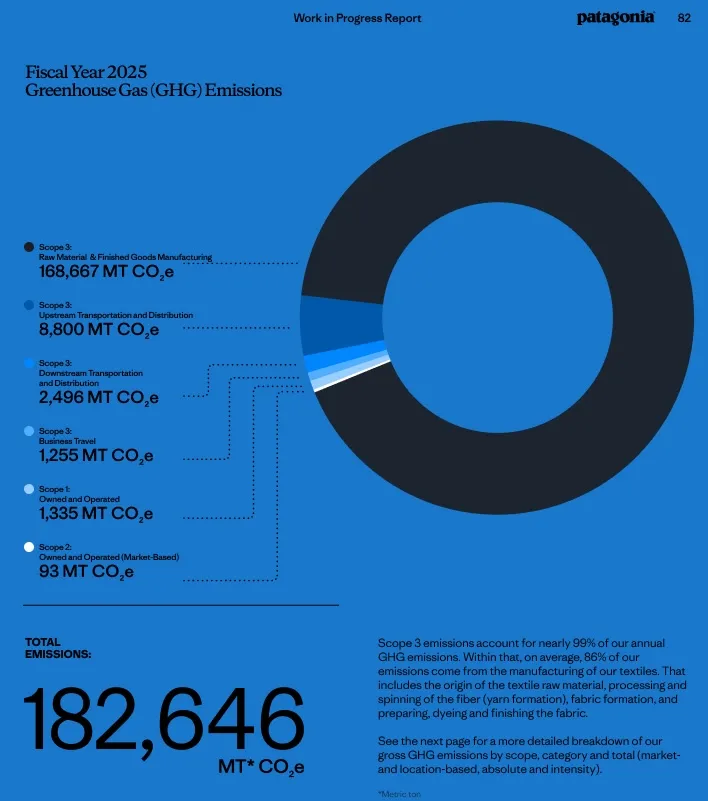
A breakdown of Patagonia’s emissions footprint by source. Source: Patagonia
Net Zero by 2040
A few years ago, Patagonia had a high-profile target of reaching carbon neutrality by 2025. The company abandoned the goal after concluding that it would require heavy reliance on offsets rather than real reductions. Instead of claiming symbolic progress, Patagonia reset its timeline and committed to reaching net zero by 2040.
To meet this target, Patagonia needs to reduce emissions by roughly ten percent each year for fifteen consecutive years. Very few consumer companies have attempted cuts of this scale without depending extensively on purchased carbon credits.
CEO Ryan Gellert explains the challenge: “You cannot solve the climate crisis through your own operations alone. The real work is in the supply chain.”
This supply chain spans farms, chemical manufacturers, dyehouses and factories across dozens of countries. It is here that Patagonia focuses most of its decarbonisation work.
Carbon Insetting: Changing the Incentive Structure
One of Patagonia’s most significant experiments is the shift from carbon offsets to carbon insetting. Instead of purchasing credits from unrelated projects, Patagonia invests directly in emissions reductions within its own supply chain.
Through its Verified Carbon Intervention Unit, Patagonia allocated 37.3 million dollars in FY25 to support interventions at supplier facilities. The fee structure calculates the cost of specific improvements, such as replacing coal-fired boilers with electric heat sources, installing rooftop solar or upgrading to more efficient machinery. Patagonia then incorporates these costs into supplier contracts.
When suppliers reduce emissions, Patagonia receives environmental attribute certificates that reflect real reductions within its value chain. These can be applied to its Scope 3 inventory. The key difference is location. The reduction happens inside the supply chain rather than in a forest or a project far from the company’s operations.
This approach is still uncommon in the apparel industry, but it has the potential to reshape incentives. If more companies adopt similar models, mills that currently lack access to capital for decarbonisation could receive long-term investment tied directly to brand partnerships.
Materials
Materials represent the most significant source of Patagonia’s emissions. FY25 marked progress in several areas:
- 84 percent of fabrics and trims now meet preferred material criteria
- 93 percent of polyester and 89 percent of nylon come from recycled sources
- More than 2,000 metric tons of discarded fishing nets have been converted into NetPlus components
- All new products contain no intentionally added PFAS
These shifts reduce dependence on virgin petroleum and improve chemical safety, but large gaps remain. Patagonia’s goal of sourcing half of all synthetic fibres from secondary waste streams stands at only six percent. Recycling infrastructure, material supply and technical performance limitations remain major barriers.
Jenna Johnson, Head of Patagonia, : “We have to redesign the entire system, not just the product.”
Chemistry
Chemistry often operates in the background of sustainability conversations, yet it has significant climate implications. Dye systems and finishing processes require high temperatures and large amounts of water and energy.
Patagonia has invested in mapping chemical risks, eliminating substances of concern and promoting lower-impact alternatives. The most visible achievement is the complete removal of intentionally added PFAS from all new products, a transition that took nearly twenty years of formulation work.
The company continues to explore lower-temperature dyes, safer elastane sources and improved chemical traceability. These changes are technical and gradual, but they matter because they shift the entire system toward safer and lower-carbon processes.
Manufacturing Energy
Patagonia’s largest emissions source remains manufacturing energy in facilities outside its ownership. The company can influence but not directly control energy decisions at these mills. Grids remain coal-heavy in several key sourcing regions, and the economics of transitioning to renewables vary widely.
Patagonia’s strategy includes screening new suppliers for environmental performance, supporting efficiency projects, co-investing in renewable energy where feasible and encouraging suppliers to develop long-term decarbonisation plans.
This work progresses slowly because the barriers are structural. Fossil fuel dominance, inconsistent incentives and capital constraints shape factory decisions. Patagonia avoids promising rapid change. Instead, it focuses on building the relationships needed to support a transition that may unfold over decades.
Nature and Biodiversity: Repairing What Apparel Has Historically Damaged
Apparel supply chains depend on ecosystems that have often been degraded through conventional agricultural practices. Patagonia continues to expand its work on regenerative agriculture, traceable natural materials and responsible land use.
Key initiatives include:
- Scaling Regenerative Organic Certified cotton to restore soil health
- Strengthening wool and natural rubber traceability
- Supporting farmers in India, Pakistan and Uganda who are transitioning to biodiversity-positive practices
- Working with NGOs on grassland and soil restoration
This work aligns with broader frameworks such as the Taskforce on Nature-related Financial Disclosures, which emphasise how dependent supply chains are on ecosystem stability.
Circularity
Circularity is often presented as a solution to fashion’s waste problem, but current recycling technologies cannot process most multi-layered garments. Patagonia avoids overstating what is possible today. It focuses instead on practical approaches:
- A large-scale repair program
- A resale platform that keeps products in circulation
- Designing garments for longer life and simpler repair
- Investing in recycling technologies while acknowledging their limitations
Durability remains the most reliable tool for reducing lifecycle impact.
💡 Patagonia operates the largest apparel repair program in the United States outside military systems and has completed more than one million repairs. The program shows that repair can be scaled economically, not just symbolically.
Durability and Design
Patagonia uses its Ironclad Quality Index to evaluate construction techniques, material resilience and long-term wear. The Black Hole series is a strong example. When recycled materials were introduced, the glossy finish became matte, but durability improved significantly. Patagonia prioritised performance over aesthetics because a longer-lasting product has a lower environmental footprint.
Designing for longevity may be Patagonia’s most effective immediate climate strategy.
Governance and Transparency
Patagonia’s ownership model allows the company to make decisions that may not maximise short-term profitability, but strengthen long-term environmental responsibility. Every dollar of distributed profit flows to the Holdfast Collective, which directs funding toward environmental protection.
The company treats transparency as a management tool. It publishes rising emissions, missed targets and unresolved challenges without editing the story for optics. This openness is unusual in a sector still accustomed to selective reporting.
Where Things Stand Today
Patagonia’s 2025 environmental picture is not a story of completion. Some numbers moved in the wrong direction, and several targets that once seemed achievable now require more time or entirely new technical pathways. Many of the solutions the sector depends on, including large-scale textile recycling and low-carbon grids in sourcing regions, remain limited by infrastructure and cost. Large parts of the supply chain still rely on fossil energy. Patagonia reports these realities openly, without altering the message to make it more polished.
This honesty offers a clearer view of what environmental responsibility looks like inside a global supply chain. Patagonia continues experimenting with new materials, rethinking chemistry, supporting factories and designing products that last longer. The work is slow, technical and often frustrating. It shows how difficult it is to decarbonise a system that was never built with climate or nature in mind.
Patagonia does not claim to have solved these problems, and it does not suggest that its model can be copied directly by other companies. What stands out instead is the consistency with which the company stays committed to the work, even when progress is uneven and the path forward is uncertain. It accepts that sustainability will involve friction, imperfect data and years when results do not match ambitions. It also accepts that genuine progress will not always show up neatly in annual reporting.
Many companies focus on presenting progress neatly, but Patagonia continues to stay with the difficult parts of the work. That choice gives its efforts a different kind of credibility. The company is not chasing perfection. It is choosing to keep going, even when the path is slow or unclear. That steady commitment may be its most meaningful contribution.
Reference: Patagonia 2025 Impact Report
Subscribe to our newsletter for more insights, case studies, and ESG intelligence.
Explore ESG Solutions on our marketplace - OneStop ESG Marketplace.
Keep abreast of the top ESG Events on OneStop ESG Events.
OneStop ESG Educate: Your go-to source for top ESG courses and training programs tailored to your needs.
Stay informed with the latest insights on OneStop ESG News.
.png%3Falt%3Dmedia%26token%3D28344aa1-1858-43c6-8095-4a3ea3068370&w=1920&q=75)

.png%3Falt%3Dmedia%26token%3D2f21bd92-a9f8-4da0-a510-7aaf783856db&w=1920&q=75)


%252010th%2520Edition.png%3Falt%3Dmedia%26token%3D28295a93-506a-42b8-aef2-79cd319b0edc&w=3840&q=75)
Comments
Have a thought on this? Share it with other readers.