Name
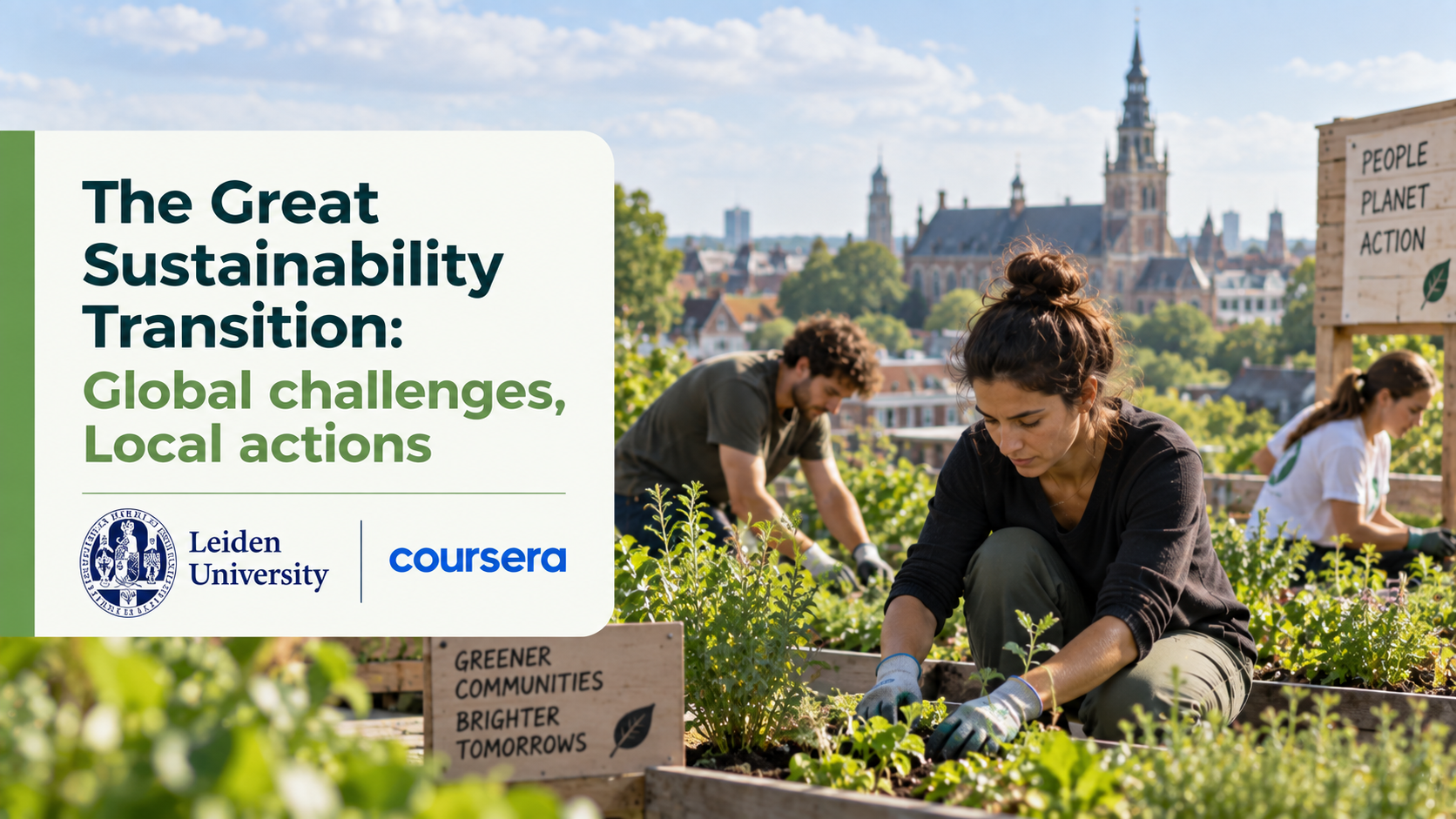
The Great Sustainability Transition: Global Challenges, Local Actions
Difficulty Level
Beginner
Certification
Yes
Ongoing
Offered By
Leiden University
Paid
Course Details
The Great Sustainability Transition: Global Challenges, Local Actions, offered by Leiden University through Coursera, is a beginner-level online course designed to help learners understand major sustainability challenges while connecting global issues with practical action in their own communities. The course introduces planetary boundaries, biodiversity loss, climate change, pollution, and systems transitions, while showing how individual and collective action can contribute to wider environmental change.
Core Content
The course is structured across four modules covering biodiversity, climate breakdown, pollution, and the wider sustainability transition. Learners examine planetary boundaries, land use, biodiversity decline, greenhouse gas emissions, mitigation and adaptation, microplastics, air and water pollution, collective-action problems, food and energy systems, and social tipping points. Each module also includes a local action activity that connects the course material with the learner’s own environment.
Key Skills
Participants will develop the ability to explain major sustainability pressures, assess environmental problems from a systems perspective, and connect global challenges with local responses. Coursera lists skills including sustainable development, natural resource management, climate change mitigation and adaptation, environmental policy, pollution prevention, community development, systems thinking, environmental science, and discussion facilitation.
Target Learners
This course is designed for students, professionals, and general learners who want a practical introduction to sustainability and environmental change. It is particularly relevant for people interested in climate action, biodiversity, environmental policy, community engagement, sustainable development, or resource management. Coursera classifies the course as beginner level, making it suitable for learners without specialist prior knowledge.
Learning Format
Hosted on Coursera, the course is delivered in a flexible online format with four modules and an estimated completion time of three weeks at around ten hours per week. The learning experience includes videos, readings, assignments, discussion prompts, citizen-science activities, and local action exercises such as biodiversity observation, climate conversations, pollution mapping, and analysing the environmental footprint of a meal. Coursera also notes that the course includes eight assignments, offers a shareable certificate, is taught in English with 21 language options available, and allows learners to progress at their own pace.
Additional Benefits
The course offers practical value by requiring learners to apply sustainability concepts directly in their own surroundings rather than treating them only as academic topics. Its combination of biodiversity, climate, pollution, collective action, and local exercises helps participants understand how personal behaviour, community engagement, and systems change interact. The course is taught by Leiden University instructors Paul Behrens and Thijs Bosker.
Browse more ESG courses and certifications to enhance your skills and knowledge.
ESG Educate
Unlocking Opportunities
Dive into the world of ESG Events, where you can discover crucial gatherings that shape the future of sustainability. From insightful conferences to interactive workshops, these events offer invaluable opportunities to stay informed, connect with industry leaders, and drive impactful change. Whether you‘re seeking to enhance your ESG strategy or stay ahead of regulatory trends, participating in these events is essential for staying at the forefront of sustainable practices and innovation. Join us in shaping a more sustainable future through knowledge sharing and collaborative action at ESG Events.