Name
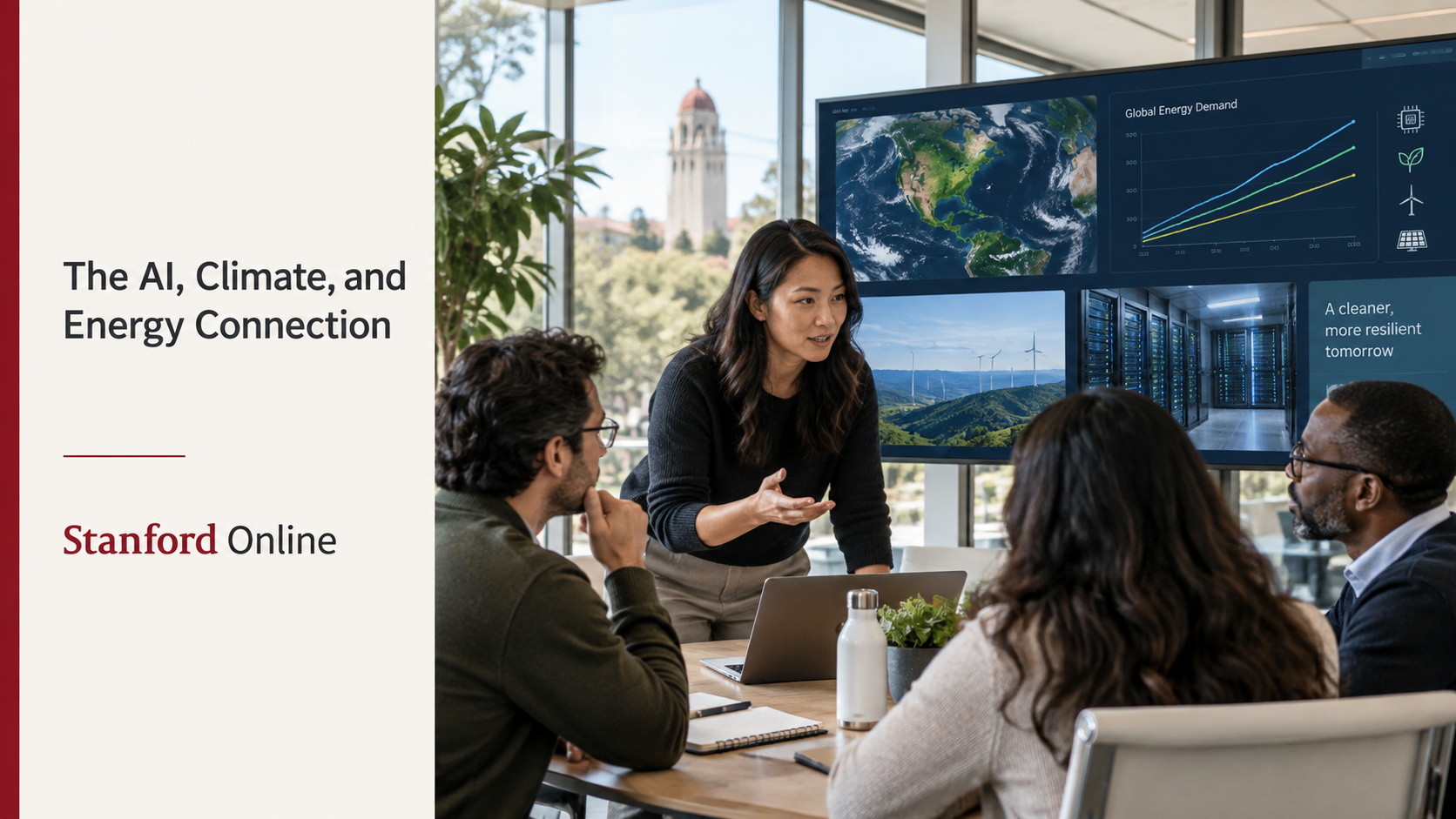
The AI, Climate, and Energy Connection
Difficulty Level
Intermediate
Certification
Yes
Ongoing
Offered By
Stanford Online
Paid
Course Details
The AI, Climate, and Energy Connection, offered by Stanford Online through Coursera, is a beginner-level online course designed to help professionals understand the climate and environmental implications of artificial intelligence and identify practical actions within their organisations. The course examines the links between AI, large language models, data centres, energy demand, and water use, while also exploring how AI can support climate adaptation, the energy transition, and nature conservation.
Core Content
The course is structured across four modules covering the relationship between AI, climate, and energy; approaches to managing AI’s environmental footprint; AI applications that can accelerate climate solutions; and practical next steps for implementation. Learners examine data-centre energy and water impacts, government incentives, community considerations, renewable energy, climate adaptation, biodiversity, and policy. Real-world examples include AI-supported wind forecasting, deforestation monitoring, battery recycling, and sustainable agriculture and infrastructure applications.
Key Skills
Participants will develop the ability to assess the environmental footprint of AI, identify actions that can reduce its energy and water impacts, and evaluate where AI can support climate mitigation and adaptation. The course also builds skills in corporate sustainability, strategic planning, procurement, stakeholder engagement, sustainable technologies, policy development, risk management, data-centre sustainability, and environmental resource management.
Target Learners
This course is designed for professionals and decision-makers who want to understand how AI-related choices affect climate, energy, and sustainability outcomes. It is particularly relevant for people working in procurement, operations, strategy, sustainability, technology, energy, or policy who need to make more informed decisions about AI deployment and infrastructure. Coursera classifies the course as beginner level and states that no prior experience is required.
Learning Format
Hosted on Coursera, the course is delivered in a flexible online format with four modules and an estimated completion time of one week at around ten hours per week. The learning experience includes videos, readings, assignments, case studies, reflection activities, and role-based exercises, allowing learners to apply the material directly to their organisational context. Coursera also notes that the course includes 21 assignments, offers a shareable certificate, was recently updated in April 2026, is taught in English with 30 language options available, and is included with Coursera Plus.
Additional Benefits
A major practical feature of the course is the development of an Impact Plan, which helps learners translate the material into actions relevant to procurement, operations, or strategy. The course combines Stanford faculty research with industry examples and policy context, giving learners a structured way to identify concrete next steps rather than stopping at conceptual understanding. It is taught by Stanford faculty including Ines M. L. Azevedo and William Abraham Tarpeh.
Browse more ESG courses and certifications to enhance your skills and knowledge.
ESG Educate
Unlocking Opportunities
Dive into the world of ESG Events, where you can discover crucial gatherings that shape the future of sustainability. From insightful conferences to interactive workshops, these events offer invaluable opportunities to stay informed, connect with industry leaders, and drive impactful change. Whether you‘re seeking to enhance your ESG strategy or stay ahead of regulatory trends, participating in these events is essential for staying at the forefront of sustainable practices and innovation. Join us in shaping a more sustainable future through knowledge sharing and collaborative action at ESG Events.