Name
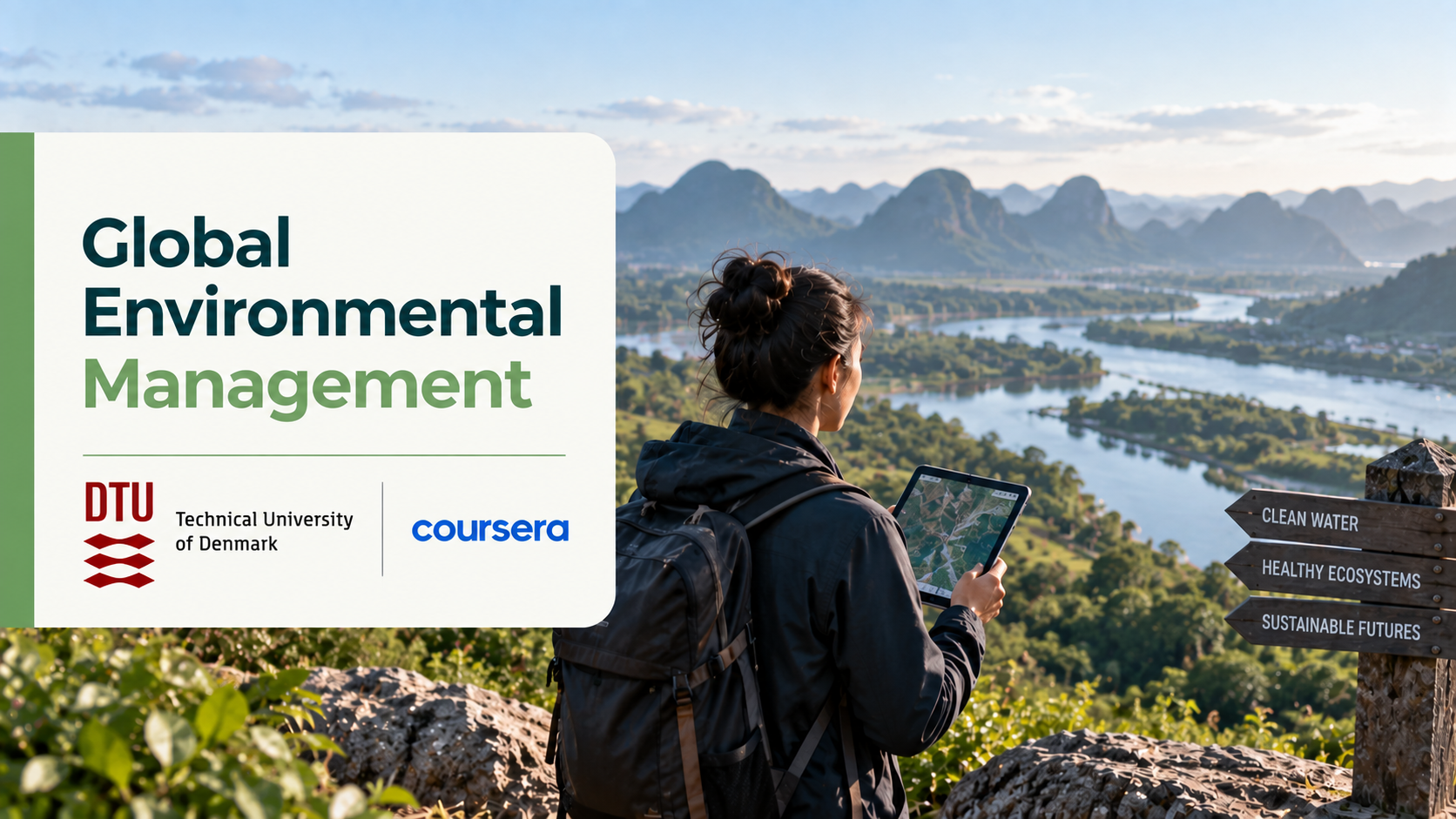
Global Environmental Management
Difficulty Level
Intermediate
Certification
Yes
Ongoing
Offered By
DTU - Technical University of Denmark
Paid
Course Details
Global Environmental Management, offered by the Technical University of Denmark (DTU) through Coursera, is an intermediate-level online course that explores how environmental challenges are managed across different regions and institutional settings. The course combines global environmental trends with practical management approaches and technologies, helping learners understand how environmental systems are shaped by urbanisation, climate change, resource use, infrastructure, and governance.
Core Content
The course is structured across five modules covering global environmental trends, environmental management systems, utility management, technologies for the built environment, and other environmental technologies. Learners examine sustainable development, demography, urbanisation, climate change, circular waste management, water supply, wastewater, stormwater, air pollution, groundwater protection, sustainable soil management, nature-based solutions, and integrated water resource management. Case studies from countries including Denmark, Greenland, China, and Kenya provide international context.
Key Skills
Participants will develop the ability to assess environmental management approaches, compare technologies used across different settings, and understand how environmental decisions are influenced by social, institutional, and physical conditions. The course also builds skills in environmental policy, water resource management, sustainable technologies, hydrology, land management, waste minimisation, environmental engineering, natural resource management, and sustainable development.
Target Learners
This course is designed for students, environmental professionals, engineers, planners, sustainability practitioners, and others interested in how environmental systems are managed around the world. Coursera classifies the course as intermediate level and recommends some related experience, making it particularly suitable for learners who already have a basic grounding in environmental science, engineering, sustainability, or resource management.
Learning Format
Hosted on Coursera, the course is delivered in a flexible online format with five modules and an estimated completion time of one week at around ten hours per week. The learning experience includes videos, quizzes, peer-reviewed assignments, case studies, and applied exercises, allowing learners to progress at their own pace while comparing environmental management approaches across different contexts. Coursera also notes that the course includes five assignments, offers a shareable certificate, is taught in English with 22 language options available, and includes some AI-graded assessments.
Additional Benefits
The course offers practical value for learners who want a broad international perspective on environmental management rather than a single-sector focus. Its combination of policy, infrastructure, water, waste, soil, groundwater, and technology provides a useful foundation for understanding how different environmental systems interact. The international case studies also help learners compare how management approaches vary according to geography, governance, resources, and local priorities.
Browse more ESG courses and certifications to enhance your skills and knowledge.
ESG Educate
Unlocking Opportunities
Dive into the world of ESG Events, where you can discover crucial gatherings that shape the future of sustainability. From insightful conferences to interactive workshops, these events offer invaluable opportunities to stay informed, connect with industry leaders, and drive impactful change. Whether you‘re seeking to enhance your ESG strategy or stay ahead of regulatory trends, participating in these events is essential for staying at the forefront of sustainable practices and innovation. Join us in shaping a more sustainable future through knowledge sharing and collaborative action at ESG Events.